Small tan roaches running when the kitchen light flips on? That’s not a spray problem — it’s a program problem.
German cockroaches (Blattella germanica) are the small, fast, indoor-only roach behind almost every kitchen infestation in Haines City — not the larger palmetto bugs that wander in from outside. A single can of spray rarely ends it, because the population lives inside cabinets and voids where spray never reaches. One call gets you matched with a licensed operator who runs a real program.
Talk to a licensed exterminator now
Call and we’ll connect you with a licensed, local exterminator who covers your address. It takes about two minutes, and a real person answers.
Free to call. Free to get matched. The licensed operator gives the quote.
Before you call: have your address ready, plus what pest you’re seeing and where. Staying on the line about two minutes helps your local operator confirm details and get you scheduled.
A real person answers · Availability of same-day and emergency service depends on the provider.
Why German roaches are different from every other roach in the house
German cockroaches are small — about half an inch — tan to light brown, with two dark parallel stripes running down the length of the pronotum just behind the head. Unlike American cockroaches or palmetto bugs, they don’t fly in from the yard; they live their entire life cycle indoors, in tight, warm, moist harborage close to a food and water source. A kitchen with a working sink and a stove is exactly that environment.
The math is what makes them dangerous to ignore: a single female produces an egg case (ootheca) carrying 30–40 eggs roughly every three to four weeks, and nymphs reach reproductive maturity in about six weeks. A handful of roaches seen out in daylight — which German roaches normally avoid — usually means the hidden population behind the cabinets has already outgrown its harborage.
Why store-shelf sprays make it worse, not better
Contact sprays and total-release foggers kill what they touch, which is rarely more than a small fraction of a German roach population living deep in cabinet voids, behind appliances, and inside wall gaps. Worse, foggers and repellent sprays can scatter a concentrated population into new hiding spots throughout the kitchen and adjoining rooms, turning a one-room problem into a multi-room one.
There’s also a resistance factor specific to German roaches: some populations have developed an aversion to the glucose used to make older bait formulas palatable, which means a bait that worked in a different house — or worked here five years ago — may simply be ignored now. A licensed operator identifies the right bait formulation and placement for the specific population, rather than guessing from a shelf product.
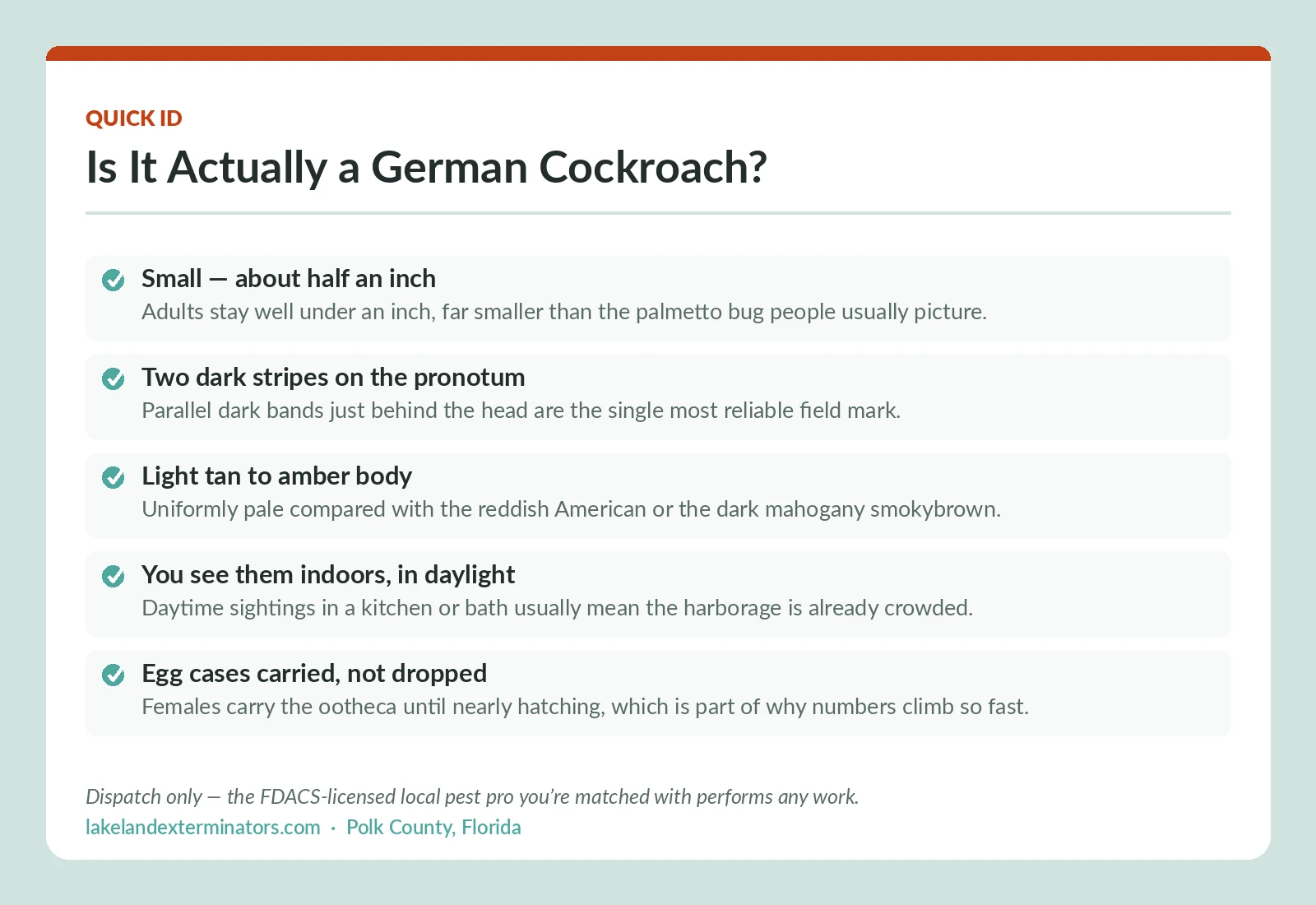
Two dark stripes and small size identify German roaches — the species behind most kitchen infestations.
What a real German roach program looks like
Inspection & harborage mapping
The operator identifies where the population is concentrated — under the sink, behind the refrigerator motor, inside cabinet hinges — before placing anything.
Targeted gel bait placement
Bait goes into cracks and voids near harborage, not out in the open, so roaches carry it back to the colony and it doesn’t contaminate food-prep surfaces.
Growth-regulator follow-through
An insect growth regulator disrupts the reproductive cycle, addressing the eggs already laid, not just the adults currently visible.
Monitoring & follow-up visits
Sticky monitors track population trend over several weeks, confirming the program is working rather than just assuming it.
Why Haines City kitchens are especially exposed
Fast-turnover rentals along the growing US-27 corridor mean a new household’s food habits, storage habits, and sanitation routine start fresh in a kitchen that may carry a legacy population from a previous tenant. Shared-wall apartment and townhome construction also lets a German roach population move between units through plumbing chases and electrical penetrations, which is why a single-unit treatment sometimes needs a building-wide conversation to fully resolve.
Ready when you are.
One call gets you matched with a licensed local operator.
Talk to a licensed exterminator now
Call and we’ll connect you with a licensed, local exterminator who covers your address. It takes about two minutes, and a real person answers.
Free to call. Free to get matched. The licensed operator gives the quote.
Before you call: have your address ready, plus what pest you’re seeing and where. Staying on the line about two minutes helps your local operator confirm details and get you scheduled.
Availability of same-day and emergency service depends on the provider.
Questions, answered straight
How do I know if it’s German roaches and not palmetto bugs?
German roaches are small (about half an inch), tan, with two dark stripes just behind the head, and they stay indoors. Palmetto bugs (American cockroaches) are much larger, reddish-brown, and fly in from outside.
Why do I keep seeing roaches even after I’ve sprayed?
Store-shelf sprays kill contact insects but rarely reach the hidden harborage where most of the population lives, and foggers can scatter roaches into new hiding spots rather than eliminating them.
Is bait guaranteed to work?
Some German roach populations have developed an aversion to glucose in older bait formulas. A licensed operator identifies the right bait type and placement for the specific population rather than guessing.
How long does it take to clear a kitchen infestation?
Most programs take several weeks and multiple visits, since bait and growth regulators work through the population’s reproductive cycle rather than killing everything instantly.
Can roaches spread from a neighboring unit?
Yes, especially in shared-wall apartments and townhomes, where roaches travel through plumbing chases and electrical penetrations between units.
What does it cost to get matched with an operator?
Nothing. Free to call and free to get matched. The licensed operator assesses the kitchen and quotes the job.
One call. A real person. Straight answers.
Get matched with an FDACS-licensed operator who covers your address.
Talk to a licensed exterminator now
Call and we’ll connect you with a licensed, local exterminator who covers your address. It takes about two minutes, and a real person answers.
Free to call. Free to get matched. The licensed operator gives the quote.
Before you call: have your address ready, plus what pest you’re seeing and where. Staying on the line about two minutes helps your local operator confirm details and get you scheduled.
Availability of same-day and emergency service depends on the provider.
Disclosure
Lakeland Exterminators is a dispatch and matching service. We connect Polk County callers with FDACS-licensed pest control operators. We are not a licensed pest control operator. We do not perform treatment, set prices, issue warranties, hold bonds, or carry pest control trade insurance. All pricing, scheduling, treatment plans, warranties and service terms are determined by the FDACS-licensed operator dispatched to your address under Chapter 482, Florida Statutes.
Same-day and 24/7 emergency services are subject to provider participation, location, technician availability, and demand. Availability is not guaranteed and may vary by market and appointment capacity.
License status of any operator you connect with is publicly verifiable at the FDACS license search.