📞 Call (888) 295-0220Open 24/7. Enter your ZIP on the keypad and talk live with a local pest control company that serves your area.
An opossum under your deck, shed, or crawl space in Polk County is usually a short-term tenant, not a long-term problem. Most move on within days once the food source is gone. If one keeps coming back, has young with her, or has gotten into a crawl space or attic, the fix is a one-way exit and then sealing the opening, done in that order so nothing gets trapped inside. Florida law lets property owners deal with nuisance opossums, but it puts tight limits on where a trapped animal can go, which is why most folks end up calling a local pest control company.
Animal in the attic, crawl space or yard in Polk County?
Call, enter your 5-digit ZIP on the keypad, and get connected live with a local pest control company. Free to call, 24/7.
Why you’re seeing opossums now
The Virginia opossum is Florida’s only marsupial, and it’s everywhere in Polk County, from the lakefront neighborhoods around Lake Hollingsworth to the wooded lots in Lakeland Highlands and the grove edges toward Bartow and Mulberry. According to UF/IFAS, most young are born between February and June, but breeding can continue through November. Young ride in the pouch for about 80 days, then ride on mom’s back and are weaned at around 95 to 100 days.
So in October you can run into two different situations. One is a young opossum that recently struck out on its own and is poking around for a place to sleep. The other is a late-season mother who still has young with her. The second one matters a lot, because sealing her out (or in) is how you end up with a much worse smell problem a week later.
Fall also brings food. Fallen citrus and loquats in older Lakeland yards, pet food left on the lanai, open garbage cans, and bird seed under a feeder all pull opossums in. They’re not picky eaters, which is exactly why they’re so common around houses.
How to tell an opossum is the one under there
- Timing. Opossums are nocturnal. You’ll hear shuffling under the deck or floor late at night, not the dawn-and-dusk scampering of squirrels.
- Tracks. Opossum hind feet have a thumb-like toe that points sideways. In sandy Polk County soil near a deck opening, the prints are often easy to spot.
- Mess. They drag in leaves and grass for an untidy nest and leave a musky smell. Trash cans knocked over or pet bowls licked clean overnight are common clues.
- Behavior. If you surprise one, it may hiss, show a mouthful of teeth, or flop over and “play dead.” That’s a stress response. Back away and leave it alone.
Heavy thumping in the attic is more likely a raccoon, and fast scratching after midnight overhead is usually roof rats. The site’s Lakeland wildlife removal guide breaks down how to sort the animal by sound and season.
Opossum under the house that won’t leave?
Call to get connected with a local wildlife pro who covers your Polk County address. It’s free to call. The pro inspects and gives the quote.
Are opossums dangerous?
Mostly no. Opossums are shy and would rather freeze or play dead than fight. Rabies is rare in them. That said, never handle any wild animal, and keep kids and pets away from one that’s cornered. If anyone gets bitten or scratched, wash the wound and call a doctor, and let the Florida Department of Health in Polk County know.
The bigger issues are practical. Opossums can carry fleas and ticks into crawl spaces and under decks, which then end up on your dogs and cats. Their nesting material and droppings under a raised floor add odor and moisture to a space that, in older Lakeland homes, is often already damp. If you’ve noticed a flea problem that won’t quit, an animal denning under the house is worth ruling out. See flea and tick treatment in Lakeland for how pros handle that side of it.
What Florida law allows
Under the Florida Fish and Wildlife Conservation Commission’s nuisance wildlife rule (68A-9.010), a property owner can take a nuisance opossum on their own property, or authorize someone else to do it. The rules that trip people up:
- Live traps have to be checked at least once every 24 hours.
- A captured animal has to be released or humanely euthanized no later than 24 hours after capture.
- You can release it on the same property where it was caught. Moving it off your property is only allowed if the release site is at least 40 contiguous acres, in the same county, and you carry written permission from that landowner.
So “trap it and drive it out to the woods” isn’t legal unless you’ve lined up a 40-acre property in Polk County with the owner’s written OK. That’s a big reason why the standard approach is eviction plus exclusion, not trapping.
How a local pest control company usually handles it
Inspection first
The pro finds where the animal is getting in, checks for young, and looks for other openings. Deck skirting, crawl space vents, gaps under a shed floor, and loose foundation access doors are the usual suspects.
One-way exit
If there are no dependent young, a one-way door goes over the main opening. The opossum leaves at night to feed and can’t get back in. If young are present, the plan changes so the family leaves together.
Sealing the opening
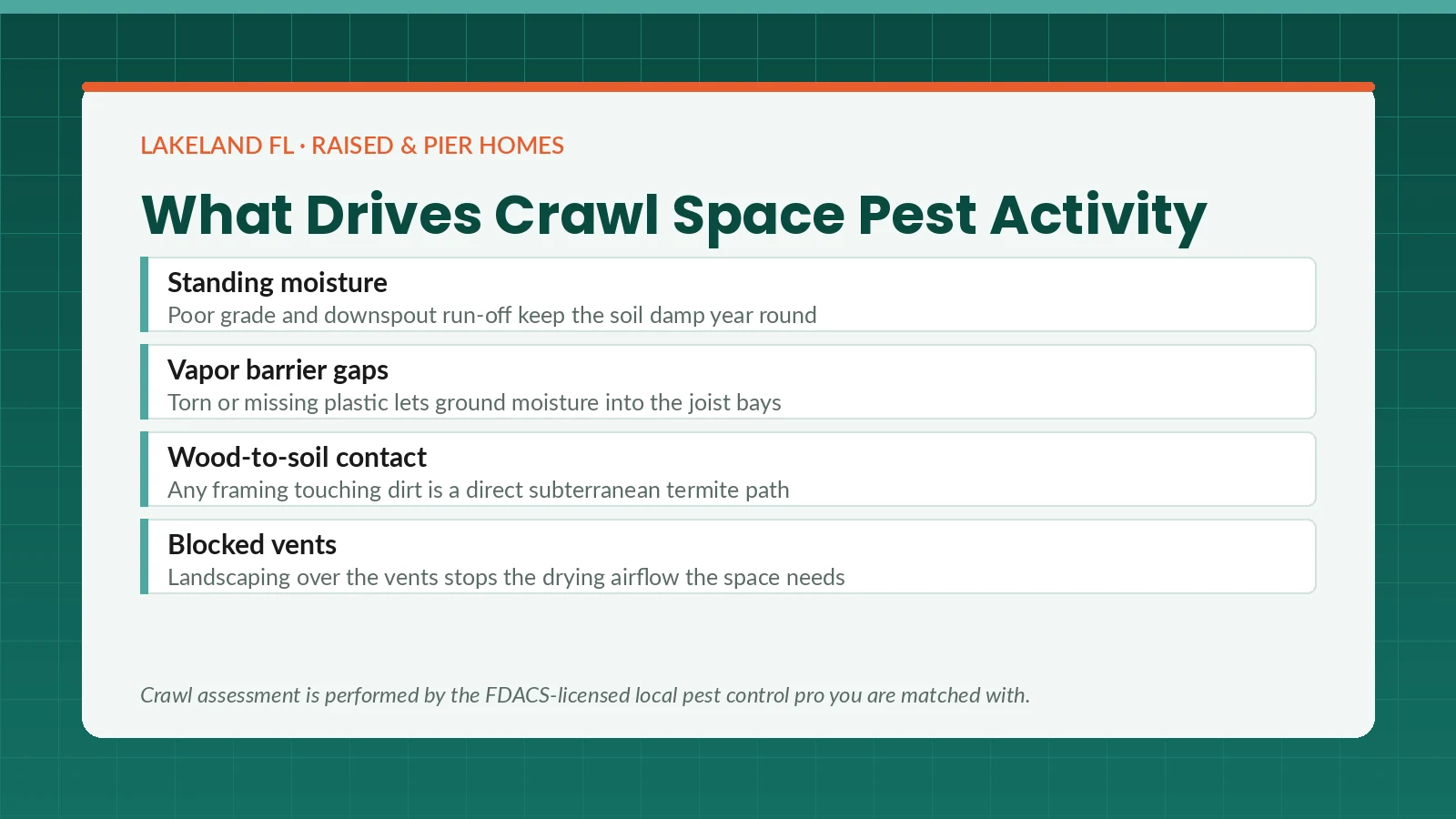
Once the space is confirmed empty, openings get closed with hardware cloth or similar. Under decks and sheds, many pros bend the mesh into an L-shape at the bottom and bury or extend it outward so the animal can’t dig under. On raised homes, that often ties into crawl space work. The site’s guide to crawl space pest control in Lakeland covers the moisture and vent issues that tend to go along with it.
What you can do yourself first
- Bring pet food and water bowls inside after dark.
- Put lids on trash cans, and use a bungee if they’re getting knocked over.
- Pick up fallen fruit under citrus and loquat trees.
- Sprinkle a little flour at the opening in the evening. Tracks going out and none coming back for two or three nights is a good sign the animal has moved on.
- Don’t block the hole until you’re sure nothing is inside.
Want it out and sealed the right way?
One call reaches a local pest control company who serves Lakeland, Winter Haven, Bartow, Auburndale, Mulberry, and the rest of Polk County.
Check the company before treatment starts
In Florida, pest control companies must hold a business license from the Florida Department of Agriculture and Consumer Services (FDACS) under Chapter 482, Florida Statutes. Ask for the company’s license number and look it up on the FDACS license search before work starts.
Get the treatment plan, the products to be used, any follow-up visits and the price in writing. For termite work, ask what the contract or bond covers, whether it’s retreatment only or includes repair of damage, and how long it lasts. Our guide on checking an FDACS pest control license walks through it.
How the call works
- Call (888) 295-0220. Any time, day or night.
- Enter your 5-digit ZIP code on your phone’s keypad when prompted.
- Get connected live with a local pest control company that serves your ZIP. Describe what happened and ask when they can come out and what the job will cost.
FAQ
Will an opossum leave on its own?
Often, yes. Opossums tend to move around and may use a spot under a deck or shed for only a few nights. Removing pet food, garbage, and fallen fruit makes it much more likely they’ll move on without help.
Can I trap an opossum and release it somewhere else in Polk County?
Only under strict conditions. Florida’s nuisance wildlife rule allows release off your property only on land of at least 40 contiguous acres in the same county, with written permission from that landowner. Otherwise the animal must be released on the property where it was caught or humanely euthanized within 24 hours.
Do opossums carry rabies?
Rabies is rare in opossums, but it isn’t impossible, and any wild animal can bite when cornered. Don’t handle one. If a person is bitten or scratched, wash the wound, see a doctor, and contact the Florida Department of Health in Polk County.
How do I know if there are babies under my deck?
You may see young riding on the mother’s back or hear faint squeaking. Breeding can run through November in Florida, so fall litters happen. A local pest control company will check for young before installing a one-way door so nothing gets sealed inside.
What keeps opossums from coming back?
Closing the opening with sturdy hardware cloth after the animal is gone, including an L-shaped footer that extends outward or underground so it can’t dig under, plus removing food sources around the yard.
Before you go
Lakeland Exterminators is a free referral line. We connect Polk County homeowners with local pest control companies. We are not a pest control company and we don’t perform treatments ourselves.
Lakeland Exterminators is a free referral line that connects callers with independent local pest control companies. We don’t perform the work. The company you’re connected with gives the quote, does the work and stands behind it.