Dunedin kept its 1920s bungalows, its gulf breeze and its walkable old town — which means it also kept the drywood termites that came with all three.
Pinellas County’s favorite small town sits squarely in Florida’s coastal drywood belt. The salt-air blocks between the marina and Main Street hold some of the county’s oldest intact wood-frame housing — bungalows and cottages whose heart-pine framing has weathered a century of swarm seasons blowing in off the gulf — and the newer rings around them (1950s-70s ranches inland, townhomes toward Curlew) run the standard barrier-expiry math on the subterranean side. Downtown adds its own economy: one of Florida’s densest little restaurant-and-brewery districts feeds American roach populations in the sanitary laterals under Main and Douglas, and the same walkable blocks give roof rats continuous canopy and fence-line travel. The dispatch line matches Dunedin homes — from a Victoria Avenue bungalow to a golf-course ranch — with FDACS-licensed operators who know which decade of housing they are standing in front of.
Talk to a live dispatch coordinator now
Pellets on a windowsill, big roaches after rain near downtown, scratching over the porch ceiling — describe it and get matched with a licensed operator working Dunedin.
(888) 295-0220Tap to call — 24/7 dispatch
Free to call. Free to get matched. The licensed operator you’re matched with gives the quote.
24/7 line · A real person answers · Availability of same-day and emergency service depends on the provider.
Need pest control in Dunedin, FL? Call (888) 295-0220 and a dispatch coordinator matches you with an FDACS-licensed operator serving 34698 — drywood inspection and treatment on old-town bungalows, subterranean verification on the postwar rings, downtown roach exclusion, and rodent and mosquito work citywide. Lakeland Exterminators is a dispatch service: the licensed local operator inspects, treats and quotes.
Why is old-town Dunedin prime drywood territory?
Three ingredients, all permanent. First, the wood: pre-war bungalows carry seasoned heart pine and cypress in framing, casings, porch ceilings and floors — exactly the dry, untreated timber drywood colonies live in, no soil contact required. Second, the delivery system: drywood swarmers ride warm evening air, and a gulf-front town gets its share every late-spring-through-summer season, each swarm season another round of lottery tickets landing on gable vents and porch rafters. Third, time: a colony stays small and quiet for years, so a 1925 house has had a hundred seasons for multiple small colonies to accumulate in different members — which is exactly what inspectors find in this belt: not one infestation but several minor ones of different ages. The evidence is understated — coarse, sand-like pellets in little cones under invisible kick-out holes, blistered paint on fascia, a hollow tick under a screwdriver handle — and the response is proportionate, not panicked: a licensed WDO inspection maps every active and legacy site, then the plan follows the map. One active colony in a porch rafter is a targeted wood treatment; multiple active sites across the structure is the tenting conversation. Salt-air maintenance is part of the defense too: paint film and screened vents are the bungalow’s armor, and the gulf works on both all year.
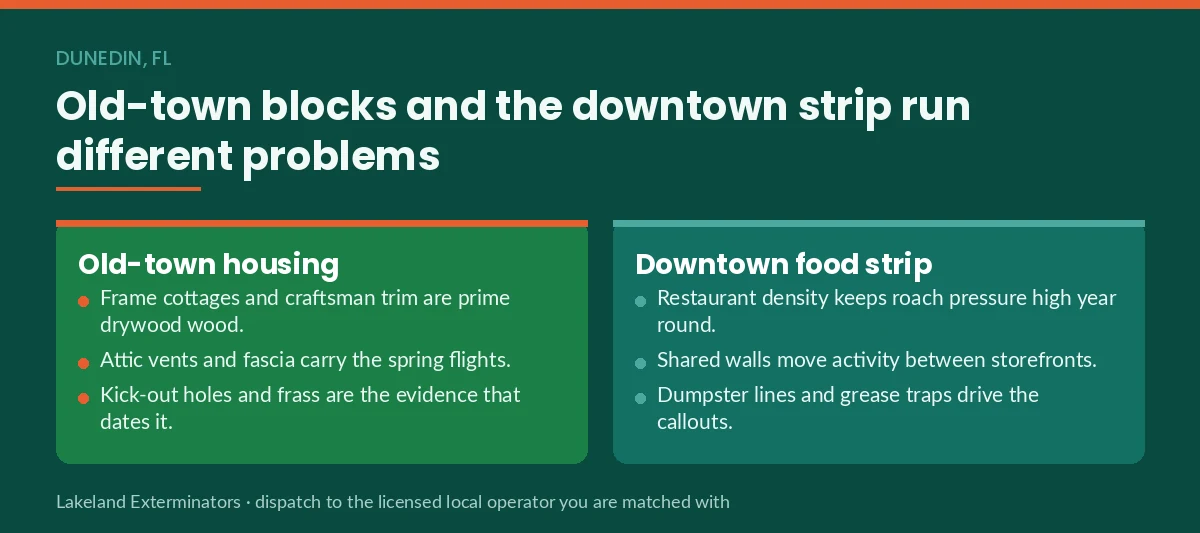
What is each part of Dunedin actually dealing with?
- Old town & the marina blocks (Victoria, Scotland, Louden): layered drywood exposure in original wood; porch ceilings, gable vents and fascia are the checkpoints; paint condition is pest control here.
- Downtown Main & Douglas corridor: restaurant and brewery density loads the sewer laterals with American roaches — adjacent homes see them surface after heavy rain; sealing plumbing penetrations and drain gaps beats reactive spraying.
- The postwar rings (Dunedin Isles to Patricia Ave): 1950s-70s ranches past barrier life — subterranean verification territory, plus original soffits due for rodent-proofing on the same ladder trip.
- Curlew Creek & the flood-prone lows: post-storm displacement pests — roaches and rats relocating uphill after high-water events; a 72-hour post-flood exterior audit catches them at the door.
- Golf-course and greenbelt edges (Dunedin GC, Hammock Park): irrigation moisture plus canopy contact — steady termite comfort below and rat commuting above; trim gaps and eave sealing are the levers.
Does the downtown food scene really change the roach picture?
Measurably. Every restaurant row in Florida runs the same underground economy: grease interceptors, floor drains and century-old sanitary laterals form a warm, wet, fed habitat for American cockroaches — palmetto bugs, locally — and the population scales with the number of kitchens feeding it. Dunedin’s compact downtown packs an unusual kitchen density into a few walkable blocks, and the residential streets that make the town charming start one lot behind them. The practical effect: homes near the district see palmetto surges after heavy rain (when laterals flood and roaches climb) out of proportion to anything the home itself is doing wrong. The fix is defensive architecture, not blame: brass or stainless mesh in floor-drain baskets, sealed gaps where plumbing penetrates walls and slab, weatherstripped doors and screened vents, and a perimeter treatment focused on the sewer-line side of the house. For the businesses themselves, licensed commercial routing with documented monitoring is both the fix and the health-inspection paper trail. Either way, this is exclusion work first — the population lives in infrastructure no fogger will ever visit.
Call the line
Tap (888) 295-0220 any hour. Describe the house and the block — a 1925 bungalow and a 1968 ranch get different first questions.
Get matched to the problem
Drywood mapping, subterranean verification, downtown roach exclusion and rodent work route to different specialists — the coordinator matches the right one.
A licensed operator takes over
An independent, FDACS-licensed and insured operator working Dunedin inspects, quotes and treats. No obligation — the dispatch call costs nothing.
Little cone of what looks like coarse sand under the porch rafter?
The line answers 24/7 and matches you with a licensed operator who can tell pellets from sawdust — and one colony from five.
One tap. One call. Matched.
(888) 295-0220Tap to call — 24/7 dispatch
Free to call. The licensed operator gives the quote.
Dunedin pest questions, answered straight
Do we have to tent the bungalow, or are there gentler options?
Why do the giant roaches show up in our shower after big storms?
Does salt air actually matter for pests, or is that a coastal myth?
What does pest control cost in Dunedin?
Disclosure
Lakeland Exterminators is a pest control dispatch and referral service, not a licensed pest control operator. All pest inspections, treatments and quotes in Dunedin are performed by independent pest control operators licensed by the Florida Department of Agriculture and Consumer Services (FDACS) and insured in their own name. Calling the dispatch line is free and creates no obligation; the licensed local operator you’re matched with sets their own pricing and terms.
More Pinellas help: Pest control in Clearwater, Clearwater termite treatment, Pest control in Palm Harbor · Drywood tenting guide · All pest control services