Half of Naples is empty when the drywood swarms fly. The colonies get the house to themselves until Thanksgiving — and the evidence waits politely on the sills.
Naples sits deep in Southwest Florida’s drywood belt, and its defining termite variable is the occupancy calendar. Drywood swarm season peaks April through July — precisely when a huge share of Port Royal, Pelican Bay and the beachfront condo stock stands closed for the summer. Mated pairs enter at rafter tails and casings of empty homes, colonies establish undisturbed, and returning owners find the pellet piles in November, months into the colony’s head start. Around that seasonal core: estate properties whose guest houses, cabanas and boat docks multiply the wood inventory; condo towers where a tent is an association decision with reserve-fund implications; and inland growth corridors — Golden Gate, North Naples — running the standard subterranean script of expired builder pretreats. The dispatch line matches all of it with FDACS-licensed operators fluent in seasonal logistics.
Talk to a live dispatch coordinator now
Pellets found at reopening, a swarm reported by the house watch, an association debating a tent — describe it and get matched with a licensed Naples termite operator.
(904) 943-3349Tap to call — 24/7 dispatch
Free to call. Free to get matched. The licensed operator you’re matched with gives the quote.
24/7 line · A real person answers · Availability of same-day and emergency service depends on the provider.
Need termite treatment in Naples, FL? Call (904) 943-3349 and a dispatch coordinator matches you with an FDACS-licensed operator serving your Collier ZIP — whole-structure fumigation scheduled around the season, no-tent options where they honestly fit, subterranean barriers and bait systems inland, and remote coordination with house watches and managers. Lakeland Exterminators is a dispatch service: the licensed operator inspects, prescribes and quotes.
How does seasonal vacancy change the treatment calculus?
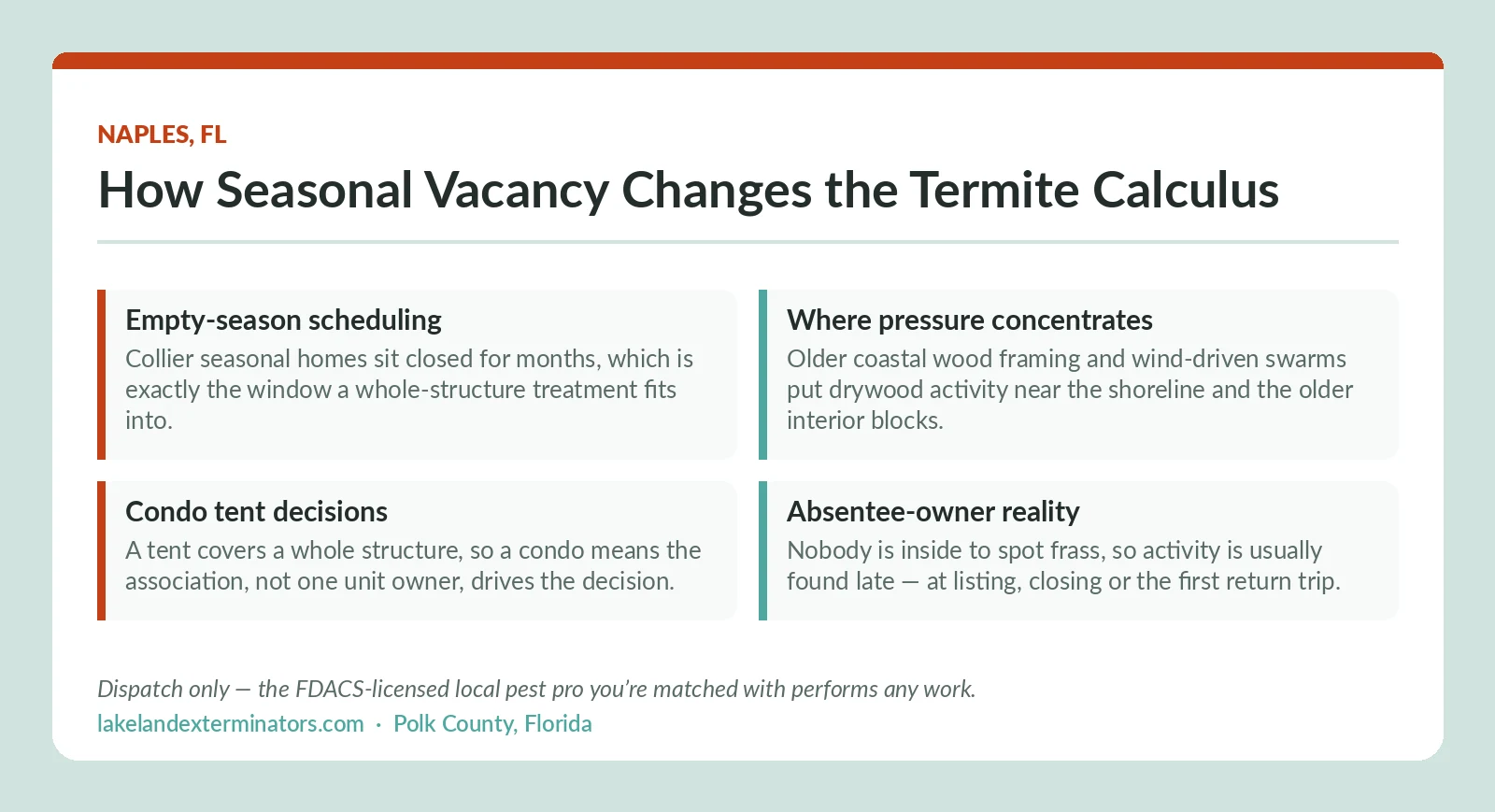
It hands owners a scheduling gift wrapped in a detection problem. The detection problem: nobody is home to notice the June swarm or the first pellets, so Naples colonies are routinely discovered later in their arc than occupied-market colonies — which is why the reopening inspection belongs on every November checklist, and why house-watch services should be briefed to photograph wings and granule piles rather than vacuum them. The scheduling gift: an empty August house is the perfect fumigation candidate. No occupants to relocate, no meals to bag on short notice, no vacation to interrupt — a tent runs its three days in a season when the owner was never coming anyway. Owners who confirm evidence in spring and book summer tents convert the region’s biggest vulnerability into its cleanest treatment window; owners who defer until the season starts pay in disruption what they saved in attention.
The inspection-first rule matters doubly here because pellets persist: granules found at reopening may record a colony tented out years ago or one chewing overhead now. Fresh accumulation after cleanup — checked on a return visit or by the house watch — and an operator’s probe of the framing separate history from activity before anyone schedules anything.
Where does termite treatment pressure concentrate around Naples?
- Port Royal & Aqualane Shores (34102): estate wood inventories — main house, guest house, cabana, dock — treated as portfolios; conservator-grade care and discretion expectations.
- Old Naples (34102): the oldest cottages and their casings — deepest drywood layering and prior-tent history to read before quoting.
- Beachfront condo corridor & Pelican Bay (34103, 34108): shared-envelope colonies, association governance and reserve planning — unit evidence is a board agenda item.
- Park Shore & Moorings (34103): 1960s–80s stock at maximum drywood exposure age with expired subterranean barriers underneath — both-species reads.
- North Naples & Vanderbilt (34108, 34109, 34110): 1990s–2000s builds past pretreat lifespan — bait systems favored where hardscape and HOA aesthetics rule.
- Golden Gate & the inland corridor (34116, 34120): the subterranean workhorse belt — wave-built slabs, irrigation against stem walls, renewal decisions overdue by the calendar.
What does a condo tent decision actually involve?
Three layers the unit owner does not control alone. Evidence: drywood colonies live in the building envelope — roof framing, shared walls, balcony headers — so pellets in one unit are building information; the operator’s written findings, ideally with an envelope survey, tell the board whether it faces a unit problem or a structure problem. Governance: fumigating a tower means declaration-level questions — who pays, how reserves apply, how relocation is coordinated — and buildings with a maintained tent-and-bond history handle it as scheduled maintenance while first-timers handle it as a crisis. Logistics: tenting an occupied tower is a relocation project, which is why associations increasingly schedule fumigation in the low-occupancy summer, exactly like seasonal homeowners. For an owner finding pellets: document, report to the association in writing, and get licensed findings — the fastest route from “my windowsill” to a decision the building can actually make. The dispatch line routes association calls to operators who brief boards for a living.
Call the line
Tap (904) 943-3349 any hour. Describe the evidence, the property — home, estate, condo unit or building — whether it is currently occupied, and your Naples ZIP.
Get matched to the logistics
Seasonal-home tents route to operators who coordinate with house watches remotely; association jobs route to board-fluent providers; inland subterranean work routes to liquid-and-bait operators.
A licensed operator takes over
An independent, FDACS-licensed and insured Naples operator inspects, prescribes and quotes. No obligation — the dispatch call costs nothing.
House watch just sent a photo of wings on the lanai?
The line answers 24/7 and coordinates with managers and house watches — you do not need to be in Florida to get it handled.
One tap. One call. Matched.
(904) 943-3349Tap to call — 24/7 dispatch
Free to call. The licensed operator gives the quote.
Naples termite questions, answered straight
Can treatment be arranged while we are out of state?
Are the pellets we found at reopening definitely an active colony?
Do estate outbuildings really need their own termite attention?
What does termite treatment cost in Naples?
Disclosure
Lakeland Exterminators is a pest control dispatch and referral service, not a licensed pest control operator. All termite inspections, treatments and quotes in Naples are performed by independent pest control operators licensed by the Florida Department of Agriculture and Consumer Services (FDACS) and insured in their own name. Calling the dispatch line is free and creates no obligation; the licensed local operator you’re matched with sets their own pricing and terms.
More Naples help: Pest control in Naples, Fort Myers termite treatment, Cape Coral termite treatment · Drywood tenting guide · All pest control services