September in Polk County: peak storm season is peak displacement season.
One call reaches a licensed, local exterminator who covers your address — and a real person answers, 24/7.
Talk to a licensed exterminator now
Call and we’ll connect you with a licensed, local exterminator who covers your address. It takes about two minutes, and a real person answers.
Free to call. Free to get matched. The licensed operator gives the quote.
24/7 line · A real person answers · Availability of same-day and emergency service depends on the provider.
Why September rewrites the Polk County pest map
By September the rainy season has been running for three months, the water table is at its annual high, and the National Hurricane Center’s climatology puts the season’s peak on September 10. When a storm crosses the I-4 corridor — or even when a strong outer band does — three displacements happen in the same 48 hours. Flooded ground pushes burrowing animals and soil insects up and out. Wind strips the tree canopy and roof edges, opening entry points at exactly the moment displaced wildlife is searching for shelter. And saturated framing, tarped roofs and debris piles create the moisture and harborage that carry pest pressure deep into fall.
That’s why September pest calls in Lakeland, Winter Haven and Bartow cluster into a pattern operators can set their watch by: rodents in week one, wildlife in weeks one and two, ants immediately, and termite consequences on a slower fuse. The site’s hurricane prep guide covers the before; this page and the recovery checklist cover the after.
The September priority list
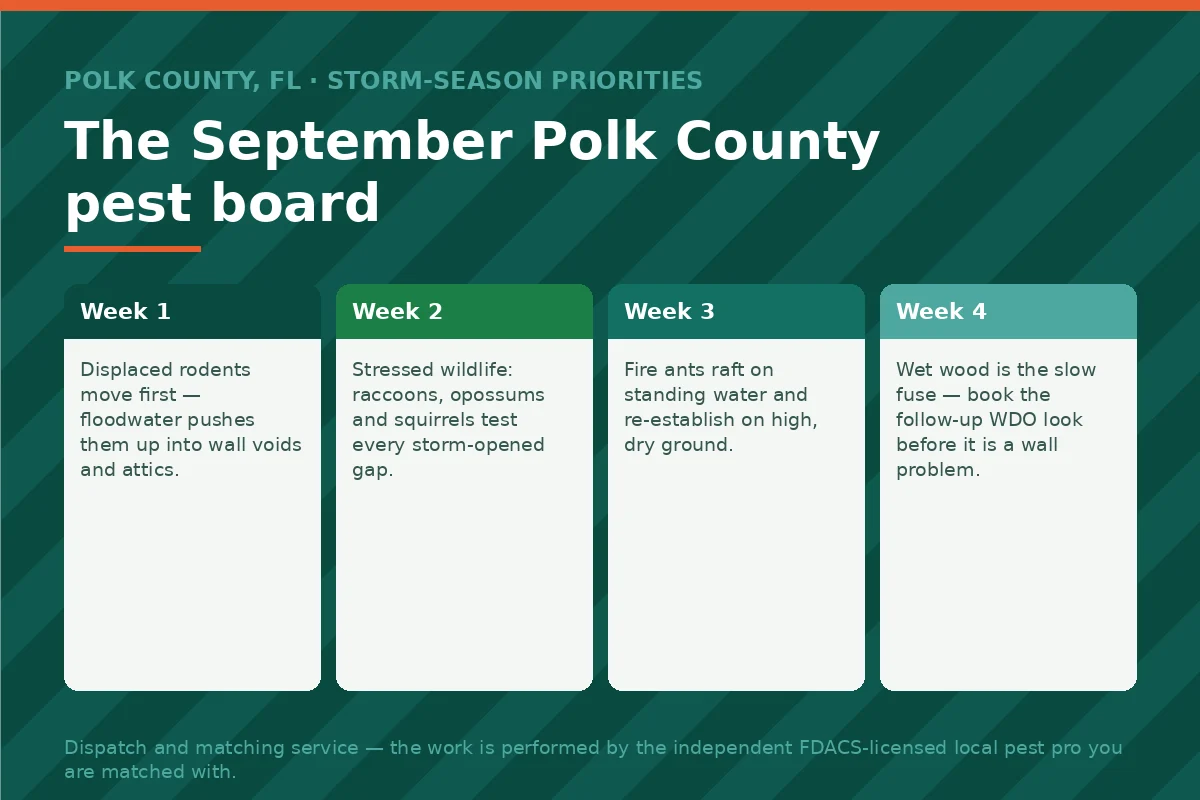
Displaced rodents — the week-one wave
Flooded burrows and stripped groves send roof rats and Norway rats toward the nearest dry structure — often through storm-opened soffits and fascia gaps. Scratching overhead within days of a storm is displacement, and it becomes residency fast.
Stressed wildlife — raccoons, opossums, squirrels
Downed trees are lost dens. Raccoons, opossums and squirrels displaced by canopy loss probe attics, chimneys and crawl spaces in the two weeks after a storm — and a nursing female who moves in is a legally protected complication in Florida.
Fire ants — the rafting hazard
Flooded fire ant colonies link legs and float — living rafts of thousands that ride standing water until they touch something solid: a fence post, a mailbox, a wading boot. Post-storm yard cleanup is the year’s highest sting-risk chore.
Wet wood — the slow fuse
Every tarped roof, soaked fascia board and moisture-wicked sill plate is an invitation. Carpenter ants find storm-wet wood within weeks; subterranean termites follow the moisture through fall. A post-storm WDO inspection catches what the adjuster doesn’t look for.
The post-storm mosquito note: floodwater mosquito species boom one to two weeks after any September storm. Area response is county-funded public work — the Polk County Mosquito Control District runs larviciding and area spraying during post-storm outbreaks — not house-by-house structural pest control. The homeowner lever is dumping every container, tarp fold and clogged gutter on the property. Structural operators focus September work on rodents, wildlife, ants, roaches and termite follow-through.
Hearing something new in the attic since the storm?
One call reaches a licensed, local exterminator who covers your address — and a real person answers, 24/7.
Free to call. Free to get matched. The licensed operator gives the quote.
September at a glance: the Polk County pest board
| Pest | September status | What you’ll see | The move |
|---|---|---|---|
| Roof rat / Norway rat | Storm-displacement surge | New scratching within days of a storm; droppings in garage or attic | Inspection + exclusion at storm-opened entry points |
| Wildlife (raccoon, opossum, squirrel) | Den-loss displacement | Heavy thumps at night, bent vent screens, chimney noise | Licensed wildlife operator — humane, legal removal |
| Fire ant | Rafting + relocated mounds | Floating mats on standing water; mounds in new spots after drainage | Boots and gloves for cleanup; licensed broadcast baiting after |
| Carpenter ant | Recruiting to wet wood | Big ants trailing tarped roof edges and soaked fascia at night | Fix moisture, then treat the nest — not just the trail |
| Subterranean termite | Moisture windfall, slow fuse | Nothing yet — that’s the trap; activity shows up months later | Post-storm WDO inspection on any water-damaged structure |
| Palmetto bug | Flooded-harborage surge | Big roaches indoors after every band of rain | Exclusion + perimeter program |
| German cockroach | Steady — indoor | Unchanged by weather; kitchen breeding continues | Gel bait + IGR program |
The full-year picture lives on the Florida termite swarm calendar and the neighboring monthly pages: June and December.
The September homeowner checklist
Walk the envelope after every storm
Soffits, fascia, ridge vents, screens, garage door seals. Photograph damage for insurance — then treat every opening as a pest entry point on a clock, because displaced animals find gaps within days.
Move debris away, fast
Brush piles against the house are rodent hotels with room service. Stage storm debris at the curb line, off the slab, and keep it moving — a pile that sits two weeks has tenants.
Dry-in beats everything
Tarped is not dried-in. The faster wet framing, fascia and sill plates dry, the smaller the carpenter ant and termite consequence. Run fans, pull wet insulation, and get repairs scheduled.
Book the follow-up WDO look
If the structure took water, a wood-destroying-organism inspection one to three months later catches the slow-fuse consequences while they’re still small — and documents the timeline for any claim.
What moves a September quote
We never set prices — the licensed operator quotes after seeing the property. After a storm, these are the levers:
- Entry-point count — storm-opened gaps multiply exclusion scope; a roofline with three new openings is a different job than one gap at a garage door.
- Wildlife vs. rodent — raccoon and squirrel work involves humane trapping rules, potential young in the den, and repair of larger openings; it is scoped differently than rat trapping.
- Cleanup and remediation — soaked or contaminated insulation, nesting removal and sanitizing add scope beyond removal itself.
- Timing of termite follow-through — a WDO inspection now versus discovering activity in a wall two years from now is the difference between a small treatment and a structural repair. The cost-factor guide breaks down the levers without pretending we set the number.
How the dispatch works in storm season
Straight up: Lakeland Exterminators is a dispatch and matching service, not a licensed pest control operator. Here is the exact path your request takes.
Describe what you found
Scratching, thumps, rafts, trails — tell the line what you’re seeing and where. A real person answers around the clock, storm weeks included.
Your address picks the operator
The request routes to an FDACS-licensed operator covering your part of Polk County. Wildlife situations route to operators handling nuisance-wildlife work; termite findings route to WDO-licensed operators.
Licensed inspection on site
The operator confirms what moved in, maps entry points and writes the quote. Pricing comes from them, never from us.
Treatment stays with the pro
Trapping, exclusion, baiting, repairs coordination — plus any warranty — all owned by the licensed operator under Chapter 482, Florida Statutes.
Verify before you hire — any Florida pest control company’s license status, categories and discipline history is public at the FDACS license search at aessearch.fdacs.gov. Post-storm weeks attract out-of-area operators; thirty seconds of verification filters them.
September pest questions, answered straight
Is a pest surge after a hurricane normal, or is it my house?
It’s the county, not just your house — every structure in the storm’s path experiences the same displacement wave. But normal doesn’t mean harmless: the animals displaced onto your property in week one become established tenants by week four if entry points stay open. The window for cheap fixes is the first two weeks.
Rats showed up right after the storm. Where did they come from?
Flooded burrows, stripped citrus and downed palms — roof rats lose both shelter and food in a single storm and relocate immediately. They follow fence lines and utility wires to the nearest dry roofline. Exclusion at the storm-opened gaps plus a licensed trapping program resolves it; trapping alone just makes room for the next arrivals.
I saw a floating mat of fire ants in my yard. What do I do?
Stay out of it — a raft that touches skin unloads thousands of stinging workers in seconds, and post-storm cleanup is the year’s worst sting scenario. Wear sealed boots and gloves for any standing-water work. Once water drains, expect mounds in new locations; licensed broadcast baiting handles the relocated colonies.
Does storm damage really attract termites?
Yes, on a delay. Subterranean termites follow moisture, and a structure that took water offers exactly the conducive conditions inspectors flag: wet wood, soil contact via debris, compromised flashing. The activity typically becomes visible months later — which is why a post-storm WDO inspection on water-damaged structures is the highest-value follow-up on this page.
Who sprays for mosquitoes after a September storm?
The Polk County Mosquito Control District runs county-funded larviciding and area spraying during post-storm outbreaks — contact the District directly for area treatment. Structural operators focus on rodents, wildlife, ants, roaches and termites. Your lever: dump every container, tarp fold and gutter on the property twice a week until the flood generation dies down.
The two weeks after a storm decide the next six months.
One call reaches a licensed, local exterminator who covers your address — and a real person answers, 24/7.
Free to call. Free to get matched. The licensed operator gives the quote.
Disclosure
Lakeland Exterminators is a dispatch and matching service. We connect Polk County callers with FDACS-licensed structural pest control operators. We are not a licensed pest control operator. We do not perform pest control treatment, set prices, issue warranties, hold retreatment bonds, or carry pest control trade insurance. All pricing, scheduling, treatment plans, warranties, bonds and service terms are determined by the FDACS-licensed operator dispatched to your address under Chapter 482, Florida Statutes.
Same-day and 24/7 emergency services are subject to provider participation, location, technician availability, and demand. Availability is not guaranteed and may vary by market and appointment capacity.
License status of any operator you connect with is publicly verifiable at the FDACS license search: aessearch.fdacs.gov.