Dealing with a pest problem right now?
📞 Call now — get matched with a licensed local exterminator: (888) 295-0220When you call, stay on the line for a few seconds while we match you with the licensed local exterminator for your area. Have your address and a quick description of the problem ready.
Licensed local pros · Fast response, subject to availability · No obligation
Polk County, Florida Pest & Termite Pressure Report
A sourced data study on the termite and pest pressure Polk County homeowners actually live with — official Termite Infestation Probability zoning, UF/IFAS termite-species and range-expansion research, FDACS licensing framework, NOAA climate data for Lakeland, and USDA agricultural and hardiness-zone data specific to Polk County. Every figure below is drawn from a public source and linked at the point of use so it can be independently checked. No figure on this page is estimated or invented.
See this month’s risk at a glance:
The Numbers at a Glance
Central Florida Termite Swarm Calendar
Polk County homes sit inside overlapping swarm windows for at least four termite types UF/IFAS tracks statewide: native subterranean termites by day in spring, drywood termites at night in summer, and two invasive species — the Asian subterranean termite and the Formosan subterranean termite — that UF/IFAS urban entomologists watch expand their range every year.
March through June is the window UF/IFAS urban entomologist Thomas Chouvenc identifies as when “termite activity is the most visible” statewide — the point at which native subterranean, Asian subterranean and Formosan swarm windows all overlap.
Source: UF/IFAS Fort Lauderdale Research and Education Center, Termite Swarming Events; UF/IFAS News, “As Florida Enters Termite Swarm Season” (March 2021).
Polk County’s Citrus-Edge Pressure, in Numbers
Homeowner narratives about Polk County pest pressure usually mention its citrus-grove edges, and USDA’s own production data backs that up: Polk is Florida’s single largest citrus-producing county, ahead of every other county in the state.
Polk County produced 3.86 million boxes of citrus in the 2023–24 season, more than any other Florida county. Together, the top five counties account for 71% of Florida’s total citrus production.
Source: USDA National Agricultural Statistics Service, Florida Citrus Statistics 2023–24.
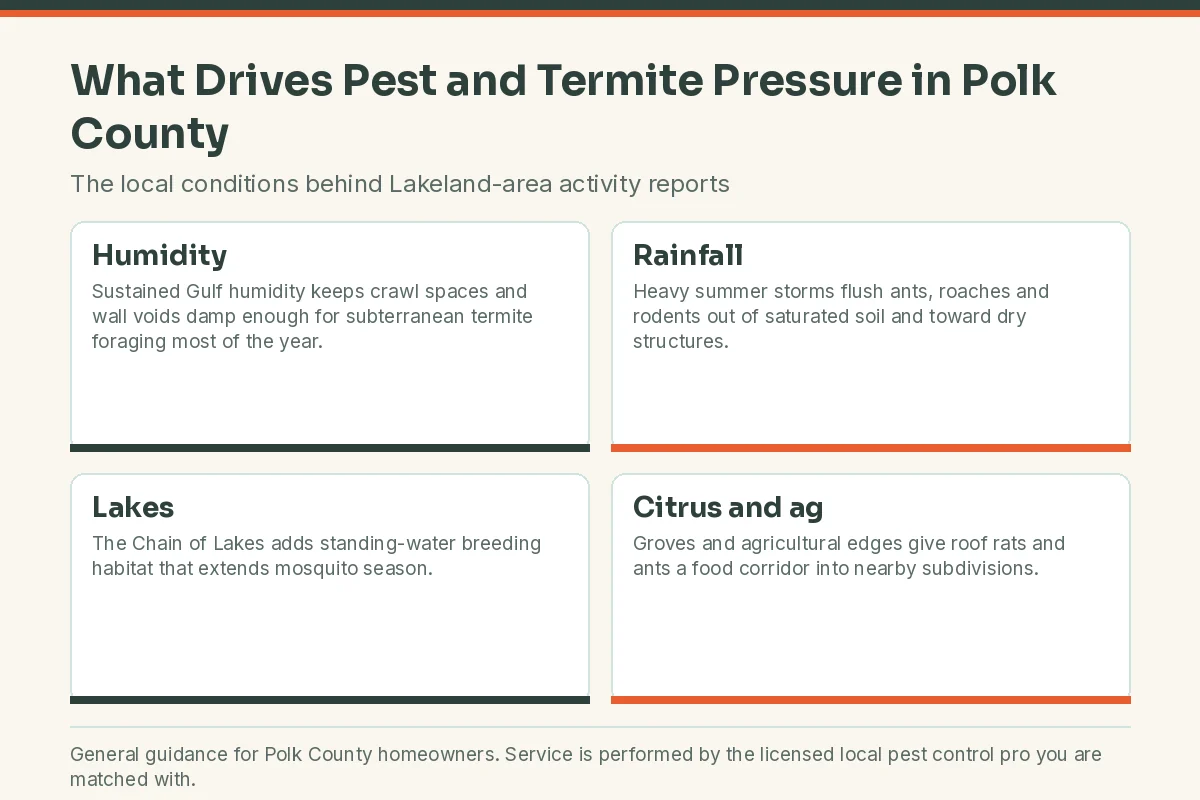
Why this matters for a homeowner: new subdivisions built on former or active grove edges in Lakeland, Winter Haven, Bartow and Lake Wales sit next to disturbed soil that fire ants and other ground-nesting ants exploit heavily — a distinct pressure pattern from the older, tree-canopy neighborhoods closer to Lakeland’s lakes.
Why Polk County Splits Into Three Distinct Pest Zones
| Zone type | Representative areas | Why it matters |
|---|---|---|
| Lakefront & older neighborhoods | Dixieland, Lake Morton, Cleveland Heights, Beacon Hill, Garden District | Proximity to Lakeland’s 38 named lakes raises ambient humidity above the county baseline, and pre-1960 construction (cypress/pine sill plates, pier-and-beam foundations) is exactly what subterranean and drywood termites favor. |
| New-construction / disturbed-soil edges | Lakeland Highlands, Christina, I-4 corridor growth in Auburndale & Davenport | Post-2000 builds on freshly disturbed soil trade termite pressure for ant pressure — ground-nesting ant species establish quickly on cleared land. |
| Citrus-grove edge | Lakeland, Winter Haven, Bartow, Lake Wales | Polk’s status as Florida’s top citrus-producing county (3.86M boxes, 2023–24) means many subdivisions sit on former or active grove land, a documented driver of ant pressure spilling into yards. |
Underpinning all three zones: Polk County sits in USDA Plant Hardiness Zone 9b, with pockets rated 10a under the 2023 update — meaning frost is rare enough that subterranean termite colonies and ground-nesting ants stay active in the soil essentially year-round rather than going dormant for a real winter.
The Statewide Spread Curve
UF/IFAS has been tracking invasive termite range expansion in Florida since at least 2016, when researchers first projected that roughly half of South Florida’s urban structures could face invasive subterranean termite risk by around 2040. A February 2026 follow-up study, led by UF associate professor of urban entomology Thomas Chouvenc using University of Florida Termite Collection records from 1990 to 2025, confirmed that 2016 projection’s accuracy and found the Formosan subterranean termite is no longer confined to a handful of cities — it’s now established across most of Florida’s coastal counties and most large urban centers statewide, with researchers projecting every Florida county could carry Formosan risk by 2050.
Polk County isn’t a coastal county, which has historically meant lighter Formosan pressure than Tampa or Miami — but it sits inland between two metro areas (Tampa/Hillsborough and Orlando/Orange) that UF/IFAS tracking already lists among the state’s established Formosan zones, directly on the path the 2050 statewide projection describes.
Frequently Asked Questions
How bad is termite pressure in Polk County compared to the rest of the country?
Florida sits in Region I — “Very Heavy” — on the Termite Infestation Probability map used in the International Residential Code and by HUD for mortgage underwriting standards, the highest of the map’s four categories, shared with Alabama and the rest of the Deep South.
Why does Florida have more termite species than any other state?
UF/IFAS researchers have documented 20 established termite species in Florida based on more than 6,500 samples collected over four decades — more species diversity than any other mainland U.S. state, driven by the state’s subtropical climate and its history as an entry point for invasive species.
Is Polk County at risk from the Formosan termite even though it’s inland?
UF/IFAS’s February 2026 research shows the Formosan subterranean termite has spread well beyond its original South Florida foothold into most large urban centers statewide, with researchers projecting every Florida county could carry some Formosan risk by 2050. Polk sits inland between two metro areas already on that expansion path.
Does Polk County’s citrus industry really affect pest pressure at home?
USDA data confirms Polk is Florida’s top citrus-producing county by a wide margin (3.86 million boxes in 2023-24). Homes built on or near former and active grove land sit closer to disturbed-soil edges that ground-nesting ants exploit, a pattern distinct from the humidity-driven pressure near Lakeland’s lakes.
What’s the difference between subterranean and drywood termite swarms?
Subterranean termites swarm during the day, especially after rain, and travel into structures through mud tubes. Drywood termites swarm at night, are drawn to lights, and leave kick-out holes with pellet-like frass instead of mud tubes.
Who is legally allowed to treat a termite problem in Polk County?
Only operators holding an active Florida license under FDACS’s Termite/WDO category, per Chapter 482, Florida Statutes, can legally perform termite treatment anywhere in Polk County.
Methodology & Sources
How this report was built: every figure above was pulled directly from a named public source — the University of Florida Institute of Food and Agricultural Sciences, the Florida Department of Agriculture and Consumer Services, NOAA, USDA NASS, the City of Lakeland, and the 2021 International Residential Code — and is linked at the point of use plus in the list below so it can be independently verified. Where a number could not be confirmed against a primary or clearly-sourced record, it was left out rather than estimated. This report contains no invented statistics, no dollar figures, and no price estimates of any kind.
- UF/IFAS EDIS – Termite Species Distribution in Florida and UF Termite Identification Services (Chouvenc, Scheffrahn & Buss, 2022)
- UF/IFAS News – New Study Shows Invasive Termites Threatening Homes in Florida Are Spreading Farther Than Predicted (Feb. 2026)
- UF/IFAS News – Half of South Florida Structures at Risk of Subterranean Termite Infestation by 2040 (2016)
- UF/IFAS Fort Lauderdale REC – Termite Swarming Events
- FDACS – Formosan Termite Surveillance Program
- USDA NASS – Florida Citrus Statistics 2023–24
- NOAA NCEI – U.S. Climate Normals
- City of Lakeland – Overview of Our Lakes
- USDA – Plant Hardiness Zone Map (2023)
- Building America Solution Center (U.S. DOE / PNNL) – Termite Infestation Probability Map, 2021 IRC Figure R301.2(7)
Related Polk County Resources
About this report
This report compiles publicly available data from the University of Florida Institute of Food and Agricultural Sciences, FDACS, NOAA, USDA NASS, the City of Lakeland, and the International Residential Code. It is a data reference, not a pest inspection or diagnosis for any specific property. Compiled July 2026; source pages are linked directly above so figures can be independently verified.
Disclosure: Lakeland Exterminators (lakelandexterminators.com) is a free referral and dispatch service for residential homeowners in Polk County. We are not a licensed pest control company and do not directly provide pest control services. All inspections and treatment are performed by independent, FDACS-licensed and insured third-party pest control operators in your area, who set their own schedule and terms. Same-day, emergency, and 24/7 availability are not guaranteed and depend on provider schedules, location, and demand. Service availability, pricing, licensing, and final response times are determined solely by the providers.