Fort Lauderdale termite work comes with a complication the brochures skip: half the decisions aren’t yours alone.
Broward’s termite pressure is South Florida-grade: drywood colonies saturating the older housing of Victoria Park, Croissant Park and Wilton Manors, Formosan subterraneans working the canal network’s moist seawall soil from Las Olas Isles outward, and the conehead termite — whose only U.S. establishment centers on Broward County — foraging in the open under active state containment. But the defining Fort Lauderdale wrinkle is shared structures: condo towers and townhome rows where a drywood finding in one unit becomes an association decision about tenting a building. The dispatch line matches you with FDACS-licensed operators who handle both the biology and the logistics — single-family or 200-unit.
Talk to a live dispatch coordinator now
Pellets on a Victoria Park windowsill, mud tubes on a canal-side seawall planter, a condo board asking for tenting bids — describe it and get routed to a licensed Fort Lauderdale termite operator.
(863) 445-9190Tap to call — 24/7 dispatch
Free to call. Free to get matched. The licensed operator you’re matched with gives the quote.
24/7 line · A real person answers · Availability of same-day and emergency service depends on the provider.
Need termite treatment in Fort Lauderdale, FL? Call (863) 445-9190 and a dispatch coordinator matches you with an FDACS-licensed termite operator serving your Broward ZIP — drywood fumigation and no-tent options, Formosan soil-and-structure programs, and operators experienced with condo and association jobs. Lakeland Exterminators is a dispatch service: the licensed operator confirms the species and quotes the treatment.
What’s different about treating termites in Fort Lauderdale?
Three localisms. First, the canal factor: over 150 miles of navigable waterways thread the city, and the moist soil along seawalls, dock footings and irrigated waterfront landscaping is congenial Formosan habitat — colonies that treat a neighborhood’s canal bank as home base and its housing stock as pantry. Waterfront soil treatment demands care with application near water, which is licensed-operator territory by both regulation and common sense. Second, the condo factor: drywood evidence in a sixth-floor unit raises questions a single-family owner never faces — can a unit be spot-treated alone, when does the association tent the building, who coordinates the vacate. Operators who work Broward associations bring findings maps boards can act on, which is often the difference between a decision and a year of deferral. Third, the conehead zone: Broward is the containment heart for this invasive — dark foraging tubes running over open ground, teardrop-headed soldiers — and suspected sightings belong with both a licensed operator and FDACS reporting.
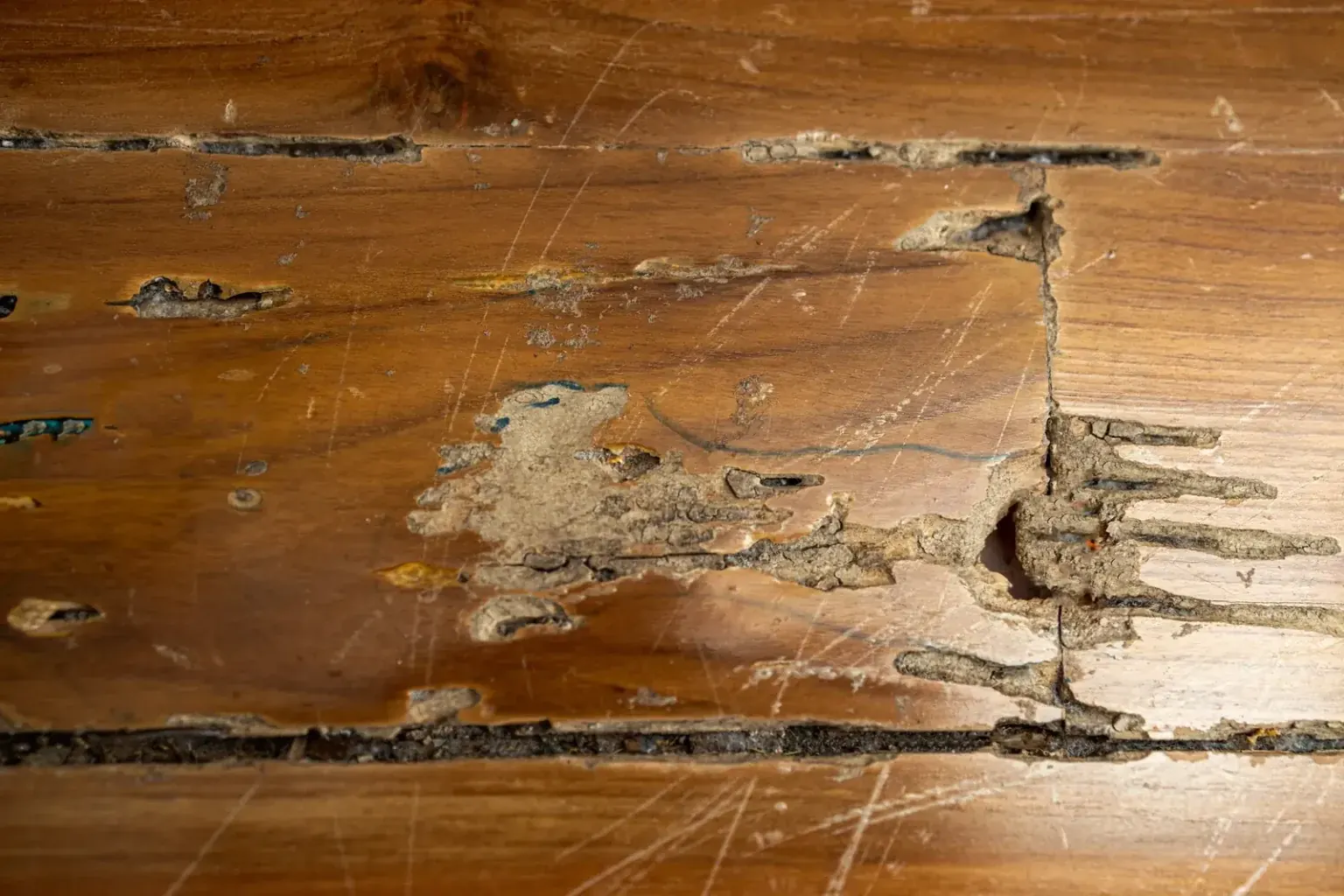
The species mechanics still rule underneath. Dry pellets and kick-out holes: drywood — localized spot or heat treatment when an inspector can prove containment, structural fumigation when spread says so. Mud tubes and soil-packed galleries: subterranean — non-repellent liquid zones or bait systems, and with Formosan evidence, void inspection for carton nests before anyone declares victory. Fort Lauderdale’s housing eras give a rough map: pre-1960 neighborhoods carry the heaviest drywood load; canal-adjacent everything carries the Formosan question; and the post-1980 western tracts mostly face expired-pretreat subterranean math. The inspection that names the species with physical evidence — and puts it on paper — is the product everything else depends on.
Where does termite treatment work concentrate in Fort Lauderdale?
- Victoria Park & Colee Hammock (33301, 33304): 1920s-40s wood — drywood heartland with renovation-triggered discoveries.
- Las Olas Isles & the finger canals (33301, 33316): waterfront Formosan pressure at seawalls and irrigated landscaping.
- Croissant Park & Tarpon River (33315, 33316): older bungalow stock — two-species inspections as standard practice.
- Wilton Manors & Oakland Park (33305, 33306, 33334): mid-century cottages and duplexes — drywood in fascia, subterranean at slabs.
- Beach condo corridor (33304, 33305, 33308): association-scale drywood decisions — tent logistics, vacate coordination, board documentation.
- Western tracts — Plantation edge, Davie edge (33324, 33325, 33328): 1980s-2000s slabs hitting pretreat end-of-life.
Unit spot treatment or building fumigation — how do condo decisions get made?
By evidence scope and structure type. Drywood colonies live in the wood member they infest — so a genuinely localized finding (one window frame, one closet header) in a concrete-framed building can often be spot-treated or heat-treated at unit scale, documented, and monitored. What tips a building toward tenting: multiple units with findings, shared wood elements (roof structures over top floors, continuous mansards and fascia runs), repeated spot-treatment history that keeps finding new pockets, or wood-framed construction where colonies cross unit lines invisibly. A board-ready operator delivers what the decision actually needs: a unit-by-unit findings map, an honest read on whether concrete separation makes spot work defensible, and fumigation logistics — vacate windows, gas-line coordination, tenant notice — priced as a project, not a mystery. Owners on the other side of the table: your leverage is asking for exactly that document. The same evidence-first rule that protects a homeowner from an unnecessary tent protects an association from an inadequate one.
Call the line
Tap (863) 445-9190 any hour. Describe the evidence and the structure — single-family, townhome or condo — plus your Broward ZIP.
Get matched by structure and species
Association and condo calls route to operators who do board-scale documentation; waterfront Formosan evidence routes to combined soil-structure providers.
A licensed operator takes over
An independent, FDACS-licensed and insured Fort Lauderdale operator inspects, proves the species, and quotes. No obligation — the dispatch call costs nothing.
Pellets in a unit? Tubes on the seawall side? Board asking for bids?
The line answers 24/7 and matches you with a licensed Fort Lauderdale termite operator.
One tap. One call. Matched.
(863) 445-9190Tap to call — 24/7 dispatch
Free to call. The licensed operator gives the quote.
Fort Lauderdale termite treatment questions, answered straight
I’m a condo owner with drywood evidence. Is treatment my bill or the association’s?
What are conehead termites and how would I recognize them?
Does living on a canal raise my termite risk?
What does termite treatment cost in Fort Lauderdale?
Disclosure
Lakeland Exterminators is a pest control dispatch and referral service, not a licensed pest control operator. All termite inspections, quotes, treatments and fumigations in Fort Lauderdale are performed by independent pest control operators licensed by the Florida Department of Agriculture and Consumer Services (FDACS) and insured in their own name. Calling the dispatch line is free and creates no obligation; the licensed operator you’re matched with sets their own pricing and terms.
More Fort Lauderdale help: Pest control in Fort Lauderdale, Bed bug treatment in Fort Lauderdale · Termite dispatch guide · All pest control services