In most Florida cities the rodent question is one building. In Ocala it is a parcel: the house, the barn, the feed room and the equipment shed — and the rats commute between all four.
Horse country changes the rodent math. A feed room holding sweet feed and alfalfa is the highest-calorie food source a rat will find in Marion County, and a hay loft is five-star harborage sitting thirty feet from it. Rats established in a barn do not stay in the barn — they radiate: into tack rooms to gnaw leather, into equipment sheds to strip wiring insulation off tractors and trucks, and eventually up the oak line into the house attic. Meanwhile the city itself runs two more classic profiles: the historic district’s canopy roof rats working century-old eaves, and the manufactured-home communities where skirting gaps and pier fields give Norway rats ground-level access no site-built house offers. The dispatch line matches Ocala properties — from a downtown bungalow to a full farm parcel — with FDACS-licensed operators who treat the whole travel network, not one building at a time.
Talk to a live dispatch coordinator now
Droppings in the feed room, gnawed tack, attic noise at dusk, chewed truck wiring — describe the property and get matched with a licensed operator working Ocala.
(904) 943-3349Tap to call — 24/7 dispatch
Free to call. Free to get matched. The licensed operator you’re matched with gives the quote.
24/7 line · A real person answers · Availability of same-day and emergency service depends on the provider.
Need rodent control in Ocala, FL? Call (904) 943-3349 and a dispatch coordinator matches you with an FDACS-licensed operator serving 34470, 34471, 34476 and the NW 34482 farm corridor — whole-parcel inspection, feed-room and barn sanitation planning, exclusion on house and outbuildings, and trapping on the travel lines. Lakeland Exterminators is a dispatch service: the licensed local operator inspects, treats and quotes.
Why do barns and feed rooms set the rodent pressure for the whole parcel?
Because rodent populations size themselves to food, and nothing else on the property competes with stored feed. A single rat needs roughly an ounce of food a day; an unsealed feed sack is a winter’s supply for a colony, and spilled sweet feed under a pallet is a standing buffet. That is why serious farm rodent work starts in the feed room, not the attic: galvanized cans with tight lids for every open bag, feed off the floor on racks, spill sweep-downs as a daily habit, and hay stacked off the wall so inspection lanes exist. With the food supply capped, trapping and exclusion actually shrink the population instead of farming it.
The radiating damage is where Ocala owners feel it financially. Rats gnaw constantly to wear down incisors, and the two favorite targets in horse country are leather and wire: a chewed saddle is a four-figure loss, and stripped wiring insulation on a tractor, a dually or a barn panel is both a repair bill and a documented fire risk. Wiring damage in outbuildings is the single most under-reported rodent cost on Marion County parcels — it hides until something fails.
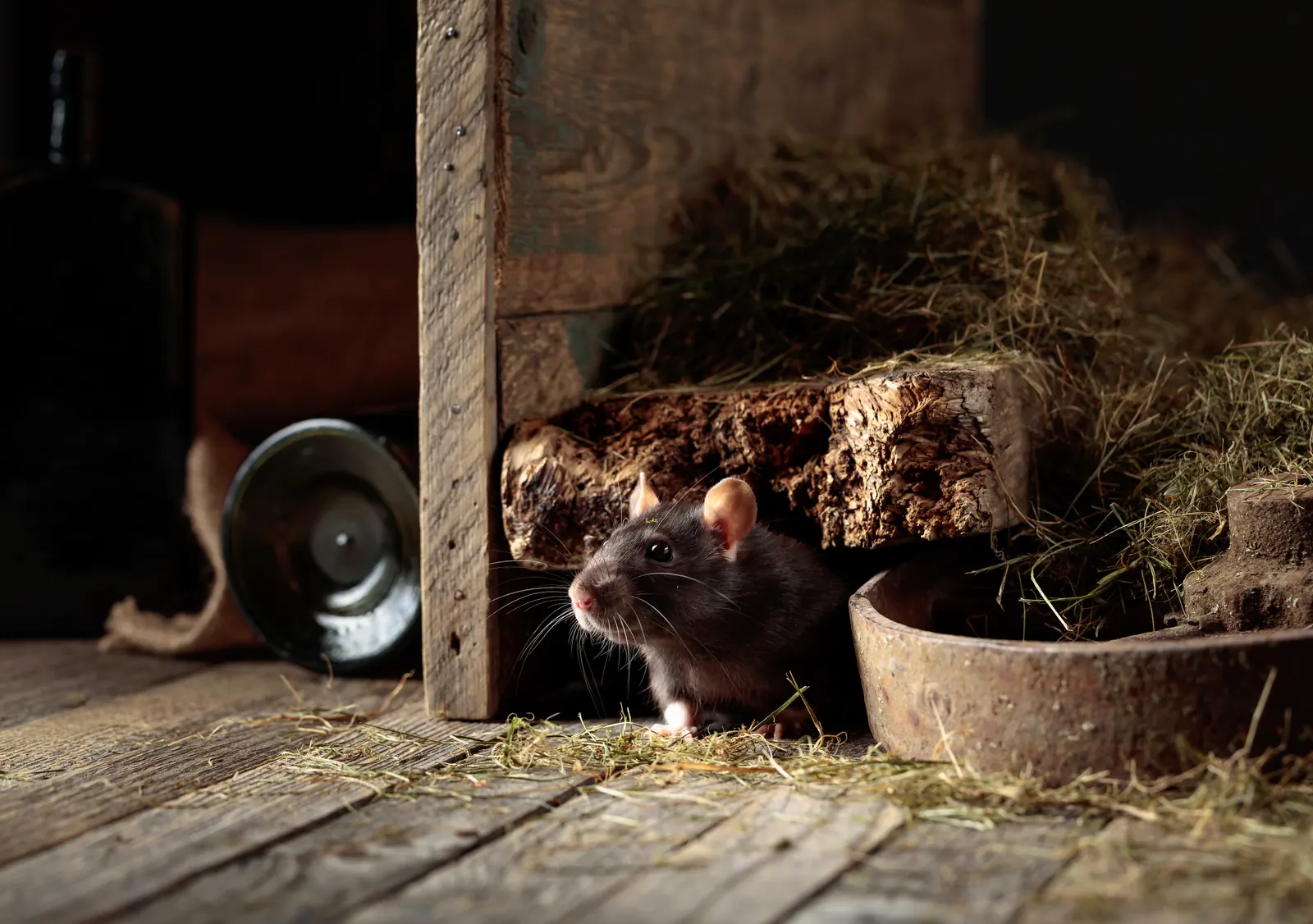
What does each kind of Ocala property face?
- Farm parcels (NW 34482, Hwy 27 & 326 corridors): barn-to-house travel networks; feed storage and hay-stack management decide whether trapping works or just harvests.
- Historic district & Tuscawilla (34470, 34471): century-old homes under heavy oak canopy — roof rats at the eave line, original soffits and vent screens long past their service life.
- Manufactured-home communities (34476, 34480 corridors): skirting gaps, pier fields and belly-wrap tears give ground-level access; exclusion means skirting repair and sealed penetrations, not bait blocks under the home.
- Newer SW subdivisions (34476): lighter pressure, but construction on former pasture inherits field rodents; garage-door sweeps and AC chase seals are the usual gaps.
- Equipment sheds everywhere: park with cab windows up, check engine bays weekly in cool months — engine compartments are heated nest boxes from November through February.
Why is poison the wrong lead tool around horses, dogs and owls?
Three audiences make broadcast rodenticide a bad first move on an Ocala property. Horses and barn dogs are the obvious two — anticoagulant baits are dangerous to both, and bait placed “where they can’t get it” has a long record of proving otherwise. The third is the barn owl population that Marion County horse farms famously host, often in dedicated nest boxes, precisely because a resident owl family removes a thousand-plus rodents a year. Secondary poisoning — an owl eating a poisoned rat — kills the free workforce and is why progressive farms run owl boxes and tamper-resistant stations only as a last layer, never the first. The professional sequence: cap the food, seal the buildings, trap the travel lines, and let the owls handle the pasture. An operator who leads with a ring of bait stations before the feed room has lids is selling a subscription, not a solution — ask for the exclusion scope and sanitation checklist in writing.
Call the line
Tap (904) 943-3349 any hour. Describe the property — house only, or house plus barn and outbuildings — and what you are finding.
Get matched to the problem
Farm-parcel work, historic-home eave exclusion and manufactured-home skirting jobs route to operators who do that specific work — the coordinator matches the right one.
A licensed operator takes over
An independent, FDACS-licensed and insured operator working Ocala inspects, quotes and treats. No obligation — the dispatch call costs nothing.
Found droppings in the feed room this morning?
The line answers 24/7 and matches you with a licensed operator who works barns and attics as one problem — because on your parcel, they are.
One tap. One call. Matched.
(904) 943-3349Tap to call — 24/7 dispatch
Free to call. The licensed operator gives the quote.
Ocala rodent questions, answered straight
Rats in the barn but not the house — should we still act?
Something chewed the wiring on the tractor. Is that rats?
We have barn owls on the property. Does that change treatment?
What does rodent control cost in Ocala?
Disclosure
Lakeland Exterminators is a pest control dispatch and referral service, not a licensed pest control operator. All pest inspections, treatments and quotes in Ocala are performed by independent pest control operators licensed by the Florida Department of Agriculture and Consumer Services (FDACS) and insured in their own name. Calling the dispatch line is free and creates no obligation; the licensed local operator you’re matched with sets their own pricing and terms.
More Marion County help: Pest control in Ocala, Ocala termite treatment, Pest control in The Villages · Rodent dispatch guide · All pest control services