Tallahassee’s canopy roads are the most beautiful roach habitat in Florida — and the city’s two-university lease cycle runs a second roach economy entirely indoors.
No Florida city is built under more tree than Tallahassee. The live oaks arching over Miccosukee, Centerville and Old St. Augustine are also the reason the smokybrown cockroach — the big, mahogany, tree-hole species — dominates North Florida roach calls: the canopy holds colonies in oak hollows, leaf-choked gutters and ivy mats, and summer rain pushes them into soffits and attics at roofline height. Indoors, a different cycle runs on the academic calendar: FSU and FAMU turn over tens of thousands of leases every August, and German cockroaches ride the used furniture and packed boxes into apartments from College Town to Killearn’s rental pockets. Two species, two calendars, two completely different treatments — and a lot of wasted money when they get confused. The dispatch line matches Tallahassee homes, tenants and landlords with FDACS-licensed operators who identify first and treat second.
Talk to a live dispatch coordinator now
Big roaches on the ceiling after rain, small ones behind the fridge after move-in — describe it and get matched with a licensed operator working Tallahassee.
(888) 295-0220Tap to call — 24/7 dispatch
Free to call. Free to get matched. The licensed operator you’re matched with gives the quote.
24/7 line · A real person answers · Availability of same-day and emergency service depends on the provider.
Need roach control in Tallahassee, FL? Call (888) 295-0220 and a dispatch coordinator matches you with an FDACS-licensed operator serving 32301, 32303, 32304 and 32308 — species identification first, then interior gel-bait programs for German roaches or soffit-line exclusion and habitat work for smokybrowns, including crawl-space assessment on the city’s older pier-and-beam stock. Lakeland Exterminators is a dispatch service: the licensed local operator inspects, treats and quotes.
Why is the smokybrown the signature Tallahassee roach?
Because the city’s defining feature — mature hardwood canopy over nearly every neighborhood from Betton Hills to Indianhead — is the species’ natural habitat. Smokybrowns are moisture-dependent tree dwellers: oak hollows, palm boots, ivy on trunks, and above all gutters packed with leaf litter, which in a canopy city means a breeding site bolted to the house at roof height. They enter high — soffit gaps, gable vents, the porch-roof joint — and appear indoors on ceilings and upper walls at night, usually after summer rain floods their outdoor harborage. Residents call anything big a palmetto bug; operators care about the distinction because the treatment is structural, not chemical-first: gutters cleared on a schedule, canopy trimmed off the roofline, high entry points screened and sealed, firewood and leaf piles pulled off the foundation, and a targeted perimeter treatment on the harborage lines. A kitchen bait placement does nothing against a species commuting from an oak.
The older neighborhoods add a second story below the floor: Tallahassee’s pre-war stock in Midtown, Frenchtown and Myers Park sits on pier-and-beam foundations, and a damp, poorly vented crawl space is ground-level harborage for smokybrowns and American roaches both. A proper inspection here goes under the house — moisture readings, vent condition, duct penetrations — because that is where the population actually lives.
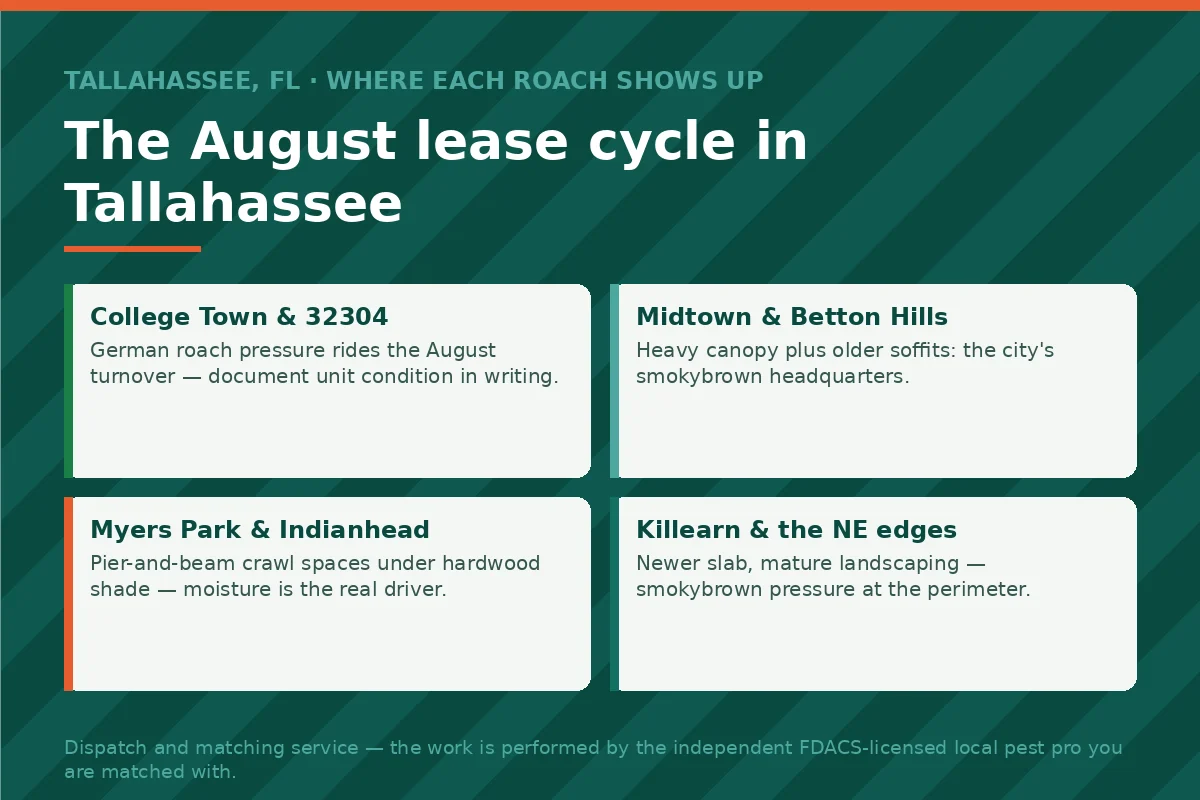
Where does each part of Tallahassee stand?
- College Town, Frenchtown & the 32304 corridors: German roach pressure on the August lease cycle — the September complaint spike is a move-week echo; building-level baiting beats unit-by-unit treatment.
- Midtown, Betton Hills, Los Robles (32303, 32308): heavy canopy plus older soffits — the city’s smokybrown core; gutter schedule and roofline sealing decide the season.
- Myers Park & Indianhead (32301): pier-and-beam crawl spaces under hardwood shade — crawl-space moisture is the roach reservoir; ventilation work is pest control here.
- Killearn & NE subdivisions (32309 edges): newer slab construction but mature landscaping — smokybrown pressure tracks tree contact and irrigation, lighter interior risk.
- Capital-area apartments and condos: shared-wall German roach dynamics — document unit condition in writing at move-in; it settles disputes and triggers timely landlord treatment.
What actually works against the August German roach wave?
Prevention is cargo inspection: in a two-university town, the highest-risk items are the free couch, the secondhand mini-fridge and the storage-unit boxes — check seams, hinges and motor compartments in the parking lot, not the kitchen. Once a population is established, the fix is a professional gel-bait program: crack-and-crevice placements matched against Florida’s documented glucose-averse German roach strains (operators rotate bait matrices when acceptance drops), an insect growth regulator to break the breeding curve, and a follow-up on the egg-hatch cycle. Foggers remain the classic student-rental mistake — they scatter roaches into wall voids and the neighbors’ units, contaminate surfaces so bait stops working, and turn a one-unit problem into a building problem. Landlords get the economics: empty-unit baiting during August turnover is faster and cheaper than treating occupied units in October around four class schedules.
Call the line
Tap (888) 295-0220 any hour. Say what you are seeing, where in the house it appears, and whether it is a rental, a house or a whole building.
Get matched to the problem
Smokybrown exclusion, German baiting programs and crawl-space moisture work route to different specialists — the coordinator matches the right one.
A licensed operator takes over
An independent, FDACS-licensed and insured operator working Tallahassee inspects, identifies the species, quotes and treats. No obligation — the dispatch call costs nothing.
Another one on the bedroom ceiling tonight?
The line answers 24/7 and matches you with a licensed operator who knows whether your roach came from an oak or a moving box — and treats accordingly.
One tap. One call. Matched.
(888) 295-0220Tap to call — 24/7 dispatch
Free to call. The licensed operator gives the quote.
Tallahassee roach questions, answered straight
Why do the big roaches show up right after summer thunderstorms?
Do the canopy roads really matter, or is that just atmosphere?
Whose job is roach treatment in a student rental?
What does roach control cost in Tallahassee?
Disclosure
Lakeland Exterminators is a pest control dispatch and referral service, not a licensed pest control operator. All pest inspections, treatments and quotes in Tallahassee are performed by independent pest control operators licensed by the Florida Department of Agriculture and Consumer Services (FDACS) and insured in their own name. Calling the dispatch line is free and creates no obligation; the licensed local operator you’re matched with sets their own pricing and terms.
More Big Bend help: Pest control in Tallahassee, Tallahassee termite treatment, Pest control in Panama City · Roach extermination guide · All pest control services