Quick answer: Water-damaged wood is typically soft, swollen, or crumbly along a clear moisture path — near a roof leak, a plumbing line, or a window seal — and doesn’t hollow out from the inside. Termite-damaged wood keeps its outer shell mostly intact while the interior gets hollowed into layered galleries following the wood grain, often packed with mud (subterranean) or dry pellet-like droppings (drywood). The two frequently occur together in Florida homes, since a moisture problem is exactly what invites a termite colony in the first place — which is why a proper WDO inspection, not a guess, is what actually sorts it out.
What does water-damaged wood actually look like?
Moisture damage follows a source. Look for a soft or swollen area that traces back to something specific — a roof leak above, a plumbing line behind a wall, condensation from an AC line, or a window or door seal that’s failed. The wood typically darkens, swells, and becomes soft to the touch uniformly through the affected section, sometimes with visible mold or a musty smell nearby. Structurally, it tends to fail from the outside in: the exposed, wet surface degrades first, and a screwdriver or awl sinks in easily across a broad area rather than into isolated pockets.
Florida’s humidity and rainy season make this kind of damage common on its own, independent of any termite activity — a leaking roof valley, a clogged gutter dumping water against a fascia board, or a slow slab leak can each rot wood over months without a single insect involved.
What does termite damage actually look like?
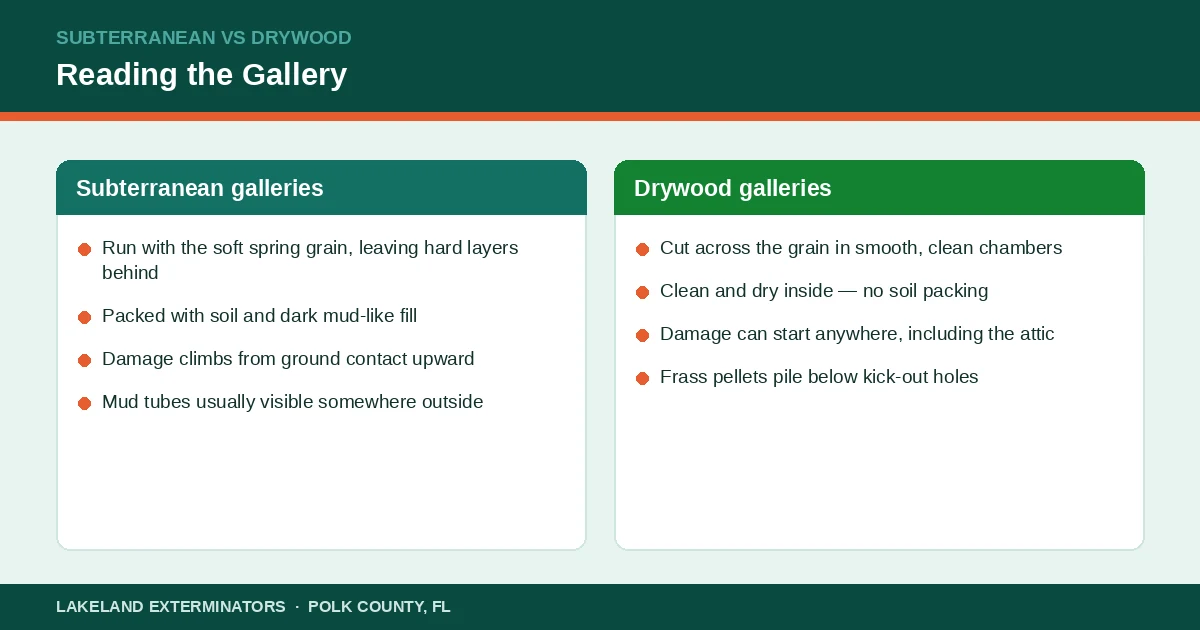
Termite damage reads very differently once you know what to look for. The outer surface of the wood is often left thin but intact — sometimes just a fraction of an inch of surface material remains, which is why a homeowner can accidentally put a finger through a windowsill or baseboard that looked completely normal a moment before. Inside, termites excavate along the wood grain in layered galleries, and depending on the species, those galleries carry specific evidence: subterranean termites pack their tunnels with mud and soil, since they need to maintain the moisture connection back to the ground, while drywood termites leave distinctive six-sided pellet-shaped droppings (frass) that accumulate in small piles below the damaged wood or get pushed out of tiny exit holes called kick-out holes.
A live colony also tends to leave more direct evidence somewhere on the property: mud tubes running from soil up a foundation wall (subterranean), or a swarm of winged reproductives at a window on a warm, humid evening, usually after rain (either species, at different times of year).
Why do the two so often show up together in Florida?
Because moisture is the common denominator both problems need. A roof leak or plumbing failure that softens wood over months also raises local humidity right where the damage is happening — and that’s exactly the condition that draws subterranean termites looking for a moisture-rich entry point, or gives drywood termites softened wood that’s easier to colonize. It’s common for a Florida inspection to turn up both conditions in the same section of framing: genuine water rot as the original problem, with an active or historical termite colony that moved in once the wood was already compromised. Treating one without checking for the other leaves half the problem unaddressed.
Can I actually tell the difference myself?
Sometimes, at a surface level — a clear moisture source with no galleries or frass points toward water damage alone, and mud tubes running up a foundation wall point clearly toward an active subterranean colony. But the two conditions overlap often enough, and the treatment paths are different enough, that guessing wrong has real consequences: treating what’s actually a moisture problem with a termiticide does nothing for the leak that’s still rotting the wood, and treating what’s actually an active termite colony as if it were simple water damage lets the colony keep spreading while a contractor just replaces boards.
A wood-destroying organism (WDO) inspection, performed by an FDACS-licensed inspector, is built specifically to sort this out. The inspector documents live insect activity, damage evidence, and prior treatment evidence separately on Florida’s standard WDO report (form 13645), which becomes the basis for whatever repair or treatment conversation follows — whether that’s a plumber, a roofer, a termite treatment, or, in the overlap cases, more than one of those at once.
Does the age of the house change which is more likely?
It shifts the odds without ruling anything out. Older homes with original wood windows, wood siding, or a pier-and-beam foundation tend to accumulate more of both problems over the decades simply because there’s been more time for a roof to develop a slow leak and more exposed, untreated wood for a termite colony to find. Newer slab-built homes are not immune to either — irrigation lines running close to a foundation can raise soil moisture enough to draw subterranean termites, and a poorly flashed window or a slow plumbing leak behind drywall rots wood in new construction just as it does in old. Age raises the odds of finding damage somewhere on the property; it doesn’t determine which kind you’re looking at in front of you.
What should I do if I find soft or hollow wood right now?
Don’t patch it or paint over it before it’s inspected — that evidence is exactly what an inspector needs to see. Photograph the area, note any moisture source you can identify (a stain, a nearby fixture, a roofline above), and avoid disturbing mud tubes or frass piles if you see them. From there, a full WDO inspection sorts out which condition, or which combination, you’re actually dealing with.
For the full identification and treatment picture, see signs of termites in Lakeland, how to identify termite damage, and drywood vs. subterranean termite identification. If you need an inspection scheduled, the WDO inspection dispatch page and Winter Haven termite inspection page can get you matched with a licensed inspector.
Found soft or hollow wood and not sure what’s causing it?
A dispatch coordinator can match you with an FDACS-licensed WDO inspector in your Florida city — a real inspection first, before anyone recommends treatment.
Free to call · 24/7 · The licensed operator you’re matched with gives the quote.
Disclosure: Lakeland Exterminators is a dispatch and matching service. We connect callers with FDACS-licensed structural pest control operators and inspectors. We are not a licensed pest control operator and do not perform inspections, treatment, set prices, or issue warranties. All pricing, scheduling and treatment plans are determined by the FDACS-licensed operator or inspector dispatched to your address under Chapter 482, Florida Statutes.