Giant roach on the bathroom floor at midnight? That is a palmetto bug — and it has friends outside.
One call reaches a licensed, local exterminator who covers your address — and a real person answers, 24/7.
Talk to a licensed exterminator now
Call and we’ll connect you with a licensed, local exterminator who covers your address. It takes about two minutes, and a real person answers.
Free to call. Free to get matched. The licensed operator gives the quote.
24/7 line · A real person answers · Availability of same-day and emergency service depends on the provider.
Know your enemy: the two palmetto bugs of Polk County
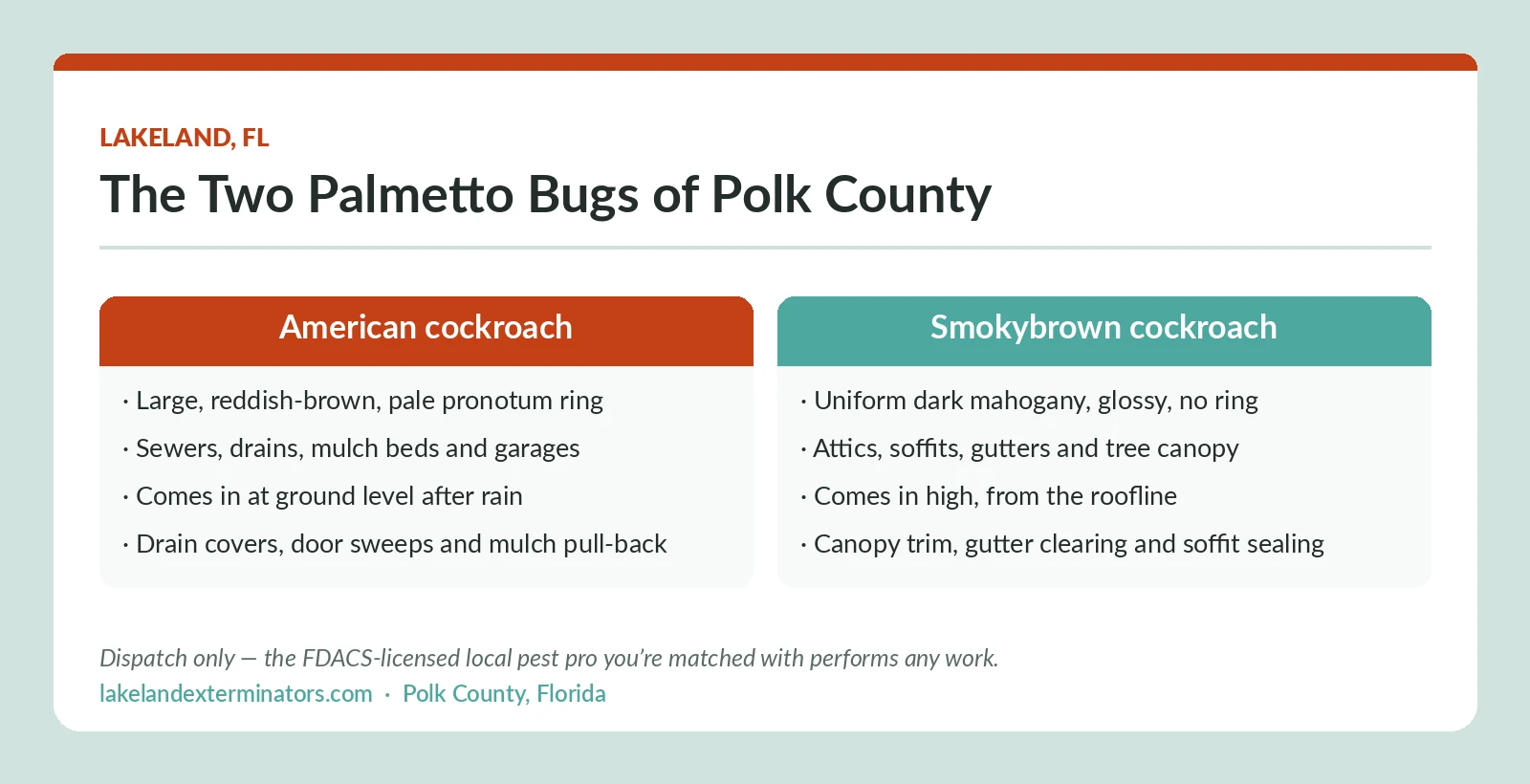
American cockroach
Periplaneta americana. The big reddish-brown one — up to two inches — that glides off the wall at you. Breeds in sewer laterals, water meter boxes, mulch beds and palm boots. Comes indoors when rain floods its harborage or drought sends it hunting water. The classic after-rain bathroom-floor visitor.
Smokybrown cockroach
Periplaneta fuliginosa. Slightly smaller, uniformly dark mahogany, moisture-dependent. Lives in tree holes, canopy litter, soffits and gutters — heavily wooded Lakeland lots are its habitat. Attracted to lights, which is why it shows up on the lanai screen at night.
Neither species wants to live in your kitchen — that is the crucial difference from the German cockroach, which breeds indoors and needs a completely different program. Big + occasional + near a door or drain = palmetto. Small + numerous + in the cabinets = German. The roach overview covers the full lineup.
Seeing them weekly instead of yearly? The perimeter is open.
One call reaches a licensed, local exterminator who covers your address — and a real person answers, 24/7.
Free to call. Free to get matched. The licensed operator gives the quote.
Why Lakeland is palmetto bug paradise
The moisture never leaves
Thirty-eight named lakes inside the city keep ambient humidity high year-round, and the mature oak-and-palm canopy over Lakeland’s established neighborhoods — Dixieland, Lake Morton, Lake Hollingsworth, Beacon Hill — drops the leaf litter and holds the moisture these roaches breed in. Add mulched landscape beds and irrigation, and the average South Lakeland yard is carrying palmetto bug habitat on all four sides of the house.
The rain-flush cycle
Summer rain bands flood sewer laterals and saturate mulch, flushing American cockroaches toward higher, drier ground — your garage, your lanai, your bathroom (they climb pipes and enter through dry drain traps). This is why sightings spike after storms, and why the rainy-season spike is a pattern, not bad luck. Homes that go weeks without running water in a guest bathroom should pour a cup of water down those drains monthly — a dry P-trap is an open door.
What the licensed program hits
Exterior perimeter treatment on a schedule, granular bait in mulch and palm boots, dust in weep holes and void entries, and exclusion — door sweeps, garage seals, screening attic and soffit vents. Indoors gets targeted crack-and-crevice work only where needed. One-off indoor sprays are the least effective thing you can buy against an outdoor-breeding species; the yard pressure just resupplies.
How the palmetto bug dispatch works
Straight up: Lakeland Exterminators is a dispatch and matching service, not a licensed pest control operator. Here is the exact path your call takes.
Describe what you found
How often, where they show up, wooded lot or open yard, after-rain pattern or constant — it all shapes the program. A real person answers around the clock.
Your address picks the operator
The call routes to an FDACS-licensed operator covering your part of Polk County — Lakeland, Winter Haven, the Ridge, all of it.
Licensed inspection on site
The operator confirms the species, walks the perimeter for harborage and entry points, and writes the quote. Pricing comes from them, never from us.
Treatment stays with the pro
Perimeter program, exclusion recommendations, any recurring plan — all owned by the licensed operator under Chapter 482, Florida Statutes.
Verify before you hire — any Florida pest control company’s license status is public at the FDACS license search. Check the operator you are matched with; the good ones expect it.
Related guides: palmetto bug species profile · German vs palmetto comparison · recurring plan costs.
Palmetto bug questions, answered straight
Does one palmetto bug mean I have an infestation?
No. A big roach walking in after a storm is Florida working as designed. The signal worth acting on is frequency — weekly sightings, multiples in one night, or finding them in the same spot repeatedly means a harborage close to (or inside) the structure and an entry point worth sealing.
Why do they always show up in the bathroom?
Plumbing. American cockroaches travel sewer laterals and climb pipes; a dry drain trap in a rarely used bathroom is an unguarded gate. Keep traps wet, and if sightings continue, the operator will check the lateral line and vent stack access points.
What does palmetto bug treatment cost in Lakeland?
Set by the licensed operator after inspection — lot size, harborage load and plan cadence move the number, and one-off knockdowns price differently than quarterly perimeter programs. We do not set or publish prices. The cost guide explains the categories.
Can they fly? One came at my face.
Sort of — American cockroaches glide and flutter, badly, usually downward from a wall toward light or motion. It feels like an attack; it is bad piloting. Smokybrowns fly a bit better and are drawn to porch lights, which is why warm-spectrum bulbs reduce nightly visitors.
Will mulch removal fix it?
It helps more than most single steps — pulling mulch back 12–18 inches from the foundation and thinning dense beds removes prime harborage. But canopy litter, palm boots and sewer access remain, which is why the durable answer pairs habitat cleanup with a perimeter program.
One number. Real perimeter expertise. The line answers now.
Free to call. Free to get matched. The licensed operator gives the quote.
Free to call. Free to get matched. The licensed operator gives the quote.
Disclosure
Lakeland Exterminators is a dispatch and matching service. We connect Polk County callers with FDACS-licensed structural pest control operators. We are not a licensed pest control operator. We do not perform pest control work, set prices, issue warranties, or carry pest control trade insurance. All pricing, scheduling, treatment plans, warranties and service terms are determined by the FDACS-licensed operator dispatched to your address under Chapter 482, Florida Statutes.
Same-day and 24/7 emergency services are subject to provider participation, location, technician availability, and demand. Availability is not guaranteed and may vary by market and appointment capacity.
License status of any operator you connect with is publicly verifiable at the FDACS license search.