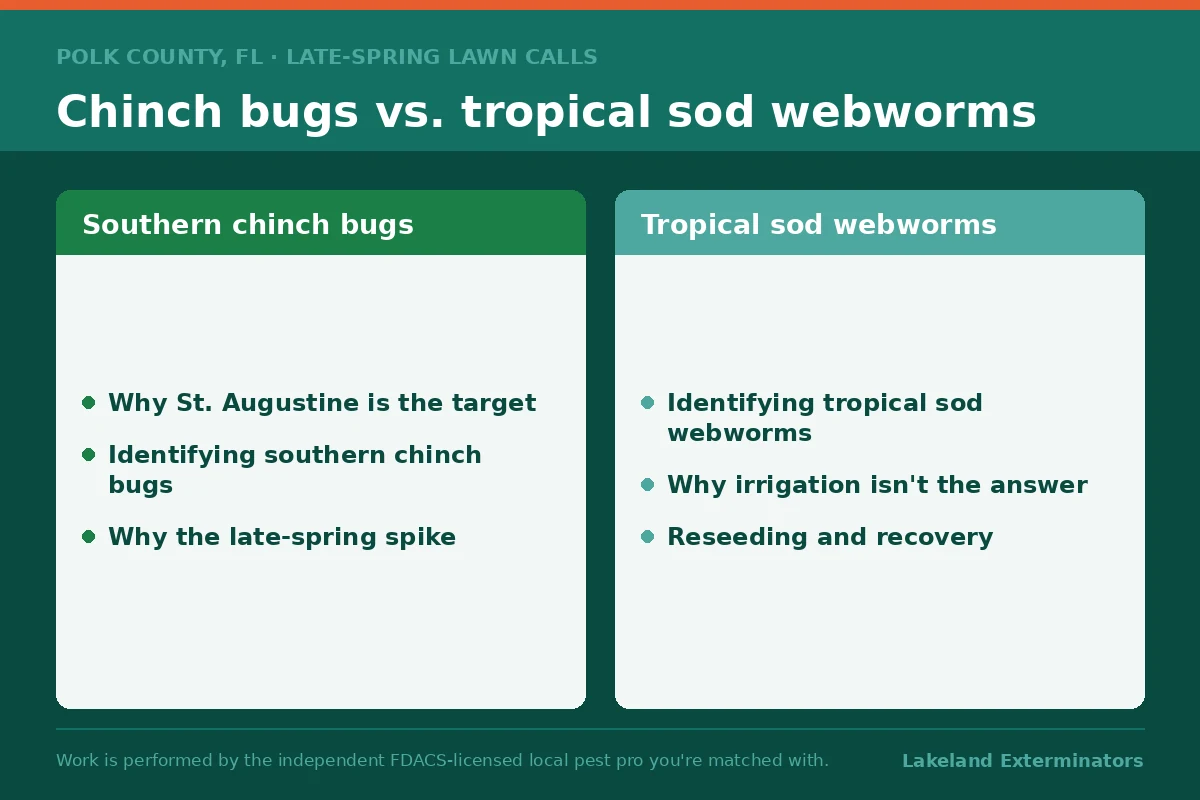
Drive around Lakeland in late May or June and you’ll see the same pattern in lawn after lawn: tan or yellow patches starting at sidewalks and driveways, expanding inward. Some of those patches are drought. Some are fertilizer burn. But in Polk County, the most common cause of late-spring lawn die-off is southern chinch bugs (Blissus insularis), and the second is tropical sod webworms (Herpetogramma phaeopteralis). Both peak in May-June in Polk County, both kill St. Augustine grass quickly, and both are routinely misdiagnosed as irrigation problems.
Dealing with a pest problem right now?
📞 Call now — get matched with a licensed local exterminator: (888) 295-0220When you call, stay on the line for a few seconds while we match you with the licensed local exterminator for your area. Have your address and a quick description of the problem ready.
Licensed local pros · Fast response, subject to availability · No obligation
This is an informational guide. Lawn pest treatment in Lakeland and Polk County is performed by independent, FDACS-licensed Florida Lawn & Ornamental companies. For the common household pests our Polk County dispatch line currently covers, see pest control in Polk County.
Why St. Augustine is the target
The dominant turfgrass across Polk County residential lawns is St. Augustinegrass — Floratam variety in older established lawns, Bitter Blue in some shadier lots, and the newer Palmetto and CitraBlue varieties in recent installs. St. Augustine has two characteristics that make it a chinch bug magnet:
- Thick stolons — The horizontal runners create humid, dense canopy at the soil line where chinch bugs thrive.
- Lake Wales Ridge sandy soils — Well-drained sand holds heat and dries the upper inch quickly, exactly the conditions chinch bugs prefer.
Bahia, Bermuda, and Zoysia turf are less susceptible. But the typical Polk County lot is St. Augustine, and the typical Polk County lawn problem in June is chinch bugs.
Identifying southern chinch bugs
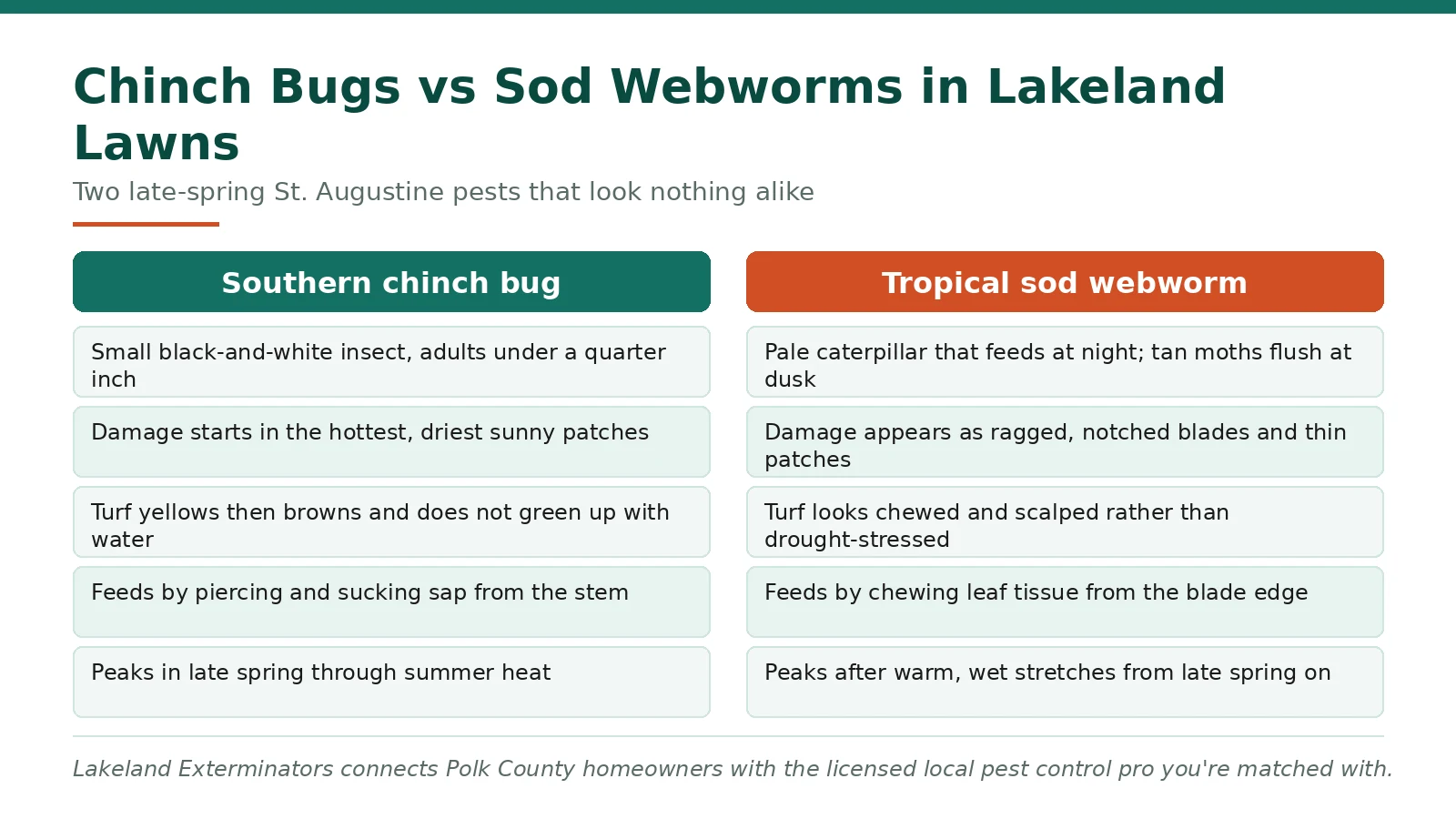
Chinch bugs are tiny — adults are about 1/8 inch long, black with white wing markings. Nymphs are red-orange. You can spot them with the float test:
- Cut both ends off a coffee can or large food can.
- Push one end firmly into the lawn at the edge of a fading patch (where green grass meets dying grass — chinch bugs concentrate at the active front, not in the dead zone).
- Fill the can with water and watch for 5 minutes.
- Chinch bugs float to the surface.
If you see 10+ chinch bugs in the floated water, you have a problem. The damage threshold in St. Augustine is roughly 25 chinch bugs per square foot, but by the time you see surface damage, populations are usually well above that.
Photos and the float test methodology are also covered on the lawn pest control — Lakeland page.
Identifying tropical sod webworms
Sod webworms cause similar-looking damage but they’re a moth larva, not a bug. The differences:
- Damage pattern — Webworms create irregular notched edges on grass blades (caterpillar feeding); chinch bugs cause whole-blade die-off (sap feeding).
- Timing — Sod webworms appear later than chinch bugs, peaking in mid-summer through fall.
- Adult moth — At dusk, you’ll see small (1/2 inch) tan-brown moths flying low over the grass. They’re depositing eggs.
- Frass — Sod webworm caterpillars leave small green pellet droppings at the soil line.
- Caterpillars themselves — 1 inch, greenish-gray, hide in the thatch during day, feed at night.
If you can pull back a patch of dying grass and find green caterpillars in the thatch, you have sod webworms, not chinch bugs.
Why the late-spring spike
Three factors converge in Polk County’s May-June window:
- Soil temperature crosses 70°F consistently — Chinch bug reproduction accelerates.
- Rainfall slows before the rainy season fully kicks in — Lawns stress just as pest pressure builds.
- Homeowners fertilize for summer green-up — Heavy nitrogen creates lush tender growth that chinch bugs prefer.
The classic Polk County pattern is a lawn that looked great through April, gets fertilized Memorial Day weekend, and shows expanding tan patches within 2-3 weeks. By the time the homeowner notices, populations are well past treatment threshold.
Why irrigation isn’t the answer
The number-one Polk County DIY response to chinch bug damage is “water more.” This doesn’t work. Chinch bugs do prefer dry conditions, but the irrigation needed to actually suppress them — 1+ inch every 2 days — wastes water, runs counter to Florida-friendly landscape guidance, and triggers other problems (fungal disease, fertilizer leaching). Worse: in many Polk County subdivisions with irrigation restrictions, you can’t legally irrigate enough to make a difference.
The correct response is targeted insecticide treatment to threshold, then resumed normal lawn care.
What lawn pest treatment actually involves
Professional lawn pest control in Polk County for chinch bug / sod webworm pressure typically uses:
- Bifenthrin or fipronil targeted to active infestation zones — Not blanket-spray; focused on the active feeding front.
- Granular formulation watered in — Better long-term residual than liquid for soil-level pests.
- Re-treatment at 21-30 days if pressure is heavy — Many chinch bug populations rebuild within a month if only one treatment is applied during peak season.
Polk County 2026 pricing:
| Service | Relative Cost Level | Notes |
|---|---|---|
| Single-service chinch bug spot treatment | Lowest | Small lawn, contained infestation |
| Lawn pest treatment (whole property, single visit) | Moderate | Standard half-acre Polk County lot |
| Quarterly lawn pest control program | Low (recurring) | Includes preventive + targeted |
| Annual lawn pest + fertilization program | Highest (annual bundle) | All-in-one with lawn care companies |
Reseeding and recovery
If chinch bug damage went unaddressed and you have dead patches over 6 square feet, treatment alone won’t restore the lawn — you need sod plugs or sod patches. Most Polk County St. Augustine sod installation runs at a moderate per-square-foot rate in 2026. The math sometimes favors treating the infestation, killing the bugs, and then letting healthy adjacent turf grow back into small patches over 4-6 weeks — but only if patches are under ~3 feet across.
One related nuisance worth ruling out during recovery: soft, grub-rich turf recovering from heavy chinch bug or sod webworm pressure can also draw armadillos rooting overnight for grubs and insects, which shows up as small conical digging rather than the tan die-off pattern described above. If that’s what you’re seeing alongside your lawn pest damage, our armadillo removal in Polk County page covers that separately.
Lakeland-specific lawn pest patterns
Some Polk County submarkets see heavier-than-average lawn pest pressure:
- Lakeland Highlands — Ridge sand drainage means lawns dry quickly; chinch bug heaven. Pest control — Lakeland Highlands.
- Plant City — Strawberry-industry runoff and lighter soils combine for elevated lawn pest pressure. Pest control — Plant City.
- Auburndale, Mulberry, Bartow — Citrus-edge subdivisions, heavier outdoor insect pressure generally. Pest control — Auburndale | Bartow | Mulberry.
- Davenport, Haines City — STR-heavy, often absentee owners; chinch bug damage frequently advanced by the time it’s noticed. Pest control — Davenport.
Frequently asked questions
How fast can chinch bugs kill a Lakeland lawn? At peak summer pressure, untreated chinch bug infestations can move from “small tan patch” to “8-foot dead zone” in 2-3 weeks in St. Augustine turf on Polk County sand.
Are chinch bugs harmful to pets or kids? No — chinch bugs don’t bite humans or pets. The treatment products used (bifenthrin, fipronil) dry within 1-2 hours and are safe for pet/child re-entry after dry-down per label.
What lawn type is least susceptible in Polk County? Bahia and Zoysia are significantly less susceptible than St. Augustine. However, both have other tradeoffs (Bahia is coarser; Zoysia has higher water needs in establishment). Most Polk County HOAs require St. Augustine, so this option isn’t always available.
Should I treat preventively or wait for damage? Most Polk County lawn care programs include preventive lawn pest applications spring and fall. If you don’t have a program, monitor monthly during May-August with the float test in any suspect area. Preventive is cheaper than reactive.
Will chinch bugs damage Bahia lawns? Rarely. Chinch bugs strongly prefer St. Augustine. Bahia lawns occasionally see other pests (mole crickets, especially), but chinch bug damage on Bahia is uncommon.
Next steps
If you’ve got expanding tan patches and you’ve already ruled out irrigation, an inspection by an FDACS-licensed Lawn & Ornamental company in Polk County confirms whether chinch bugs or sod webworms are driving the damage and what treatment fits.
Related Polk County lawn reading:
- Lawn pest control — Lakeland
- Flea yard treatment — Lakeland
- Tick control — Lakeland
- June pest control — Polk County
- Pest control complete guide — Lakeland
Disclaimer: Lakeland Exterminators is a local dispatch and referral service, not a licensed pest-control operator. We connect Polk County, Florida homeowners with independent, FDACS-licensed and insured pest-control companies. All inspections and treatments are performed by those independent providers, who set their own pricing, scheduling, and service terms.
Any reference to same-day, emergency, or 24/7 service describes the typical scheduling of matched independent providers and is not guaranteed; actual response times vary by provider, season, location, and demand.