Polk County Wildlife
Dealing with a pest problem right now?
📞 Call now — get matched with a licensed local exterminator: (888) 295-0220When you call, stay on the line for a few seconds while we match you with the licensed local exterminator for your area. Have your address and a quick description of the problem ready.
Licensed local pros · Fast response, subject to availability · No obligation
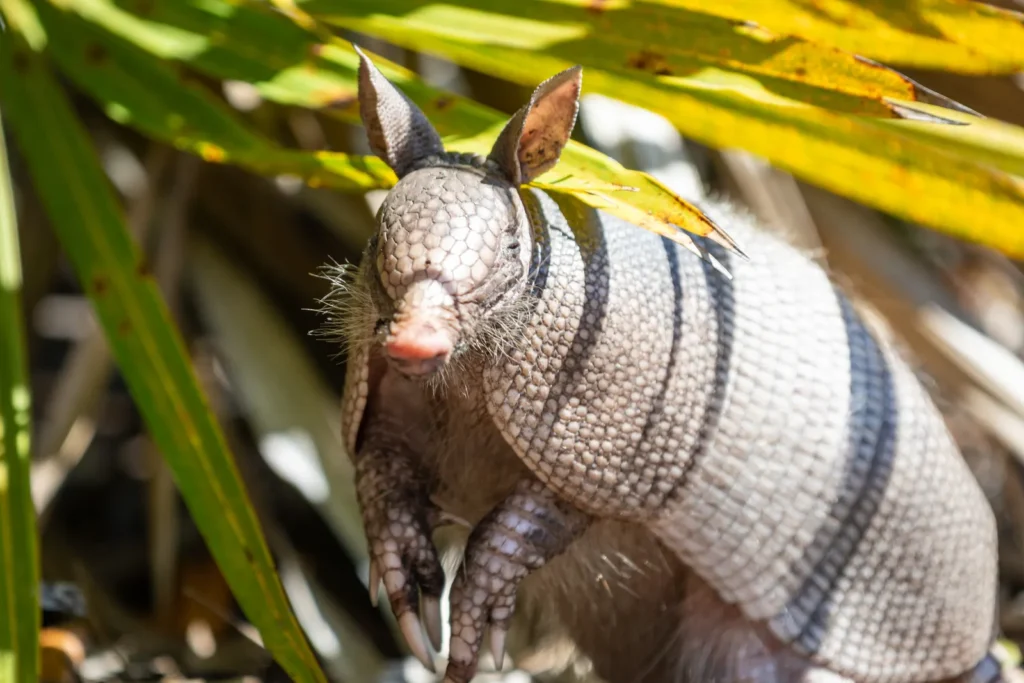
Waking up to fresh cone-shaped holes punched across your Polk County lawn, or a collapsed flower bed overnight? That’s almost always the nine-banded armadillo rooting for grubs in Central Florida’s sandy soil. They don’t bite, but they wreck turf, undermine slabs, and dig burrows fast. Here’s how licensed removal works here.
Why armadillos love Polk County yards
The nine-banded armadillo is not native to Florida — it expanded into the state through the twentieth century and is now established statewide — and Polk County happens to offer close to ideal conditions. Armadillos dig, and digging is easy here: the sandy, well-drained soils of the Central Florida ridge, the reclaimed and disturbed ground across the county’s old phosphate lands, and the loose, irrigated topsoil of a maintained lawn are all far easier to work than heavy clay.
They are also digging for something specific. Armadillos are insectivores whose diet is dominated by grubs, earthworms, beetle larvae, ants, and other soil invertebrates. They have poor eyesight and hunt almost entirely by smell, rooting through the top few inches of soil where those invertebrates live. This is the single most important fact about controlling them: an armadillo tearing up your lawn is telling you your lawn has a healthy population of soil insects. A yard with a significant white grub or mole cricket population is a reliable, renewable food source, and it will keep attracting animals even after the current one is gone.
Irrigation compounds it. A well-watered St. Augustine lawn holds soft, moist soil and abundant invertebrates through periods when unirrigated ground is dry and hard, which concentrates foraging onto exactly the turf homeowners care most about. Rain does the same thing temporarily, which is why damage often appears in bursts after the wet season storms.
The damage that brings homeowners to this page
Lawn and bed rooting
The classic signature is shallow, cone-shaped or funnel-shaped holes an inch or two across and a few inches deep, punched across turf overnight, often accompanied by flipped-over sod, uprooted bedding plants, and disturbed mulch. Unlike mole tunnels, which run as raised ridges just under the surface, armadillo damage is a series of discrete digs. If you are seeing raised surface ridges rather than holes, you may be looking at a different animal — see mole damage: tunnels and ridges.
Burrows and structural undermining
This is the part that actually costs money. Armadillo burrows are substantial — typically seven to eight inches in diameter and capable of running many feet with multiple entrances — and armadillos habitually site them under cover: beneath concrete slabs and porches, under AC condenser pads, along driveway and sidewalk edges, beneath pool decks and screen enclosure footers, under sheds, and into the sides of retention slopes. Over time that excavation removes support from beneath the slab or pad above it, and settlement, cracking, and tilting follow. Burrows against a foundation also create a channel that directs water where it should not go.
Secondary problems
Burrow systems get reused by other animals once the armadillo moves on, and open burrows around a pool cage or deck are a trip and equipment hazard. Damage to irrigation lines and low-voltage landscape wiring from digging is common.
Treat the food source, not just the animal
Removing one armadillo from a yard with a heavy grub population usually buys a season at most. Armadillos are solitary and have overlapping home ranges, so a vacated, well-stocked yard gets found again. A durable outcome pairs removal with reducing what it is eating — which means addressing the soil-insect population in the turf. That is a lawn-pest question as much as a wildlife one; see lawn pest control in Lakeland. It is also why armadillo damage frequently shows up on the same properties dealing with fire ants and other soil-active insects.
Why repellents and home remedies do not solve it
There is no repellent product with a track record of reliably keeping armadillos out of a yard. Mothballs, castor oil, ammonia rags, predator urine, ultrasonic stakes, and cayenne are all recommended constantly online and none of them holds up in practice against an animal that is hungry, has poor eyesight, works at night, and is following scent to a food source. Some of them — mothballs in particular — are also being used contrary to their label, which is both ineffective and a legal problem.
Physical exclusion, by contrast, does work when it is done properly, because armadillos dig under barriers rather than climb them. Fencing intended to exclude armadillos has to extend below grade and ideally angle outward at the base; a fence that simply meets the ground is an invitation. Around specific structures — a shed, a deck, a pool equipment pad, a screen enclosure footer — buried hardware cloth skirting is usually more practical and more effective than trying to fence a whole property.
How licensed removal works
Inspection first
A competent visit identifies active burrows (as distinct from abandoned ones), maps travel routes, and confirms the animal is actually an armadillo rather than a mole, a raccoon, feral hogs, or a dog. It should also assess whether burrows have compromised anything structural, because that changes the urgency and may bring in a separate trade.
Trapping
Armadillos are notoriously hard to bait, precisely because they hunt live soil invertebrates by smell rather than seeking out food in the open. Effective trapping therefore relies on placement and funnelling rather than lure: traps set flush at active burrow entrances or along a natural travel edge such as a fence line or foundation wall, with wing boards angled to funnel the animal into the trap opening. Trap sets that ignore this and simply put a baited cage in the middle of the lawn are the usual reason a homeowner’s DIY attempt fails for weeks.
Disposition, and why the law matters here
What happens to a live-trapped animal is regulated in Florida. The Florida Fish and Wildlife Conservation Commission’s nuisance-wildlife rules constrain relocation — you generally cannot simply drive a trapped animal across the county and release it — and a licensed operator works within those requirements. This is one of the clearest reasons to use a licensed professional rather than handle it yourself: they are accountable for doing the disposition lawfully and humanely, and they will tell you what the current rules require.
Exclusion and repair
The work is not finished when the animal is gone. Burrows should be collapsed and filled once confirmed inactive, and the entry points that made the property attractive — open skirting under a shed or deck, an unscreened gap at a slab edge, a gap under a screen enclosure — should be closed with buried hardware cloth or equivalent. For broader wildlife work on the property, see wildlife removal in Lakeland.
Do not handle armadillos
Armadillos are not aggressive and do not bite people in any meaningful sense, but they are the only non-human animal known to naturally carry Mycobacterium leprae, the bacterium that causes Hansen’s disease, and Florida reports a small number of locally acquired human cases each year. The absolute risk from casual proximity is very low, and there is no reason for alarm about an armadillo crossing your yard. The sensible precaution is simply not to handle armadillos, live or dead, not to let dogs engage them, and to wear gloves if you must move a carcass — which is also a good reason to let a licensed operator do the handling.
What to expect on timing
Armadillo work is rarely a one-visit job. Trapping takes time because it depends on the animal’s own movement pattern, and a set may need repositioning once the operator sees where the animal is actually travelling. Multiple animals on a property are possible, especially where there is good cover and a strong food source. A realistic plan runs over days rather than hours, and includes a return to confirm burrows are inactive before they are filled.
Get matched with a licensed Polk County armadillo pro
Lakeland Exterminators is a dispatch and matching service, not a licensed pest control or wildlife operator. We do not trap, treat, price, or warranty the work. Tell us what you are seeing — the damage pattern, where the burrows are, and whether anything structural is involved — and we route it to an independent, licensed Florida company that handles armadillo work in Polk County. That company inspects and sets its own scope, pricing, and terms. For the full county picture, start at pest control in Polk County.
Polk County armadillo FAQs
Are armadillos dangerous to my family or pets?
They are not aggressive and are not a biting or attacking risk. The one real caution is that armadillos are the only non-human animal known to naturally carry the bacterium that causes Hansen’s disease, and Florida reports a small number of locally acquired cases each year. Absolute risk from casual proximity is very low; the sensible precaution is simply not to handle armadillos, live or dead, and to keep dogs from engaging them.
Why is an armadillo digging up my Polk County lawn?
It is hunting soil invertebrates — grubs, earthworms, and beetle larvae — by smell, and your lawn has them. Irrigated turf in Polk County’s sandy soil stays soft and holds a healthy invertebrate population, which makes it far easier and more productive digging than unirrigated ground. The damage is a symptom of the food supply underneath.
Do repellents or home remedies actually work on armadillos?
No. Mothballs, castor oil, ammonia, predator urine, ultrasonic stakes, and cayenne have no reliable record against armadillos, and some are being used contrary to their product label, which is a legal problem as well as an ineffective one. Physical exclusion works because armadillos dig under barriers rather than climb them, so a barrier has to extend below grade.
Can armadillo burrows damage my house?
Yes, and this is the expensive part. Burrows run roughly seven to eight inches across and are habitually sited under cover — beneath slabs, porches, AC condenser pads, driveway edges, pool decks, screen enclosure footers, and sheds. Sustained excavation removes support from what sits above, producing settlement and cracking, and a burrow against a foundation also channels water where it should not go.
How long does removal take?
Usually days rather than hours. Trapping depends on the animal’s own movement pattern, sets often need repositioning once the operator sees the actual travel route, and more than one animal may be present where cover and food are good. A complete job also includes returning to confirm burrows are inactive before they are collapsed and filled.
Why is bait not working in my trap?
Because armadillos hunt live soil invertebrates by smell rather than seeking food in the open, they bait poorly. Effective trapping relies on placement rather than lure — traps set flush at active burrow entrances or along a travel edge such as a fence line or foundation wall, with wing boards angled to funnel the animal in. A baited cage in the middle of the lawn is the usual reason a DIY attempt runs for weeks.
Can I just trap it and release it somewhere else?
Not freely. What may lawfully be done with a live-trapped animal in Florida is governed by the Fish and Wildlife Conservation Commission’s nuisance-wildlife rules, which constrain relocation, so driving an animal across the county and releasing it is not an open option. A licensed operator works within those requirements and is accountable for handling disposition lawfully and humanely.
Will another armadillo just move in?
It can, and that is the usual reason a yard has repeat problems. Armadillos are solitary with overlapping home ranges, so a vacated property with a strong soil-insect population gets found again. Pairing removal with reducing the grub and soil-insect population in the turf, plus closing off attractive harborage under sheds and decks, is what makes the result last.
Last reviewed August 2026 · reviewed on a quarterly cycle. Lakeland Exterminators is a dispatch and matching service that connects Polk County homeowners with independent, licensed Florida pest-control and wildlife companies; we are not a licensed operator and do not perform trapping or treatments ourselves.
Disclaimer: Lakeland Exterminators is a local dispatch and referral service, not a licensed pest-control operator. We connect Polk County, Florida homeowners with independent, FDACS-licensed and insured pest-control companies. All inspections and treatments are performed by those independent providers, who set their own pricing, scheduling, and service terms.
Any reference to same-day, emergency, or 24/7 service describes the typical scheduling of matched independent providers and is not guaranteed; actual response times vary by provider, season, location, and demand.