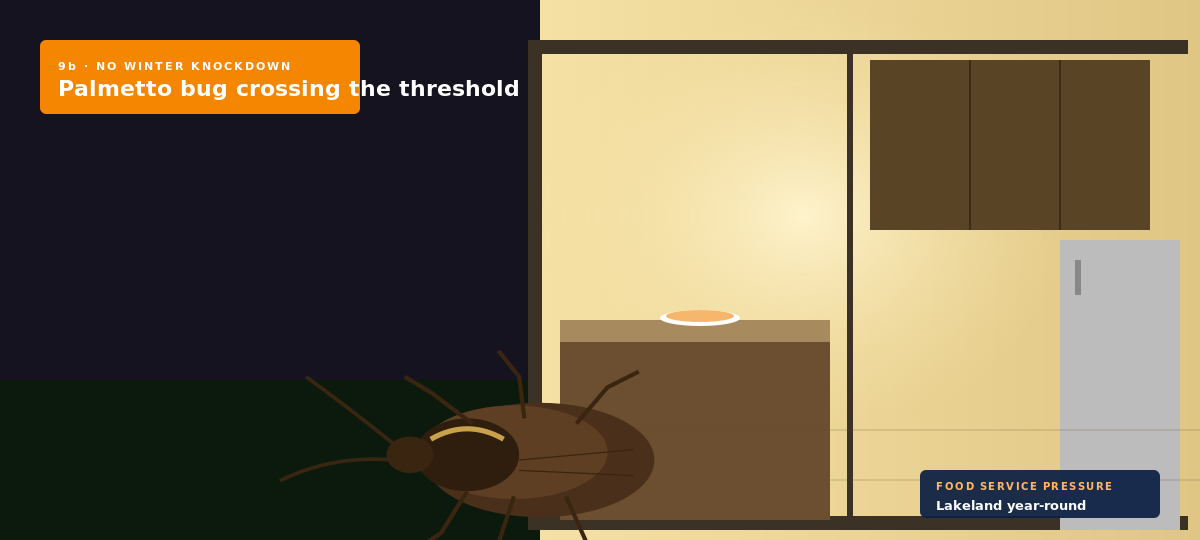
Seeing small light-brown roaches scatter when you flip on the kitchen light at night in your Lakeland home? That’s the German cockroach — a different animal from the big “palmetto bug” that wanders in from the yard. German roaches live and breed indoors, multiply explosively, and won’t clear with a can of spray. Here’s how real control works and how to get matched with a licensed pro.
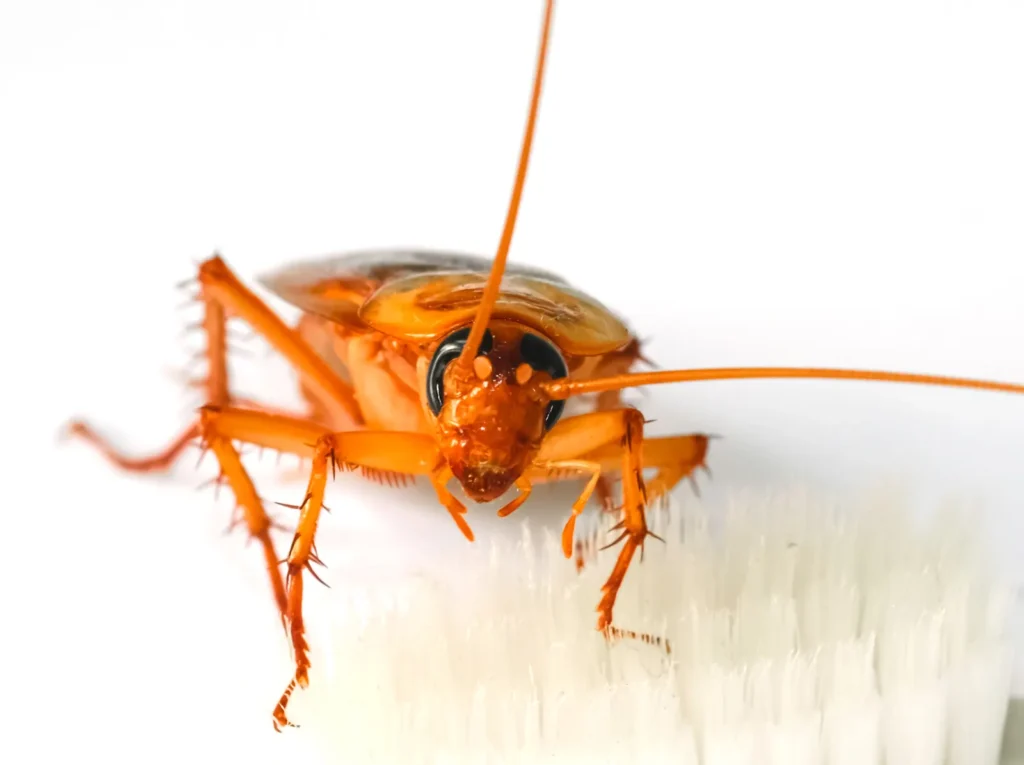
Get matched with a Lakeland roach control pro
One call reaches a licensed, local exterminator who covers your address — and a real person answers, 24/7.
German roach vs. palmetto bug — why it matters
Almost every roach conversation in Lakeland starts with a misidentification, and getting it right changes everything about what happens next. These are two fundamentally different animals with different biology, different entry stories, and completely different treatment approaches.
The German cockroach
Small — about half an inch — light brown to tan, with two dark parallel stripes running lengthwise behind the head. It is an indoor obligate: it does not live in your yard and it did not wander in from the mulch. It lives, breeds, and dies inside the building, concentrated in kitchens and bathrooms because it needs warmth, moisture, and food within a short distance of harborage. If you flip on the kitchen light at night and small light-brown roaches scatter for the gap beside the dishwasher, that is this species.
The American cockroach and friends
The insect Floridians call a palmetto bug is usually the American cockroach — an inch and a half or more, reddish-brown, and a strong flier. Along with the smokybrown and Florida woods roach, it is an outdoor animal that lives in mulch, leaf litter, palm skirts, tree holes, sewers, and crawl spaces, and comes indoors incidentally, often through a drain, a gap under a door, or a soffit. See palmetto bugs in Lakeland for how that problem is handled, because it is largely an exterior and exclusion job.
The distinction is the whole game. Outdoor roaches are managed with exclusion, harborage reduction, and perimeter work. German roaches are managed indoors, with baiting, growth regulators, and sanitation — and treating one as if it were the other is the most common reason a roach problem never resolves.
Why German roaches multiply so fast
The reproductive arithmetic explains the panic homeowners feel. A female produces an egg case containing roughly thirty to forty eggs, and unlike most roaches she carries it until just before hatching, which protects it from almost anything applied to surfaces. Development from egg to reproducing adult takes on the order of a few months in warm indoor conditions — and every home in Lakeland is warm indoor conditions year-round. Generations overlap, so a population that looks like “a few roaches” contains a large hidden reservoir of nymphs and egg cases in voids you cannot see.
They also stay close to home. German roaches typically harbor within a short distance of food and water, which is why activity concentrates in a predictable set of places: the motor compartment and door gasket of the refrigerator, under and behind the dishwasher, the void beneath the sink, the hinges and undersides of cabinet doors, the gap between the countertop backsplash and the wall, small appliances that stay plugged in and warm, and the underside of the kitchen table. That predictability is what makes professional treatment effective — the harborage is findable.
How they got into a clean house
German roaches are carried in, not attracted in. The routine vectors are grocery bags and cardboard boxes, secondhand or delivered appliances, furniture, moving boxes from a previous address, and shared walls and plumbing chases in multi-family housing. Cleanliness is not what determines whether they arrive — it determines how fast they build once they do, because sanitation controls how much food and water is available to support the population. Blaming the household is both wrong and unhelpful; the productive question is where the introduction came from and whether it is ongoing.
Why a can of spray makes it worse
This is the single most consequential mistake, and it happens in most homes before anyone calls a professional. Over-the-counter aerosol and residual sprays are largely repellent products. Applied around a kitchen, they do three destructive things:
- They scatter the population. Roaches flushed out of a treated harborage do not die there — they disperse into adjacent voids, wall cavities, adjoining rooms, and in multi-family housing into neighbouring units. A contained kitchen problem becomes a whole-unit problem.
- They contaminate bait placements. Gel bait works because roaches eat it and carry the active ingredient back into the harborage, where it also affects nymphs through feeding on faeces and dead insects. Spray residue on or near a bait placement makes roaches avoid it, and a professional arriving after a spray campaign is often working around a kitchen where bait will simply be refused.
- They do nothing to egg cases. Because the female carries the ootheca until hatch, surface residue does not reach the eggs. What looks like success is a lull before the next generation emerges.
There is a further wrinkle worth knowing: some German cockroach populations have developed glucose aversion, a heritable behavioural resistance in which roaches reject the sugars used in bait matrices. If a home has been baited and the bait is being ignored, that is a real possibility and it changes product selection. See German cockroaches in Lakeland for more on how that shows up locally.
How licensed control breaks the cycle
Inspection and monitoring
The job starts by finding harborage and establishing a baseline. Sticky monitors placed at wall-floor junctions, behind and under appliances, and inside cabinet voids tell a technician where the population actually is and, on the follow-up, whether it is declining. Without monitors, “it seems better” is the only available measure, which is not enough.
Gel baiting
Precisely placed gel bait in harborage and travel areas is the backbone of modern German roach control, because it exploits their own behaviour to carry the active ingredient into voids that no application can reach directly. Placement quality matters far more than volume — many small placements in the right cracks beat a heavy application in the wrong place.
Insect growth regulators
An IGR disrupts development so nymphs cannot mature into reproducing adults. It does not produce a dramatic overnight drop, which is exactly why it is valuable: it collapses the next generation while baiting removes the current one. This is the component most often missing from a DIY attempt.
Vacuuming, sanitation, and exclusion
Physical removal of insects, egg cases, and faecal deposits reduces the population immediately and removes the aggregation pheromone that draws roaches to established harborage. Sanitation targets the resources: grease behind and under the range, crumbs in cabinet corners, pet food left out, and — often decisive — moisture from a dripping trap, a sweating supply line, or a damp cabinet base. Sealing gaps around plumbing penetrations, at the backsplash, and along cabinet kick plates removes harborage permanently.
Follow-up
Because of the egg-case biology, a single visit is rarely the whole job. A realistic program runs over several weeks with at least one follow-up timed to address newly emerged nymphs, with monitors read each visit to verify the trend.
The multi-family problem
In an apartment, duplex, or condo, German roaches move between units through shared plumbing chases, wall voids, and outlet boxes. Treating one unit in isolation frequently fails because the population retreats next door and returns. If you rent, raise this with the property manager early — Florida Statute 83.51(2)(a) requires the landlord of a dwelling unit other than a single-family home or duplex to make reasonable provisions for extermination of roaches during the tenancy, and coordinated treatment across adjoining units is usually what the problem actually requires.
The health angle
German cockroaches are a recognised indoor allergen source. Cockroach allergens from faeces, shed cuticle, and body fragments become part of household dust and are a well-documented asthma trigger, with the strongest evidence in children and in dense housing. They also mechanically carry bacteria across surfaces from the places they forage. This is a legitimate reason to treat an infestation as a household health issue rather than a purely cosmetic annoyance — and a reason that thorough cleanup of faecal deposits, not just killing insects, is part of a competent job.
For the broader range of pests Lakeland homes deal with, see exterminator services in Lakeland.
Lakeland German roach FAQs
How is a German roach different from a palmetto bug?
They are different animals with different treatment. German roaches are about half an inch, light brown with two dark stripes behind the head, and live and breed exclusively indoors in kitchens and bathrooms. The palmetto bug is usually the American cockroach — an inch and a half or more, reddish-brown, and a strong flier that lives outdoors in mulch, palm skirts, and drains and comes in incidentally. Outdoor species are an exclusion and perimeter problem; German roaches are an indoor baiting problem.
Why do store-bought sprays make German roaches worse?
Because most are repellent products. They scatter the population out of treated harborage into wall voids, adjoining rooms, and in multi-family housing into neighbouring units; they contaminate areas where gel bait would otherwise be accepted, causing roaches to refuse it; and they do not reach egg cases, because the female carries the ootheca until just before hatching. The apparent improvement is a lull before the next generation.
How did German roaches get into a clean Lakeland home?
They are carried in rather than attracted in — grocery bags and cardboard, secondhand or delivered appliances, furniture, moving boxes from a previous address, and shared walls and plumbing chases in multi-family housing. Cleanliness does not determine whether they arrive; it determines how quickly they build once they do, because sanitation limits the food and water available to support them.
How many treatments will it take?
More than one, essentially always. Because females carry egg cases until just before hatching, surface treatments do not reach eggs, so a realistic program runs over several weeks with at least one follow-up timed to address newly emerged nymphs. Sticky monitors read at each visit are what tell you whether the population is actually declining rather than just seeming quieter.
Can German roaches make my family sick?
They are a recognised indoor allergen source. Allergens from faeces, shed cuticle, and body fragments become part of household dust and are a well-documented asthma trigger, particularly for children and in dense housing. They also mechanically carry bacteria from where they forage onto surfaces. That is why thorough cleanup of faecal deposits, not just killing insects, is part of competent treatment.
I baited and the roaches ignored it. What now?
That can be glucose aversion — a heritable behavioural resistance in which some German cockroach populations reject the sugars used in bait matrices. It is real and documented, and it means the answer is a different bait formulation rather than more of the same. It is also a good reason to have a licensed technician select product rather than continuing to buy retail bait that the population has already learned to refuse.
I live in an apartment. Will treating just my unit work?
Often not. German roaches move between units through shared plumbing chases, wall voids, and outlet boxes, so a population can retreat next door during treatment and return afterward. Florida Statute 83.51(2)(a) requires the landlord of a dwelling unit other than a single-family home or duplex to make reasonable provisions for roach extermination during the tenancy, so raise it with the property manager early.
Where should I look to confirm I have them?
Check the warm, moist, tight places within a short distance of food and water: the refrigerator motor compartment and door gasket, under and behind the dishwasher, the void beneath the sink, cabinet door hinges and undersides, the gap between backsplash and wall, small appliances left plugged in, and the underside of the kitchen table. Look for live insects, dark faecal specks that look like ground pepper, and shed skins.
Break the breeding cycle
Tell us your address and where you’re seeing them. We’ll match you with a licensed, insured Lakeland company to schedule an inspection.
Last reviewed August 2026 · reviewed on a quarterly cycle. Lakeland Exterminators is a dispatch and matching service that connects Polk County homeowners with independent, FDACS-licensed pest-control companies; we are not a licensed pest control operator and do not perform treatments ourselves.
Disclaimer: Lakeland Exterminators is a local dispatch and referral service, not a licensed pest-control operator. We connect Polk County, Florida homeowners with independent, FDACS-licensed and insured pest-control companies. All inspections and treatments are performed by those independent providers, who set their own pricing, scheduling, and service terms.
Any reference to same-day, emergency, or 24/7 service describes the typical scheduling of matched independent providers and is not guaranteed; actual response times vary by provider, season, location, and demand.