Pest problem in Eagle Lake? Get matched with a licensed operator who works the shoreline blocks.
One call reaches a licensed, local exterminator who covers your address — and a real person answers, 24/7.
Talk to a licensed exterminator now
Call and we’ll connect you with a licensed, local exterminator who covers your address. It takes about two minutes, and a real person answers.
Free to call. Free to get matched. The licensed operator gives the quote.
24/7 line · A real person answers · Availability of same-day and emergency service depends on the provider.
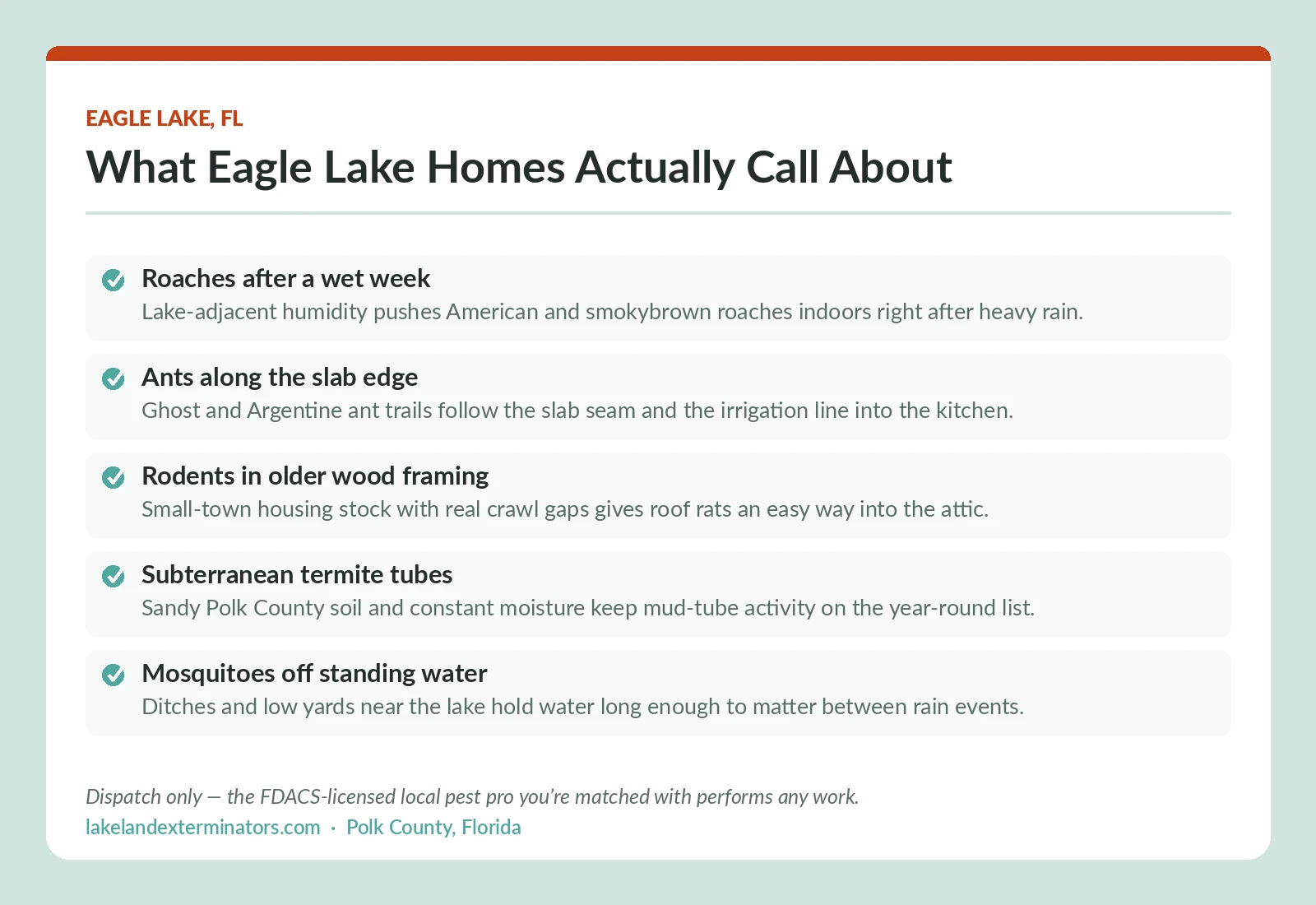
What Eagle Lake homes actually call about
Palmetto bugs off the shoreline
Lake McLeod keeps the humidity where American and smokybrown cockroaches want it. Harborage loads up in oak litter, palm boots and meter boxes, and after every summer rain band the big roaches walk plumbing penetrations into kitchens and bathrooms.
Subterranean termites in the old blocks
The mill-era streets carry decades of subterranean history — moist shoreline soil, older slabs and pier foundations, and mature landscaping that keeps the ground damp. Mud tubes on a stem wall here are a call-this-week finding.
Roof rats in the oak canopy
Mature oaks and remnant citrus overhang rooflines all over town — a roof rat highway straight to the eave line. Fall and winter bring the scratching-overhead calls; exclusion plus trap-out is the sequence that actually ends them.
Ants — new-build and established
Fresh-cleared subdivision land pushes displaced ant colonies into new homes for their first seasons, while ghost ants trail through established kitchens near the water. Species ID decides the bait — and whether the fix holds.
Roaches after the rain? Scratching overhead? That is enough to call.
One call reaches a licensed, local exterminator who covers your address — and a real person answers, 24/7.
Free to call. Free to get matched. The licensed operator gives the quote.
Why Eagle Lake pest pressure punches above the town’s size
1. Everything is close to the water
Eagle Lake is barely two square miles, and almost every street sits within easy reach of Lake McLeod or one of the smaller lakes and wetlands stitched between here and Winter Haven. That proximity keeps ambient humidity high year-round — which stocks palmetto bug harborage, keeps earwigs, centipedes and millipedes moving after rain, and holds soil moisture at the level subterranean termite colonies need to feed twelve months a year. There is no dry-season reprieve on the shoreline blocks; pest biology just keeps running.
2. Mill-town wood is old wood
Eagle Lake grew up around rail and citrus a century ago, and its oldest housing stock shows it — frame construction, original soffits, pier foundations and add-on slabs. That profile carries both termite species: subterranean colonies working up from damp shoreline soil and drywood swarmers drifting into attic vents May through August. If an older Eagle Lake home has never had a WDO evaluation, that is the highest-leverage call its owner can make — before the next repaint hides the evidence an inspector reads.
3. New subdivisions reset the board
The growth running down US-17 toward Bartow is bringing Eagle Lake its first big wave of new construction in decades. Land clearing displaces everything that lived there first: ant colonies re-target new slab lines and irrigation, rodents and snakes work through adjacent yards for a season or two, and new landscaping watered daily creates exactly the moist soil band subterranean termites forage. New-build owners should treat year one as the pest settling-in period and get ahead of it rather than react to it.
The Eagle Lake seasonal calendar
| Season | What picks up | What you will see |
|---|---|---|
| February – May | Subterranean termite swarms; spring ant flush | Wings on sills after warm rain; mud tubes at slab joints and piers; new fire ant mounds in open turf. |
| May – August | Drywood swarms; peak roach season begins | Evening swarmers at porch lights; palmetto bugs indoors after rain bands. |
| June – September | Palmetto bugs, earwigs, millipedes at peak | Big roaches up plumbing penetrations; occasional invaders at slab edges, lanais and pool decks. |
| October – February | Roof rats and attic wildlife | Dusk scratching overhead; droppings in attics; activity along oak-limb roof contact points. |
How getting matched works
Call the dispatch line
33839 routes to operators who actually cover the Eagle Lake–Winter Haven corridor, not whoever is nearest a Lakeland exchange.
A real person answers, 24/7
Describe what you are seeing — roaches after rain, wings, tubes, attic noise. Shoreline homes should say so; moisture context changes the inspection.
An FDACS-licensed operator takes it
The call routes to an independent, licensed and insured Polk County operator. Verify any company at the FDACS license search — thirty seconds, free, and honest companies expect it.
The operator inspects and quotes
Pricing, scheduling, treatment plans and any warranty or bond come from the licensed operator — never from us. You owe nothing until you accept their quote.
Straight up: Lakeland Exterminators is a dispatch and matching service, not a licensed pest control operator. Nearby coverage: Winter Haven, Bartow, Cypress Gardens, all of Polk County.
Eagle Lake pest questions, answered straight
What does pest control cost in Eagle Lake?
Set by the licensed operator after inspection — pest type, structure, severity and plan cadence move the number, and shoreline moisture honestly affects the recommendation. We do not set or publish prices. The Polk County cost guide explains what drives each category.
Why do giant roaches keep showing up inside after it rains?
Heavy rain floods the harborage American cockroaches live in — mulch, oak litter, palm boots, sewer laterals — and they climb to dry ground, which means up plumbing penetrations and under door sweeps. One roach after a storm is weather; a pattern of them means harborage close to the slab. An operator will treat the perimeter band and point out the harborage worth removing. The roach guide covers the details.
Does a lakefront home need termite protection even if it is newer?
Newer construction starts with a pre-construction soil treatment, but those degrade over years, and shoreline soil moisture is exactly what subterranean colonies forage. Find the treatment certificate from closing, then ask the operator what renewal or a bond looks like for your slab. The bond guide explains the products.
Are the companies this line routes to actually licensed?
Yes — structural pest control in Florida legally requires an FDACS license under Chapter 482, and termite work requires the WDO category specifically. Verify any company at the FDACS license search before you sign anything.
Oak limbs touch my roof — does that really matter for rats?
It is the single most common roof rat entry setup in town. Limb-to-roof contact is a highway; rats follow it to the eave line and find or make a gap. Trim the contact points back, then have the operator inspect the eave line and quote exclusion — trapping without sealing just schedules the next round.
One ZIP. One call. A licensed operator who knows Eagle Lake.
Free to call. Free to get matched. The licensed operator gives the quote.
Free to call. Free to get matched. The licensed operator gives the quote.
Disclosure
Lakeland Exterminators is a dispatch and matching service. We connect Polk County callers with FDACS-licensed structural pest control operators serving Eagle Lake, Winter Haven, Lakeland and the surrounding Polk County area. We are not a licensed pest control operator. We do not perform pest control work, set prices, issue warranties, or carry pest control trade insurance. All pricing, scheduling, treatment plans, warranties and service terms are determined by the FDACS-licensed operator dispatched to your address under Chapter 482, Florida Statutes.
Same-day and 24/7 emergency services are subject to provider participation, location, technician availability, and demand. Availability is not guaranteed and may vary by market and appointment capacity.
License status of any operator you connect with is publicly verifiable at the FDACS license search.