Little Havana’s walkups have housed a century of arrivals. The buildings’ shared walls and shared plumbing mean pest control here is a building skill, not an apartment skill.
Between the Miami River and Coral Way, Calle Ocho anchors one of the densest runs of pre-war and mid-century multifamily housing in Florida: two- and three-story walkups, converted houses, corner mixed-use buildings with apartments over restaurants. Density is the pest math. German cockroaches move through shared kitchen walls and plumbing chases, making a single untreated unit the engine for a whole floor. American roaches ride century-old sewer laterals up through the buildings after every rainy-season soak. Drywood termites have been mining the pre-war roof framing and window casings for generations, and alley rat populations work the restaurant corridor’s waste stream nightly. For tenants, that stack of facts comes with rights; for owners, with obligations; for both, with a playbook that actually works. The dispatch line matches all of it with FDACS-licensed operators who know multifamily protocol cold.
Talk to a live dispatch coordinator now
Roaches in the cabinets that survive every spray, pellets from a ceiling pinhole, a landlord who is not responding — describe it and get matched with a licensed operator working Little Havana.
(888) 295-0220Tap to call — 24/7 dispatch
Free to call. Free to get matched. The licensed operator you’re matched with gives the quote.
24/7 line · A real person answers · Availability of same-day and emergency service depends on the provider.
Need pest control in Little Havana, Miami? Call (888) 295-0220 and a dispatch coordinator matches you with an FDACS-licensed operator serving 33125, 33130 and 33135 — German roach building protocols, drywood termite inspection in pre-war stock, rodent exclusion for walkups and mixed-use buildings, and documented multifamily treatment. Lakeland Exterminators is a dispatch service: the licensed local operator inspects, treats and quotes.
Why does one untreated unit defeat a whole building’s effort?
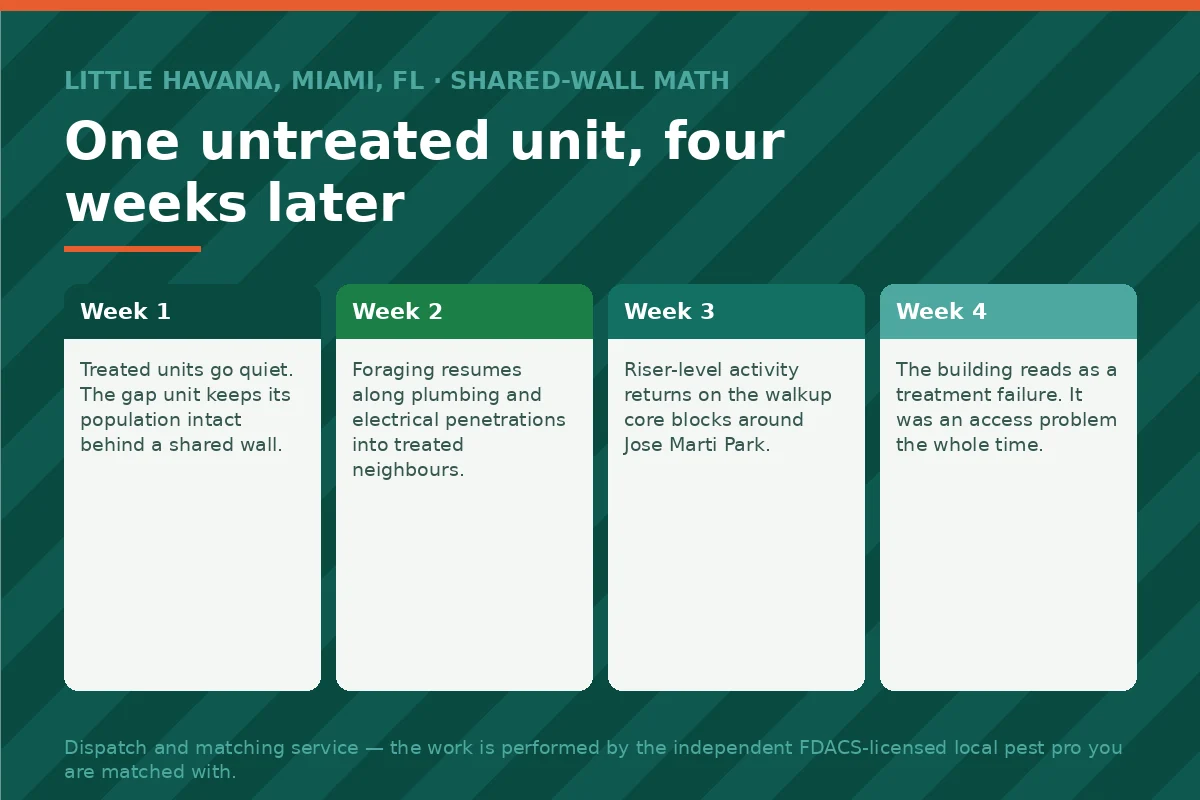
Because the building, not the apartment, is the roach’s territory. German cockroaches follow warmth, moisture and food odor along the plumbing chases and wall voids that every unit on a riser shares — a colony behind one kitchen’s cabinets seeds the units above, below and beside it within weeks. That is why the spray-my-unit-only cycle fails on repeat: treated apartments recolonize from the neighbor, tenants conclude treatment does not work, and the building settles into permanent infestation. The protocol that breaks the cycle treats the riser as the unit: licensed inspection across connected apartments, gel bait and growth regulator at harborage in the infested core, preventive placements in adjacent units, and a follow-up timed to egg hatch. Buildings that run it annually stay quiet; buildings that spot-spray stay busy.
Tenants hold more cards than they often hear. Florida law generally obligates landlords of multifamily housing to exterminate roaches and rodents; the tenant’s lever is the written, dated report — ideally with photos and a taped specimen — which starts the legal clock and documents the condition. A landlord who responds inside a week is normal; silence for a month is when the statute’s remedies and the code-enforcement route become relevant. Either way, the specimen matters: German roach versus American roach changes the entire prescription.
What is each part of Little Havana dealing with?
- Calle Ocho restaurant corridor (33130, 33135): the waste stream feeds alley rats and keeps American roach pressure high in shared laterals — mixed-use buildings need commercial-grade exclusion.
- Riverside & the Miami River edge (33125, 33130): older frame and masonry stock with the neighborhood’s deepest drywood termite layering in roof framing and casings.
- Shenandoah border blocks (33135, 33145): converted single-family rentals — German roach introductions ride tenant turnover; move-in inspections pay.
- The walkup core around Jose Marti Park (33130): shared-wall density at its highest — riser-level treatment protocol is the only thing that holds.
- Flagler Street corridor (33125, 33130): apartments over storefronts — after-hours kitchen heat and moisture pull building-wide populations toward residential floors.
- Marlins Park orbit (33125): redevelopment construction scatters established rat and roach populations into surrounding blocks for a season at a time.
What should owners of pre-war buildings watch beyond roaches?
The wood and the walls. Little Havana’s pre-war stock carries some of Miami’s oldest continuous drywood termite exposure — colonies in roof framing, floor joists and window casings announce themselves with pellet piles and, during April-to-July dusk swarms, with wings inside units. For a multifamily owner the stakes compound: a fumigation decision means coordinating tenant relocation building-wide, so early detection via periodic attic-and-casing inspections is worth real money — catching a colony while targeted injection is still honest can defer a tent for years. Rodents run the same compounding logic: rats entering one roofline gap patrol every unit’s ceiling void, and exclusion — hardware cloth, flashing, sealed utility penetrations — is a per-building cost that beats per-unit complaints indefinitely. The operators the dispatch line matches for these calls work buildings, not just bedrooms: written findings, unit-by-unit documentation, and treatment sequencing a landlord can schedule around occupancy.
Call the line
Tap (888) 295-0220 any hour. Describe the evidence, whether you rent, own or manage, and your ZIP — 33125, 33130 or 33135.
Get matched to the building
Riser-level roach protocols, drywood inspections and building exclusion route to multifamily operators; single-unit and house calls route to residential specialists.
A licensed operator takes over
An independent, FDACS-licensed and insured operator working Little Havana inspects, documents and treats. No obligation — the dispatch call costs nothing.
Third spray this year and the roaches are back again?
That is a building problem wearing an apartment costume. The line answers 24/7 and matches you with a licensed operator who treats risers, not just rooms.
One tap. One call. Matched.
(888) 295-0220Tap to call — 24/7 dispatch
Free to call. The licensed operator gives the quote.
Little Havana pest questions, answered straight
My landlord ignores my roach reports — what are my options?
Are the big roaches after rain the same problem as the small kitchen ones?
We found wings inside in June — how urgent is that?
What does pest control cost in Little Havana?
Disclosure
Lakeland Exterminators is a pest control dispatch and referral service, not a licensed pest control operator. All pest inspections, treatments and quotes in Little Havana are performed by independent pest control operators licensed by the Florida Department of Agriculture and Consumer Services (FDACS) and insured in their own name. Calling the dispatch line is free and creates no obligation; the licensed local operator you’re matched with sets their own pricing and terms.
More Miami help: Pest control in Miami, Miami roach control, Miami termite inspection, Pest control in Westchester · Rental property pest guide · All pest control services