Port Orange runs from salt marsh to fly-in hangars in about four miles — and every mile writes a different pest problem.
Daytona’s quiet neighbor covers more ecological ground than cities three times its size. The eastern edge sits against Rose Bay and the Spruce Creek estuary — genuine salt-marsh mosquito country, where a spring tide or tropical rain can hatch a brood that rides the sea breeze into every backyard in 32127. The middle belt is classic Volusia suburbia: the 1980s-2000s subdivisions off Dunlawton and Taylor Road, nearly all of them now past their builder termite pretreat’s useful life. And the western reach holds one of Florida’s oddest housing stocks — the Spruce Creek Fly-In, where homes come with aircraft hangars, and hangars come with everything a rodent wants: warmth, clutter lanes, wiring and quiet. The dispatch line matches Port Orange homes with FDACS-licensed operators who know which of the three cities-within-a-city they are driving into.
Talk to a live dispatch coordinator now
Dusk swarms off the marsh, wings by the slider in spring, droppings along the hangar wall — describe it and get matched with a licensed operator working Port Orange.
(888) 295-0220Tap to call — 24/7 dispatch
Free to call. Free to get matched. The licensed operator you’re matched with gives the quote.
24/7 line · A real person answers · Availability of same-day and emergency service depends on the provider.
Need pest control in Port Orange, FL? Call (888) 295-0220 and a dispatch coordinator matches you with an FDACS-licensed operator serving 32127, 32128 and 32129 — termite inspection and barrier renewal for the subdivision belt, marsh-aware mosquito programs on the eastern edge, garage and hangar rodent exclusion, and roach and ant work citywide. Lakeland Exterminators is a dispatch service: the licensed local operator inspects, treats and quotes.
What can and cannot be done about salt-marsh mosquitoes?
Honesty first: the salt-marsh species that breed in Rose Bay and the Spruce Creek margins are a public-scale phenomenon. Their eggs bank in marsh mud, hatch by the million on flooding tides, and the adults fly miles — which is why Volusia County’s mosquito control program (impoundment management, aerial larviciding, truck routes) is the tool that matches the source, and why no yard treatment can promise a marsh-free evening after a big brood. What private-side work does control is everything else, and everything else is most nights: the container-bred Aedes living within a hundred yards of your patio — bromeliads, saucers, gutters, toys, tarps — and the Culex line in any swale or ditch that has stopped draining. A licensed program audits and kills those sources with Bti larviciding, treats the resting vegetation where adults wait out the day, and times revisits to the rain cycle. The result on a marsh-edge street: the background hum drops to livable, the brood nights get shorter, and the screened porch does the rest. Operators who promise more than that next to an estuary are selling weather.
What is each part of Port Orange actually dealing with?
- Eastern edge — Allandale, Harbor Oaks, the Rose Bay margin (32127): salt-marsh brood pressure plus older cottage stock with open soffits; screening discipline and exclusion carry more weight than chemistry here.
- The Dunlawton subdivision belt (32127, 32129): 1980s-90s homes at full barrier expiry — spring swarms and slab-joint mud tubes are the annual evidence; verification inspections are overdue on original-condition homes.
- Waters Edge & the 2000s wave (32128): pretreats crossing the expiry line now; pond-margin mosquito and new-sod fire ant arcs run the yard-level pressure.
- Spruce Creek Fly-In (32128): hangar homes — a hangar is a rodent paradise (warmth, clutter, quiet, wiring) and aircraft wiring shares cars’ vulnerability to chew damage; hangar exclusion and monthly trap checks belong in the ownership routine.
- Sweetwater & canal-adjacent streets: moist-soil termite pressure and waterline rat traffic — the marine checklist (dock lines, cover tension, sealed deck boxes) applies inland here.
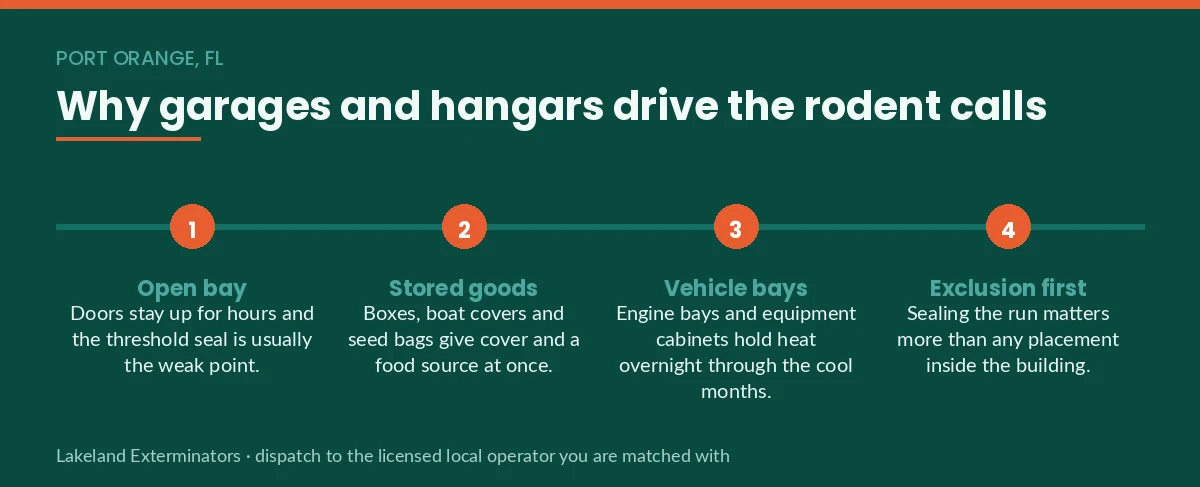
Why do garages and hangars drive the rodent calls here?
Because Port Orange’s housing waves came with big enclosed spaces — two- and three-car garages in the subdivision belt, full aircraft hangars at Spruce Creek — and enclosed, lightly trafficked space is exactly what rodents select for. The pattern repeats: entry under a garage door whose sweep no longer touches the slab, or through the gap where hangar wall panels meet the foundation; nesting in stored boxes, seasonal decorations and shop rags; and gnawing on whatever wiring runs nearest — car harnesses, golf cart chargers, avionics. The fix is the same discipline at any scale: sweeps and thresholds renewed so daylight disappears, wall-base gaps sealed with metal and hardware cloth, storage lifted onto racks so floor sightlines exist, snap traps on the wall lines checked on a schedule, and no poison inside enclosed spaces — a carcass behind a hangar wall or garage shelving unit is a weeks-long problem nobody enjoys. For the Fly-In specifically: treat the hangar as part of the house on every inspection scope, because to the rats it is the best room in the house.
Call the line
Tap (888) 295-0220 any hour. Describe what you are seeing and which Port Orange you are in — marsh edge, subdivision belt or Fly-In.
Get matched to the problem
Termite verification, marsh-aware mosquito programs and garage or hangar exclusion route to different specialists — the coordinator matches the right one.
A licensed operator takes over
An independent, FDACS-licensed and insured operator working Port Orange inspects, quotes and treats. No obligation — the dispatch call costs nothing.
Backyard fine all week — then unusable two nights after the high tide?
The line answers 24/7 and matches you with a licensed operator who knows a marsh brood from a yard problem — and treats the one that can be treated.
One tap. One call. Matched.
(888) 295-0220Tap to call — 24/7 dispatch
Free to call. The licensed operator gives the quote.
Port Orange pest questions, answered straight
Why are the mosquitoes worst two or three nights after a storm or big tide?
Our 1992 house near Dunlawton has never been re-treated. How urgent is that?
Something is chewing in the hangar — does aircraft wiring really attract rodents?
What does pest control cost in Port Orange?
Disclosure
Lakeland Exterminators is a pest control dispatch and referral service, not a licensed pest control operator. All pest inspections, treatments and quotes in Port Orange are performed by independent pest control operators licensed by the Florida Department of Agriculture and Consumer Services (FDACS) and insured in their own name. Calling the dispatch line is free and creates no obligation; the licensed local operator you’re matched with sets their own pricing and terms.
More Volusia County help: Pest control in Daytona Beach, Daytona Beach termite treatment, Pest control in DeLand · Mosquito dispatch guide · All pest control services