Gainesville has two roach problems on two calendars: German roaches that ride the August lease cycle, and smokybrown roaches that drop out of the oak canopy all year.
Every August, tens of thousands of leases turn over in the same two weeks, and with them moves the largest volume of used furniture, secondhand mini-fridges and packed boxes anywhere in North Florida. German cockroaches — the small, fast-breeding indoor species — travel exactly that way, which is why September is Gainesville’s heaviest roach-complaint month in the student corridors. Meanwhile the city’s signature heritage oaks run a completely different pipeline: smokybrown roaches live in tree holes, palm boots and gutters full of leaf litter, and they come indoors at soffit height — a canopy problem no kitchen bait will ever fix. The dispatch line matches Gainesville tenants, landlords and homeowners with FDACS-licensed operators who treat the right species with the right playbook.
Talk to a live dispatch coordinator now
Small roaches in the kitchen a week after move-in, or big ones appearing near ceilings after rain — describe it and get matched with a licensed operator working Gainesville.
(888) 295-0220Tap to call — 24/7 dispatch
Free to call. Free to get matched. The licensed operator you’re matched with gives the quote.
24/7 line · A real person answers · Availability of same-day and emergency service depends on the provider.
Need roach control in Gainesville, FL? Call (888) 295-0220 and a dispatch coordinator matches you with an FDACS-licensed operator serving 32601, 32603, 32605 and 32608 — species identification first, then gel baiting with insect growth regulator for German roaches or exclusion-and-habitat work for smokybrowns, with the follow-up visit that makes it stick. Lakeland Exterminators is a dispatch service: the licensed local operator inspects, treats and quotes.
Why does the August lease cycle drive German roach season?
Because German cockroaches do not walk in from the yard — they are couriered in. A single gravid female riding a secondhand microwave carries an egg case with dozens of nymphs; sixty days later a quiet kitchen is a breeding population behind the fridge. Multiply that by a city where the majority of near-campus units change hands in one two-week window, and you get the September spike operators see every year in the corridors off University Avenue, SW 13th Street, Archer Road and the complexes of 32608. Shared walls finish the job: in a garden-style building, a heavy unit seeds its neighbors through plumbing chases and outlet voids, which is why treating one apartment in isolation keeps failing no matter how good the product is.
The fix that works is boring and specific: crack-and-crevice gel baiting matched to current bait-aversion realities (part of Florida’s German roach population has evolved glucose aversion — a licensed operator rotates bait matrices instead of hammering one), an insect growth regulator to collapse the breeding curve, and a follow-up visit timed to the egg-hatch cycle. Foggers do the opposite of all of that — they scatter roaches deeper into voids and adjacent units, and contaminate surfaces so baits stop working.
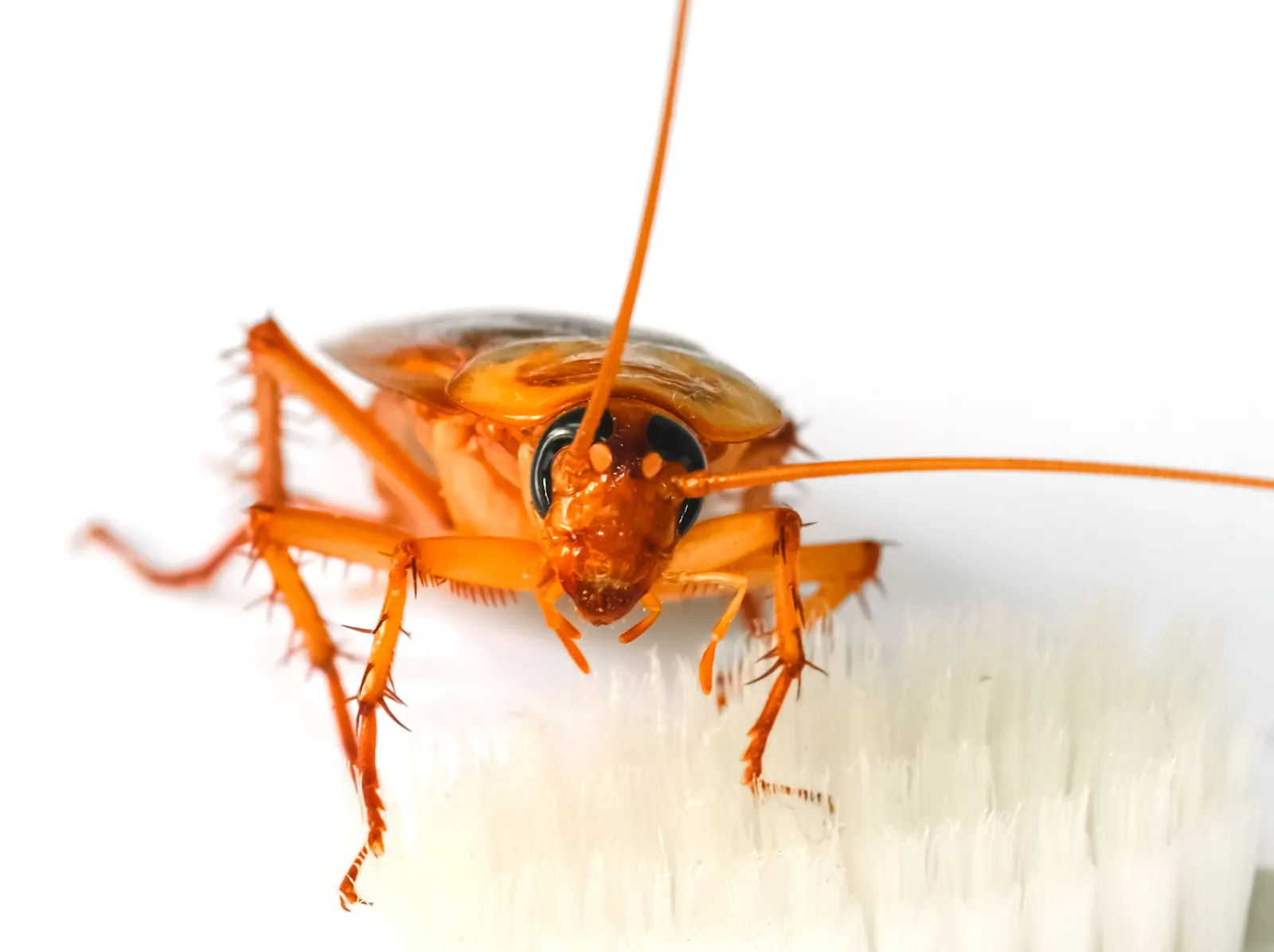
What is the smokybrown roach, and why does the canopy matter?
The smokybrown is North Florida’s big outdoor roach — mahogany-dark, an inch and a half long, and a tree-dweller. Gainesville’s celebrated live oak canopy, from the Duckpond’s historic streets to the wooded lots of northwest 32605, keeps colonies in tree holes, ivy mats, gutters and palm boots. They enter homes high — soffit vents, attic gaps, the joint where a porch roof meets the wall — especially after summer rain drives them out of saturated harborage. Residents meet them at night on a ceiling or bathroom wall and call them palmetto bugs; the label matters less than the playbook. Kitchen gel bait does nothing for a species that lives in your trees. What works: sealing the high entry points, clearing gutters and leaf litter, moving firewood and ivy off the structure, and a perimeter treatment focused on harborage lines rather than a blanket yard spray. In the Duckpond and Pleasant Street historic districts, crawl-space ventilation and skirting condition are part of the same conversation — moist crawl spaces are American roach and smokybrown harborage at the foundation line.
- Student corridors (32601, 32603, SW 13th & Archer Road): German roach pressure on the lease cycle; building-level baiting beats unit-by-unit whack-a-mole.
- Duckpond & Pleasant Street (32601): pre-war homes with crawl spaces under heavy canopy — smokybrown and American roach pressure at both soffit and foundation.
- Northwest Gainesville (32605, 32606): wooded-lot smokybrowns; gutters and tree contact decide how many reach the attic.
- Southwest complexes (32608): high-turnover multifamily — document unit condition at move-in and move-out; it settles deposit disputes and triggers timely treatment.
- Haile Plantation and newer stock: lighter interior pressure, but irrigation and mulch depth still set the perimeter roach line.
Who handles treatment in a Gainesville rental — tenant or landlord?
Florida practice puts extermination of an established infestation in multifamily housing on the landlord in most standard leases, while tenants own sanitation and prompt reporting. In a college rental market that split gets tested every September. The workable protocol: tenants report in writing with photos the week roaches appear (not month three), landlords schedule a licensed operator rather than handing over a can of spray, and both sides keep the paper — the inspection finding, the treatment date, the follow-up. Landlords who bait proactively during August turnover, while units are empty and kitchens are bare, spend less than landlords who treat occupied units in October; empty-unit treatment is faster, more thorough and does not require coordinating four roommates’ schedules.
Call the line
Tap (888) 295-0220 any hour. Say what you are seeing, where, and whether it is a rental, a house or a whole building.
Get matched to the problem
German roach baiting programs, smokybrown exclusion work and multifamily building protocols route to different specialists — the coordinator matches the right one.
A licensed operator takes over
An independent, FDACS-licensed and insured operator working Gainesville inspects, identifies the species, quotes and treats. No obligation — the dispatch call costs nothing.
Flipped on the kitchen light and watched them scatter?
The line answers 24/7 and matches you with a licensed operator who knows which Gainesville roach you have — and which playbook kills it.
One tap. One call. Matched.
(888) 295-0220Tap to call — 24/7 dispatch
Free to call. The licensed operator gives the quote.
Gainesville roach questions, answered straight
Small roaches in the kitchen two weeks after move-in — did we bring them?
Are the giant roaches on the ceiling the same problem as the small kitchen ones?
Our whole building has them — can one unit actually get clean?
What does roach control cost in Gainesville?
Disclosure
Lakeland Exterminators is a pest control dispatch and referral service, not a licensed pest control operator. All pest inspections, treatments and quotes in Gainesville are performed by independent pest control operators licensed by the Florida Department of Agriculture and Consumer Services (FDACS) and insured in their own name. Calling the dispatch line is free and creates no obligation; the licensed local operator you’re matched with sets their own pricing and terms.
More North Florida help: Pest control in Gainesville, Gainesville termite treatment, Pest control in Ocala · Roach extermination guide · All pest control services