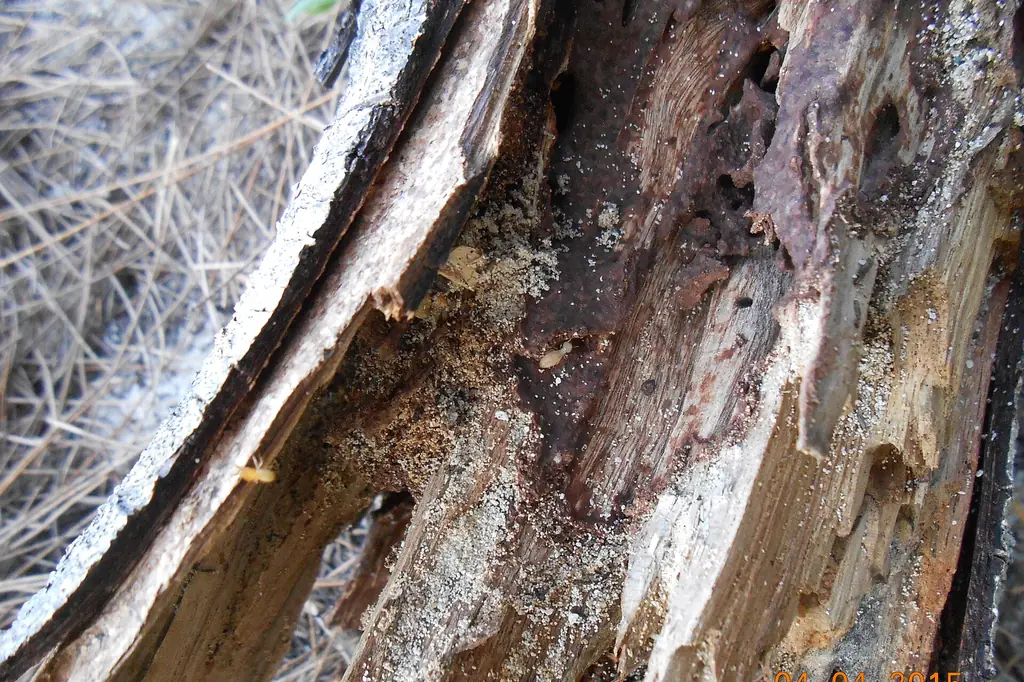
Little piles that look like coffee grounds? That’s the drywood termite calling card.
One call reaches a licensed, local exterminator who covers your address — and a real person answers, 24/7.
Talk to a licensed exterminator now
Call and we’ll connect you with a licensed, local exterminator who covers your address. It takes about two minutes, and a real person answers.
Free to call. Free to get matched. The licensed operator gives the quote.
24/7 line · A real person answers · Availability of same-day and emergency service depends on the provider.
How to identify Cryptotermes brevis
Florida is one of only four states where this species is an established structural pest, and Polk County sits squarely in its range. Four signs, in the order homeowners usually find them:
Frass pellets — the diagnostic sign
Six-sided fecal pellets about 1mm long, pushed out of the wood in dry, gritty piles that look like coarse sand or coffee grounds. Color tracks the wood being eaten — pale tan to dark brown. Fresh piles reappear days after you vacuum them. That reappearance is the confirmation.
Kickout holes
Pinpoint exit holes in the wood surface above every frass pile — the colony’s housekeeping chute. Often the only visible break in an otherwise clean-looking board, and easy to mistake for a nail hole until you find the pile below it.
Swarmers at dusk
Reddish-brown, about 7/16″ long, with two pairs of equal-length smoky-gray wings showing a distinctive arched leading vein. They fly on warm, humid evenings May through August, drawn to interior lights — wings collect around fixtures, windows and sliding doors.
Soldiers with plug-shaped heads
If a board is opened, drywood soldiers show a phragmotic head — dark, flat-fronted, plug-like, used to block gallery entrances. Smaller than subterranean soldiers, and a solid lab-grade ID feature for the inspector.
Where drywood colonies live in Polk County homes
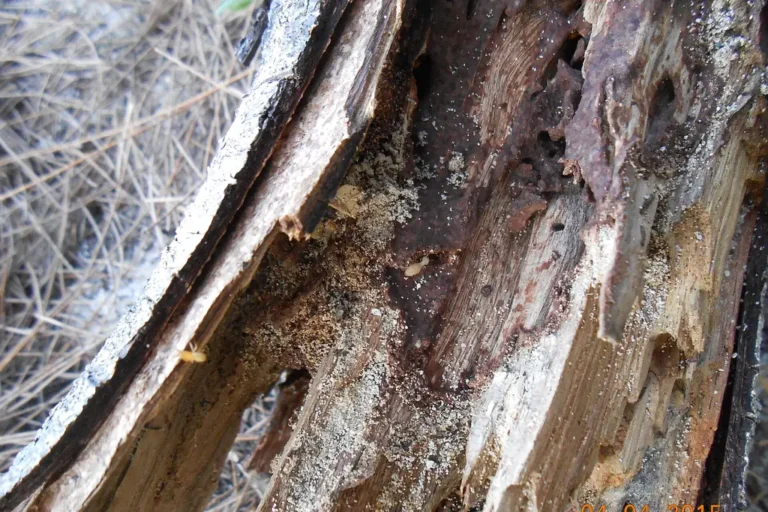
Drywood colonies live entirely inside dry, sound wood — no soil contact, no moisture source, no mud tubes. In Polk County they establish in attic rafters and trusses, fascia and soffit framing, window and door frames, baseboards and crown molding, hardwood floors and antique furniture. The Lake Wales Ridge running down the county’s spine is a documented high-pressure zone, and the vacation-rental corridor adds a second exposure route: infested wood furniture moving between properties.
Three Polk County risk multipliers worth knowing:
- Pre-1980 construction — Dixieland, South Lake Morton, the Garden District and the older cores of Winter Haven and Bartow carry decades of exposed, unpainted end grain in soffit details and attic framing.
- Ventilated attics — soffit and gable vents are the swarmers’ front door. Torn or missing insect screening converts a June evening swarm into a ten-year problem.
- Imported and antique wood — C. brevis is the classic “furniture termite”: a colony can arrive inside a dresser and swarm into the house years later.
Colony math explains the slow burn: a founding pair grows for three to five years before the colony is large enough to notice, and produces its first swarmers around year five to seven. By the time frass piles appear, the colony is usually mature — and where there is one mature colony, inspectors routinely find more.
Frass pile came back after you vacuumed it?
One call reaches a licensed, local exterminator who covers your address — and a real person answers, 24/7.
Free to call. Free to get matched. The licensed operator gives the quote.
Drywood vs. subterranean: the sixty-second sort
| Trait | Florida drywood | Eastern subterranean |
|---|---|---|
| Lives | Entirely inside dry wood — attic down | In soil — foundation up |
| Tell-tale sign | Six-sided frass pellets + kickout holes | Pencil-thin mud tubes on slab or piers |
| Swarm season | May–August, dusk, humid evenings | February–May, sunny mornings after rain |
| Swarmer look | Reddish-brown, smoky-gray wings | Dark brown-black, translucent wings |
| Moisture need | None — lives in wood at 10% moisture | Constant soil moisture contact |
| Treatment family | Fumigation, localized injection, heat | Liquid soil barrier, in-ground bait |
Both species can be active in the same Polk County house at the same time — which is one reason a licensed inspection beats guesswork. The eastern subterranean guide and Formosan guide cover the soil-dwelling side; the swarm calendar maps the whole year.
The treatment paths a licensed operator will discuss
Florida law puts termite treatment squarely with FDACS-licensed companies — fumigation additionally requires the dedicated Fumigation license category. Here is what each path involves, so the conversation makes sense when you have it.
Whole-structure fumigation — the tent
Sulfuryl fluoride gas penetrates every void in the structure, reaching colonies no inspection can fully map. The reference treatment for multi-area activity and the common answer when a closing requires a clean WDO report. Expect 24–72 hours out of the house plus aeration and clearance testing. The gas leaves no residue — ongoing protection depends on annual inspection afterward.
Localized (no-tent) treatment
Foam or liquid injection into galleries through small drill holes, plant-derived d-limonene injection, or targeted heat. Legitimate when the activity is verifiably bounded — one window frame, one accessible rafter run — and the honest operator says so plainly when it is not.
Heat treatment
Whole-room or whole-structure heating that holds core wood temperature at 130–140°F for roughly 35–60 minutes. Chemical-free and same-day re-entry, with real limits: heat sinks (tile, concrete, plumbing walls) shelter galleries, so probe-verified extent matters.
Preventive borate treatment
Borate application on exposed bare wood — during construction, renovation or post-fumigation — makes framing inhospitable to future colonies. A prevention layer, not a cure for an established infestation.
What decides the operator’s quote (we never set prices)
- Extent and mappability — a bounded single-colony pocket and a structure-wide multi-colony picture are different jobs by an order of magnitude.
- Structure volume and complexity — tenting scope scales with the cubic footage under tarp; attached lanais, pool cages and rooflines complicate the seal.
- Re-treatment terms — what the warranty covers after a tent or a spot treatment differs by operator; ask exactly what the number includes.
The tenting cost guide and the termite cost guide break down every factor — without pretending we set the number. The quote belongs to the licensed operator who walks your property.
How the drywood dispatch works
Straight up: Lakeland Exterminators is a dispatch and matching service, not a licensed pest control operator. Here is the exact path your call takes.
Describe what you found
Frass piles, kickout holes, dusk swarmers, wings in a light fixture — tell the line what you’re seeing and where. A real person answers around the clock.
Your address picks the operator
The call routes to an FDACS WDO-licensed operator covering your part of Polk County. Fumigation candidates route to operators holding the Fumigation category.
Licensed inspection on site
The operator confirms the species, probes the extent, checks for additional colonies and writes the quote. Pricing comes from them, never from us.
Treatment stays with the pro
Tent, no-tent, heat or borate — plus any warranty — all owned by the licensed operator under Chapter 482, Florida Statutes.
Verify before you hire — any Florida termite company’s license status, categories and discipline history is public at the FDACS license search at aessearch.fdacs.gov. For tenting, confirm the Fumigation category specifically; the good operators expect the check.
Drywood termite questions, answered straight
How do I know it’s drywood and not subterranean?
Frass pellets and kickout holes mean drywood; mud tubes on the foundation or piers mean subterranean. Drywood evidence starts high (attic, window heads, fascia), subterranean starts low (slab edge, baseboards). Both can be present in the same home, which is why the licensed inspection covers the whole structure.
Can drywood termites actually destroy a house?
Not overnight — but yes, meaningfully. An established colony works slowly, and multi-colony infestations compound over five to fifteen years: window frames lose their fastening, fascia and rafter tails hollow out, hardwood floors delaminate. The slow pace is exactly why annual inspection is the whole defense.
Does fumigation reach every termite in the structure?
Fumigation is designed to do exactly that — the gas penetrates voids, galleries and framing no spot treatment can reach, which is why it remains the reference treatment for spread-out drywood activity. It leaves no residue and no ongoing barrier, so protection afterward depends on annual WDO inspection and quick response to new evidence. The licensed fumigator’s clearance testing governs re-entry.
The frass pile is tiny. Can I just watch it for a while?
A small pile does not mean a small colony — it means one active kickout hole. Colonies this species builds are compact but numerous, and the visible pile is usually years into the timeline. Vacuum it, mark the spot with tape, and if pellets return within days, book the inspection.
Do I need to treat the whole house or just the one board?
That is precisely the question the licensed inspection answers. Localized treatment is defensible when probing verifies the activity is bounded. When frass shows up in multiple rooms, or swarmers emerged indoors more than once, whole-structure fumigation is usually the honest recommendation — and an operator who promises otherwise before inspecting is guessing with your framing.
How often should Polk County homes be inspected for drywood termites?
Annually. A standard WDO inspection covers attic framing, fascia, window and door frames, and floor seams — the drywood hot zones — alongside the subterranean checks. Homes on the Lake Wales Ridge, pre-1980 construction and anything with prior activity have the strongest case for the yearly cadence. The WDO inspection guide covers what’s in scope.
Drywood colonies don’t leave on their own. Ever.
One call reaches a licensed, local exterminator who covers your address — and a real person answers, 24/7.
Free to call. Free to get matched. The licensed operator gives the quote.
Disclosure
Lakeland Exterminators is a dispatch and matching service. We connect Polk County callers with FDACS-licensed structural pest control operators. We are not a licensed pest control operator. We do not perform termite treatment, set prices, issue warranties, hold retreatment bonds, or carry pest control trade insurance. All pricing, scheduling, treatment plans, warranties, bonds and service terms are determined by the FDACS-licensed operator dispatched to your address under Chapter 482, Florida Statutes.
Same-day and 24/7 emergency services are subject to provider participation, location, technician availability, and demand. Availability is not guaranteed and may vary by market and appointment capacity.
License status of any operator you connect with is publicly verifiable at the FDACS license search: aessearch.fdacs.gov.