DIY or call a pro? Here’s the honest line — and it isn’t “always call a pro.”
Plenty of Lakeland pest problems you can genuinely handle yourself with a little elbow grease and a Saturday. A few will beat you every single time, no matter how much you spray, and the spraying itself is often what makes them worse. This page tells you which is which.
Talk to a licensed exterminator now
Call and we’ll connect you with a licensed, local exterminator who covers your address. It takes about two minutes, and a real person answers.
Free to call. Free to get matched. The licensed operator gives the quote.
24/7 line · A real person answers · Availability of same-day and emergency service depends on the provider.
The honest answer up front
Most pest advice online is written by people who make money when you hire someone. So let’s get the awkward part out of the way: we don’t take a cut of what you eventually pay an operator, which means we have no particular reason to talk you into a service call you don’t need.
Here’s the real split. A decent chunk of what shows up in a Lakeland house is a moisture and gap problem wearing a bug costume. Fix the moisture, close the gap, and the bug leaves. That’s DIY, and honestly it’s work a professional can’t do for you anyway — nobody’s coming to re-grade your mulch bed every spring.
The rest — German cockroaches, subterranean termites, roof rats, certain ants — are biology problems. They have a colony, a reproductive engine, and a harborage you can’t reach. Those don’t care how many cans you empty. In several of those cases, spraying is actively counterproductive, and we’ll explain exactly why below, because the mechanism is genuinely interesting and almost nobody tells you.
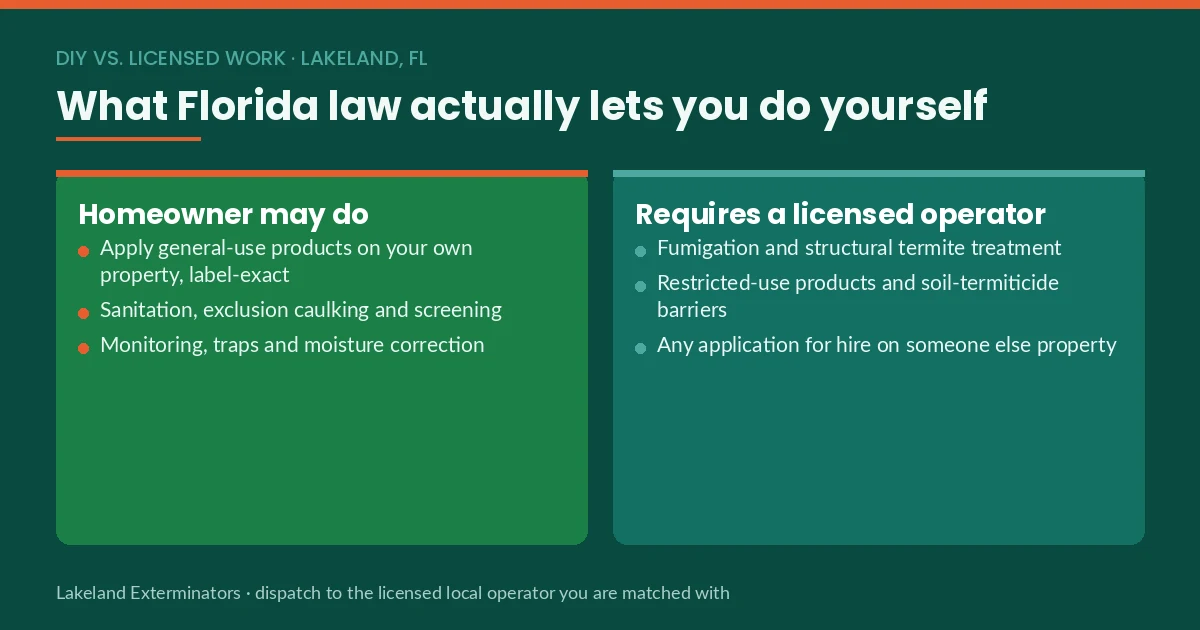
Where DIY genuinely works in Lakeland
Do these yourself. Skip the service call. You’ll get a better result than a spray-and-go visit would give you, and it costs almost nothing.
- The occasional palmetto bug on the lanai. It came in from the mulch, not from a nest in your wall. Pull mulch and leaf litter back six inches from the slab, fix the door sweep, and you’ll cut sightings dramatically. A perimeter product at label rate handles the stragglers.
- Silverfish, earwigs, centipedes, millipedes. Every one of these is a humidity story. Run a dehumidifier in the garage, fix the leaking hose bibb, clear the gutters, get the sprinkler heads off the foundation. They leave on their own. Chemistry is almost beside the point.
- House crickets in the garage. Replace the garage door sweep. That’s the whole intervention — a quick, inexpensive hardware-store fix.
- Webs and spiders on the exterior. Knock them down mechanically, and change the porch bulbs to warm/yellow LEDs so you’re not running a nightly buffet of flying insects that attracts the spiders in the first place. Treat the cause, not the web.
- Clothes moths. Hot wash or freeze the affected items, vacuum the closet thoroughly, store wool in sealed containers. Genuinely a DIY job.
- Yard and exterior sanitation generally. Trim tree limbs back from the roofline, stack firewood off the ground and away from the house, eliminate wood-to-soil contact, clear the tarp pile behind the shed. This is the single most underrated pest control in Polk County and it’s free.
Notice a theme? The DIY column is almost entirely habitat modification, not chemistry. That’s not an accident. It’s the part that actually holds.
Where DIY predictably loses — and why the biology beats the can
German cockroaches
Two problems at once. Pyrethroid resistance is widespread in this species, so the retail spray that says “kills roaches” often simply doesn’t. Worse, most retail products are repellent — roaches sense the treated surface and avoid it, dispersing deeper into wall voids and into adjoining rooms. You didn’t kill the population. You spread it.
German cockroach guide →Ghost ants and carpenter ants
Ghost ants practise colony budding: stress the colony with a repellent spray and it fractures into multiple satellite colonies, each with its own queen. You will genuinely have more ant trails a week after spraying than before. Carpenter ants nest inside damp structural wood you can’t see, so the trail you’re treating isn’t the problem.
Ant control guide →Subterranean termites
The colony lives in the soil, potentially a long way from the structure, and can number in the hundreds of thousands. There is no consumer product on any shelf in Polk County that addresses that. Florida also restricts soil treatment around structures to licensed operators — this one isn’t even legally yours to attempt.
Termite control →Roof rats
Bait without exclusion is a treadmill: you remove the rats currently inside and the soffit gap keeps letting more in. Bait alone also has a specific and memorable failure mode — rodents die inside your wall voids, and you live with that smell for weeks. Sealing the entry is the actual job.
Rodent exclusion →Widow spiders in numbers
Knocking down a web does nothing about the egg sacs, and each sac hatches a new generation. A single widow in a garage corner is a DIY situation. An established population in a screened enclosure, meter box, or stack of patio furniture is a barrier-treatment situation.
Spider control →Anything you’ve already sprayed twice
Honestly, this is the clearest signal there is. If you’ve treated the same trail or the same room twice and it came back, the population is not where you’re spraying. More product will not fix a targeting problem.
The complete Lakeland guide →Tried it twice and it came back?
One call reaches a licensed, local exterminator who covers your address — and a real person answers, 24/7.
Talk to a licensed exterminator now
Call and we’ll connect you with a licensed, local exterminator who covers your address. It takes about two minutes, and a real person answers.
Free to call. Free to get matched. The licensed operator gives the quote.
What a licensed operator has that the hardware store doesn’t sell you
This is the part that actually explains the price difference, and it’s not “stronger poison.” It’s mostly smarter poison, plus a trained pair of eyes.
Non-repellent actives
Most retail insecticide is repellent — the insect detects it and avoids the treated zone. That feels like it’s working (you stop seeing them there) while quietly scattering the population. Professional non-repellent products are undetectable to the insect, so it walks through, picks up the active, returns to the nest, and shares it. That transfer effect is the entire ballgame with social insects, and you can’t buy it in a supermarket aisle.
Insect growth regulators
IGRs don’t kill adults; they stop the next generation from reaching breeding age. Almost nothing on the consumer shelf includes one, which is exactly why a DIY roach or flea program “works” for three weeks and then the population rebounds from eggs and pupae that were never touched.
Baits with delayed toxicity
A good bait is deliberately slow. The forager has to survive long enough to carry it home and feed the colony. Kill it too fast at the bait station and you’ve accomplished nothing. Getting that balance right — and matching the bait matrix to the species’ current food preference, which shifts seasonally — is craft, not shopping.
Soil termiticide and structural fumigation
Trenching and injecting a continuous termiticide barrier, installing a monitored bait system, or tenting a structure are licensed-only operations in Florida for good reason. The volumes and the failure modes are both serious.
The ability to read your house
Honestly, this may be the most valuable part and it’s the least discussed. An experienced operator walks your slab line and sees the failed expansion joint, the stucco that stops short of grade, the plumbing penetration nobody sealed in 1984, the irrigation head soaking one corner of the foundation every morning at 6am. You have been walking past all of it for years.
What Florida law actually lets you do yourself
Worth knowing before you start, because the line is clearer than most people assume.
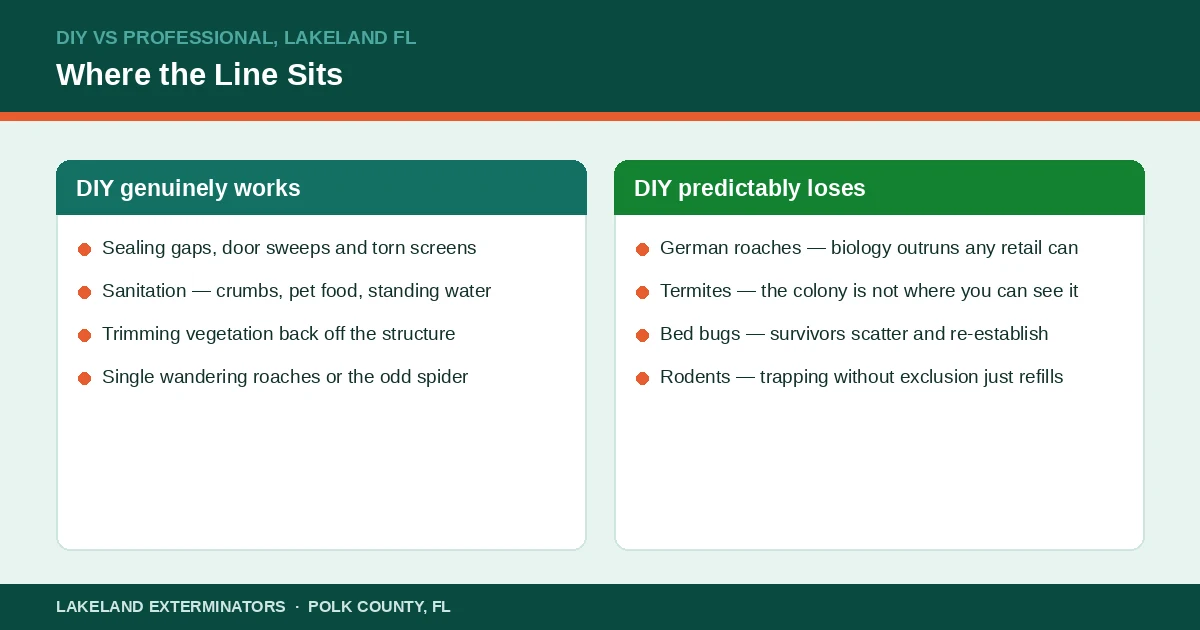
- You may treat your own property. Florida allows a homeowner to apply EPA-registered consumer pest control products on their own property, following the label. The label is the law — “more product” than the label specifies is not just wasteful, it’s a violation, and it’s the most common DIY mistake.
- Liability stays with you. Misapplication, drift onto a neighbour’s property, contamination, pet exposure — that’s on the homeowner. A licensed operator carries insurance for exactly this; you don’t.
- Soil termite treatment around a structure is restricted. Under Chapter 482, Florida Statutes, structural pest control — including termite soil treatment and structural fumigation — requires an FDACS-licensed business and a certified operator. This isn’t a formality; it’s the category of work with the highest potential to hurt someone.
- Pest control for compensation always requires a license. If someone is doing pest work at your house for money and can’t produce an FDACS license number, they are operating illegally — whatever the truck says.
Any license can be checked in about ninety seconds at the FDACS license search. Our FDACS licensing explainer covers what each category legally permits.
The hybrid that actually works
The people who spend the least on pest control in Lakeland aren’t the pure DIY crowd, and they’re not the ones on a monthly plan they never think about. They do the free structural work themselves and buy professional help only where the biology demands it.
Close the building envelope
Garage door sweep, weatherstripping, screened weep holes and vents, sealed plumbing and cable penetrations, intact soffit-to-fascia line. A weekend of work that stops most of what would otherwise walk in.
Break the moisture cycle
Mulch pulled back from the slab, gutters clear, downspouts running away from the foundation, sprinkler heads not soaking the wall, no wood-to-soil contact anywhere. This is the single highest-leverage thing you can do in Polk County.
Cut the highway
Trim oak limbs and palm fronds back from the roofline. Roof rats are climbers — take away the bridge and the soffit gap stops mattering nearly as much.
Bring in a licensed operator for the biology
Termites, German cockroaches, an established rodent population, ants that keep coming back. Those need non-repellents, IGRs, proper baits, and exclusion work. That’s where the money is well spent.
If you want to think about cadence rather than one-off calls, quarterly vs. monthly pest control lays out the tradeoff, and the Lakeland pest control cost guide explains what actually drives a quote. Before you sign anything, run through the questions to ask a pest control company.
Free to call. Free to get matched. The licensed operator gives the quote. Availability of same-day and emergency service depends on the provider.
DIY vs. professional questions, answered straight
Can I treat termites in my own Polk County home?
Not the way it actually needs to be treated. Under Chapter 482, Florida Statutes, structural pest control — including termite soil treatment around a structure and structural fumigation — requires an FDACS-licensed business and certified operator. And even setting the law aside: subterranean termite colonies live in the soil, potentially well away from your house, and no consumer product reaches them. Retail “termite” products are limited to small localised wood applications and do nothing to a colony.
Why did spraying make my ant problem worse?
Because you probably had ghost ants, and you used a repellent product. Repellents stress the colony, and ghost ants respond by budding — the colony fractures into multiple satellite colonies, each with a queen, each starting its own trail. One trail becomes six. It’s a real, documented behaviour, and it’s the single most common way a DIY ant treatment backfires in Florida.
Is professional pest control worth the money?
For habitat problems — silverfish, crickets, the odd millipede — genuinely no, and we’ll say so. Fix the moisture and the gaps yourself. For biology problems — German cockroaches, subterranean termites, an established rodent population, ants that keep returning — yes, because the products that actually work (non-repellents, IGRs, proper baits) aren’t sold to consumers, and because DIY attempts frequently make those specific problems harder to solve. We don’t set prices and don’t take a cut, so we’ve got no reason to push you either way.
Are retail pesticides safe around pets and kids?
At label rates, once dry, consumer products are generally considered safe for their labelled use. The real risk isn’t the product — it’s over-application. “A bit extra to be sure” is the classic homeowner move and it puts concentrations above the label rate, which is both a legal violation and the actual source of most pet exposure incidents. Read the label, follow it exactly, and observe the re-entry interval.
Should I use a bug bomb or total-release fogger?
Almost never. Foggers deposit product on exposed horizontal surfaces — which is precisely where the pests aren’t. They don’t reach into wall voids, under appliances, or into the cracks where German cockroaches actually live, and the repellent effect drives that population deeper and wider. They also present a genuine fire risk near pilot lights. It’s the classic panic purchase and it usually costs you more later.
What’s the one DIY job everyone in Lakeland should do?
Pull the mulch back from your slab. Six inches of bare, dry margin between the landscaping and the foundation removes the harborage that palmetto bugs, millipedes, earwigs, and silverfish depend on, and it lets you actually see mud tubes if subterranean termites ever build them. It’s free, it takes an afternoon, and it does more than most chemical applications.
If I’ve already sprayed, should I tell the operator?
Yes — absolutely, and be specific. What product, where, how much, how recently. It genuinely changes the plan. Recent repellent applications can interfere with bait acceptance and with non-repellent strategies, and an operator who doesn’t know may end up troubleshooting a problem you created. Nobody’s judging. It just saves everyone a wasted visit.
Past the point where a can will fix it?
One ZIP, and a coordinator routes you to a Polk County operator licensed for that specific job.
Talk to a licensed exterminator now
Call and we’ll connect you with a licensed, local exterminator who covers your address. It takes about two minutes, and a real person answers.
Free to call. Free to get matched. The licensed operator gives the quote.
Disclosure
Lakeland Exterminators is a dispatch and matching service. We connect Polk County callers with FDACS-licensed pest control operators. We are not a licensed pest control operator. We do not perform treatment, set prices, issue warranties, hold bonds, or carry pest control trade insurance. All pricing, scheduling, treatment plans, warranties and service terms are determined by the FDACS-licensed operator dispatched to your address under Chapter 482, Florida Statutes.
Same-day and 24/7 emergency services are subject to provider participation, location, technician availability, and demand. Availability is not guaranteed and may vary by market and appointment capacity.
License status of any operator you connect with is publicly verifiable at the FDACS license search.
Nothing on this page is a pesticide recommendation. Always read and follow the product label — the label is the law — and consult an FDACS-licensed operator for anything beyond routine consumer use.