Big black-and-red ants and a pile of sawdust? Before you panic about termites — read this.
One call reaches a licensed, local exterminator who covers your address — and a real person answers, 24/7.
Talk to a licensed exterminator now
Call and we’ll connect you with a licensed, local exterminator who covers your address. It takes about two minutes, and a real person answers.
Free to call. Free to get matched. The licensed operator gives the quote.
24/7 line · A real person answers · Availability of same-day and emergency service depends on the provider.
Carpenter ant or termite? Settle it in sixty seconds
This is the single most useful thing on this page, so it goes first. Both leave debris. Both swarm in spring. Both show up in the same damp Lakeland wood. But they are completely different animals, with completely different consequences and completely different treatments — and one of them is regulated as a wood-destroying organism.
| Look at | Carpenter ant | Termite |
|---|---|---|
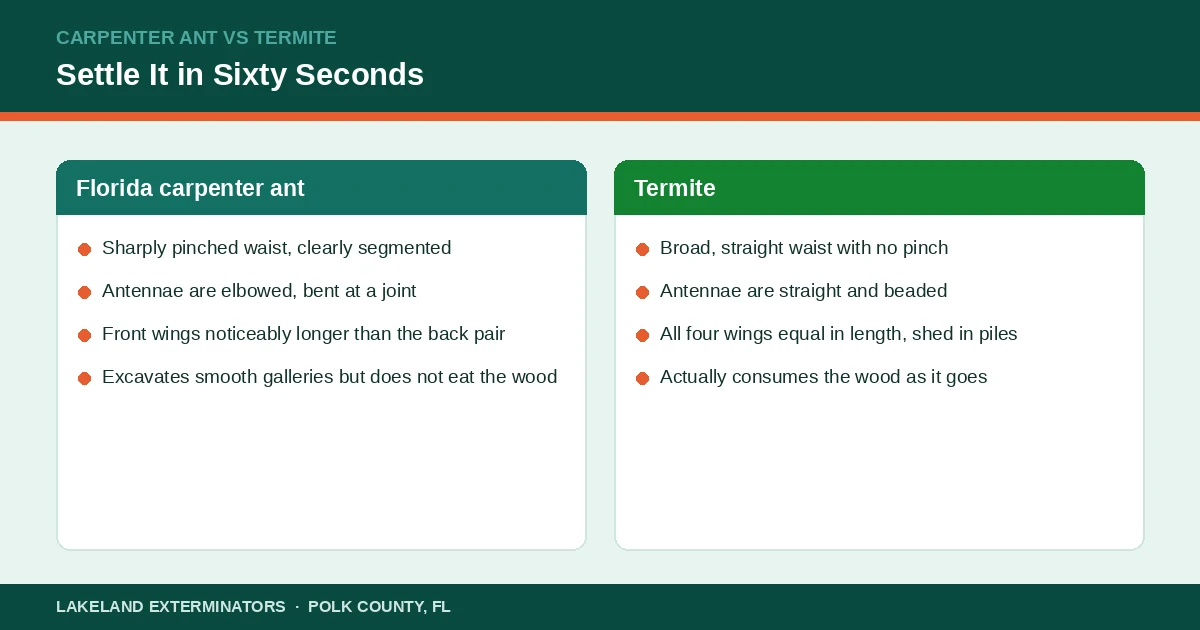
| Waist | Pinched, obvious hourglass. | Thick and straight — no waist at all. |
| Antennae | Bent, elbowed. | Straight, like a tiny string of beads. |
| Wings (swarmers) | Front pair clearly longer than the back pair. | Four wings, all the same length, shed in piles on the sill. |
| The debris | Coarse shavings that look like pencil sharpener output, mixed with dead insect parts. | Subterraneans build mud tubes and pack galleries with soil. Drywoods push out hard, gritty fecal pellets, not shavings. |
| Inside the wood | Galleries sanded smooth, almost polished. Clean. | Rough galleries, packed with mud, soil or pellets. |
| What it means | You have a moisture problem the ants moved into. Serious, fixable. | Structural pest under Chapter 482. Needs a licensed termite treatment, not an ant service. |
If you’re seeing mud tubes climbing your slab, or a pile of identical shed wings on the windowsill after a warm February rain, stop reading about ants and go here instead: termite control in Lakeland. If you’re buying or selling and need it documented, that’s a WDO inspection. Guessing wrong in either direction costs real money.
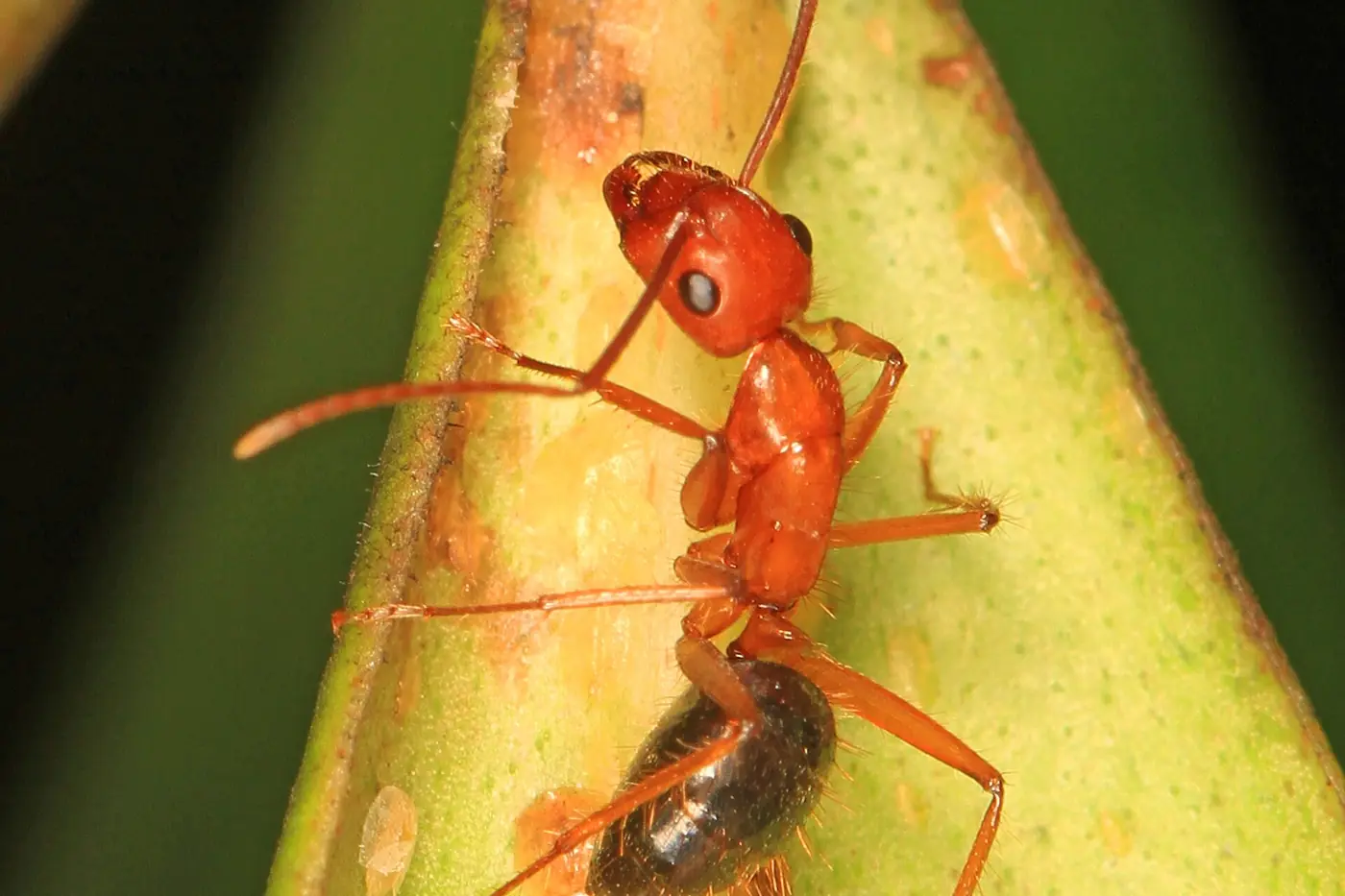
The two carpenter ants you’ll actually meet in Polk County
Florida carpenter ant
Camponotus floridanus. The common one. Big — workers vary a lot in size within the same nest — with a rusty reddish-orange head and thorax and a black abdomen, covered in fine golden hairs. Locals sometimes call them “bull ants.” Active at night, heavy sugar and honeydew feeders, and they’ll bite if you handle them.
Tortugas carpenter ant
Camponotus tortuganus. More slender, longer-legged, lighter amber-and-dusky coloring. Common in Central and South Florida and often found nesting in palms and moist wall voids. Same treatment logic, same moisture story.
What they actually do to a house
Here’s the deal: carpenter ants do not eat wood. They have no gut machinery for digesting cellulose — that’s the termite’s trick. What they do is excavate. They chew galleries into wood that’s already soft with moisture or fungal decay, throw the shavings out a small slit-like opening, and move in. The pile of coarse frass under a window casing or on a baseboard is spoil, not food.
That distinction is the whole game. Carpenter ants are, functionally, a moisture alarm. They’re telling you there’s a slow leak at that window, a rotted sill under the shower, a bathroom fan venting into the attic, a soffit that’s been taking wind-driven rain since the last hurricane. Kill the ants, ignore the water, and you’ll be back here next year — either with more ants or, worse, with rot and termites.
They also nest outside and forage in. A live oak with a dead limb, a queen palm with a rotted boot, a wood fence post, a stack of firewood against the wall, an old railroad tie in the landscaping — all of it is a parent nest, and the ants trail into the house at night along utility lines, branches touching the roof and irrigation risers.
What tells you they’re inside the structure, not just visiting
- Frass in the same spot, twice. Vacuum it up. If it’s back in a few days, there’s a nest above it — not a foraging trail passing through.
- Rustling in the wall. Yes, really. A big carpenter ant colony in a quiet wall void at night makes a faint crinkling sound, like cellophane.
- Winged ants indoors, in spring. Swarmers emerging inside the house mean a mature nest inside the house. Swarmers on the porch light mean the neighborhood has them.
- Night traffic. Carpenter ants forage after dark. Kill the kitchen lights and check the counters and baseboards with a flashlight around 10 p.m. — that’s when a daytime “couple of ants” turns out to be a highway.
- Trails to one specific spot. Under the sink, around the tub surround, at the water heater, along the AC air handler platform. Follow the trail; it ends at the water.
Why Lakeland houses get them
The old wood-frame core. Dixieland, Lake Morton and the Garden District, Cleveland Heights, the streets around Lake Hollingsworth — 1920s-to-1950s frame construction with wood sills, real window casings, original glazing and decades of Florida rain. That is carpenter ant paradise. The rotted sill under a bathroom window is the classic Polk County nest site.
Slab houses with a roof problem. South Lakeland, Highland City, Christina, Grasslands — block-and-stucco on slab, so no crawl space, but the ants come in from the top: a soffit or fascia holding water, a chimney chase, a shower pan that’s been weeping into the framing, an attic that’s damp because the bath fan vents into it instead of out through the roof.
The trees. Live oaks and palms are the other half of the story. A limb touching the roof is a bridge that no perimeter treatment can stop — the ants walk right over the barrier at gutter height. Trimming branches back a few feet from the roofline does more for carpenter ant pressure than another gallon of anything.
The Polk County carpenter ant calendar
| When | What’s happening | What you’ll notice |
|---|---|---|
| Feb – May | Also peak subterranean termite swarm season here, after warm rains. Carpenter ants ramp up as temperatures climb. | The season of confusion. Winged insects indoors — check the waist and the wings before you decide what you have. |
| May – Jun | Carpenter ant swarmers fly, usually at dusk or after dark, and pile up around porch lights and pool cages. | Big winged ants on the lanai screen. Alarming, mostly harmless — unless they’re emerging from inside a wall. |
| Jun – Sep storm season | Daily storms keep soffits, fascia and window sills wet. Wind-driven rain finds every gap in the envelope. | Peak activity and the peak call window. New leaks become new nests within a single wet season. |
| Oct – Jan | Colonies slow down but stay active in warm, damp interior voids — wall cavities near water heaters and showers. | Fewer ants outdoors, so indoor trails stand out more. A good window to open up and fix the moisture source. |
Sawdust on the sill and no idea what’s making it?
A licensed inspector will tell you in one visit whether it’s ants or a wood-destroying organism.
Talk to a licensed exterminator now
Call and we’ll connect you with a licensed, local exterminator who covers your address. It takes about two minutes, and a real person answers.
Free to call. Free to get matched. The licensed operator gives the quote.
How a licensed operator actually handles carpenter ants
Not by spraying the trail. Anyone who shows up, fogs a baseboard and leaves has treated the symptom. The real sequence looks like this:
Find the nest, not the ants
Night inspection, moisture meter, tapping suspect wood, following trails back to a void, a tree, a fence post or a wet sill. Carpenter ant work lives or dies on this step.
Treat the void directly
Dust or foam injected into the gallery, so it reaches the brood and the queen, rather than a surface spray the foragers walk around.
Bait and perimeter for the satellites
Carpenter ants run satellite nests. Baiting and a non-repellent exterior band pick up the colonies that weren’t in the wall you opened.
Fix the water — or they come back
The leak, the fan, the soffit, the branch on the roof. That’s usually a handyman or roofer, not the pest operator, and a straight-talking operator will tell you exactly that.
What the licensed operator will ask you
- Where exactly is the sawdust, and how often does it come back? Bring a photo, and don’t clean it all up before they arrive.
- Any known leaks, roof damage or plumbing repairs? Even old ones. That’s where the nest is.
- Are you seeing them at night? Night activity means an established colony, not a stray.
- Winged ants indoors or outdoors? Indoors is a very different conversation.
- Trees or limbs touching the roof? Firewood or landscape timbers against the wall? Those are parent nests until proven otherwise.
- Have you had a termite inspection? If there’s any doubt about the debris, the ID gets settled first.
What carpenter ant work costs in Polk County
We don’t set prices and never quote them. Here’s how operators here typically structure the job:
- Inspection and ID. The most valuable hour of the whole job, and the step that stops you from paying for the wrong treatment.
- Targeted void treatment. Priced by the number of nest sites and how much access is needed. A nest in an accessible wall void is straightforward; one behind tile in a shower wall isn’t.
- Perimeter and bait program. Often folded into a recurring exterior service, since Polk County outdoor ant pressure never really stops.
- The repairs. Roofing, plumbing, carpentry. Not the pest operator’s scope, and usually the biggest line item — but skipping it is how people end up paying for ant service every year forever.
See the Lakeland pest control cost breakdown for how this compares to termite and general pest work. Whatever it comes to, the number comes from the licensed operator after inspection — not from us.
Related Polk County pages
Termite control
Mud tubes, shed wings, soil-packed galleries. If the debris isn’t shavings, start here.
Termite control in Lakeland →WDO inspection
Buying or selling in Polk County? The wood-destroying organism report is the document that settles it.
WDO inspections →All ant species
Every ant we route in Lakeland and Polk County, with the ID cues for each.
Ant control in Lakeland →Ghost ants
The tiny pale ones on the counter. Nothing to do with wood — and spraying them makes it worse.
Ghost ant control →Fire ants
Mounds in the yard, stings on the ankle. Outdoor work, whole different plan.
Fire ant control →County-wide service
Winter Haven, Bartow, Auburndale, Haines City, Lake Wales — same dispatch, same licensed network.
Pest control in Polk County →Find the nest. Fix the water. Stop the cycle.
One ZIP. A real person on the line. An FDACS-licensed operator who inspects before they treat.
Talk to a licensed exterminator now
Call and we’ll connect you with a licensed, local exterminator who covers your address. It takes about two minutes, and a real person answers.
Free to call. Free to get matched. The licensed operator gives the quote.
Carpenter ant questions, answered straight
How do I tell carpenter ants from termites?
Three things. Waist: an ant has a pinched, hourglass waist; a termite is straight-sided. Antennae: an ant’s are bent at an elbow; a termite’s are straight and beaded. Wings: an ant’s front wings are longer than its back wings, while a termite’s four wings are all the same length and shed in neat piles. Then look at the debris — carpenter ants throw out coarse shavings mixed with insect parts, while subterranean termites build mud tubes and pack galleries with soil.
Do carpenter ants eat the wood in my house?
No. They can’t digest cellulose. They chew galleries into wood that is already damp or decaying and push the shavings out. The damage is real but it’s excavation, not consumption, and it’s almost always concentrated where there’s a moisture problem — a leaking window, a wet sill, a soffit taking rain, a shower pan weeping into the framing.
Is carpenter ant damage as serious as termite damage?
Usually not, and it’s usually slower — but that’s cold comfort, because the wood they’re nesting in is already compromised by water. The honest way to think about it: carpenter ants are a symptom. The water that softened the wood is the disease, and untreated water damage is what invites decay fungus and, eventually, termites.
Why do I only see them at night?
Because Florida carpenter ants forage mostly after dark. If you’re seeing a handful during the day, turn the lights off and check with a flashlight around 10 p.m. — that’s when you find out whether it’s a stray or a highway. Night activity along a consistent route is a strong sign of an established nest.
Where do carpenter ants nest in a Lakeland house?
Wherever wood meets water. Rotted window and door sills in the older frame homes around Dixieland and Lake Morton. Wall voids near showers, water heaters and A/C air handlers. Damp attic framing under a soffit that’s been taking wind-driven rain. Outdoors: live oak limbs, palm boots, fence posts, landscape timbers and firewood stacked against the wall.
Will spraying the trail get rid of them?
No. Surface sprays kill the foragers you see and leave the nest — and carpenter ants run satellite nests, so there’s usually more than one. Effective treatment means locating the galleries and treating the void directly, backing that with bait and an exterior perimeter, and then fixing the moisture that made the wood habitable in the first place.
I found big winged ants indoors in the spring. Is that bad?
It matters where they came from. Swarmers emerging from inside your wall mean a mature colony is living in the structure. Swarmers piling up on the porch light or the pool cage screen in May and June mean the neighborhood has carpenter ants and yours flew to the light. Also worth ruling out termites — February through May is prime subterranean swarm season in Polk County, and shed termite wings on a windowsill are a different emergency.
Is the pest control company actually licensed?
Every operator in the network is a licensed Florida pest control business, and you never have to take our word for it. License status is public: search the company at the Florida Department of Agriculture and Consumer Services license lookup before anyone treats your home. Pest and wood-destroying organism work in Florida is regulated under Chapter 482, Florida Statutes.
Disclosure
Lakeland Exterminators is a dispatch and matching service. We connect Polk County callers with FDACS-licensed pest control operators. We are not a licensed pest control operator. We do not perform treatment, set prices, issue warranties, hold bonds, or carry pest control trade insurance. All pricing, scheduling, treatment plans, warranties and service terms are determined by the FDACS-licensed operator dispatched to your address under Chapter 482, Florida Statutes.
Same-day and 24/7 emergency services are subject to provider participation, location, technician availability, and demand. Availability is not guaranteed and may vary by market and appointment capacity.
License status of any operator you connect with is publicly verifiable at the FDACS license search.