You wipe the counter clean, and twenty minutes later there’s a thin line of tiny ants tracking across it anyway. In Polk County, that’s almost always one of two culprits — ghost ants or what most homeowners call “sugar ants,” which around here is usually shorthand for a few different small ant species drawn to anything sweet or greasy left out. They’re small, fast, and genuinely frustrating to deal with on your own, mostly because the usual response — spraying the trail you can see — tends to make the problem worse, not better.
Dealing with a pest problem right now?
📞 Call now — get matched with a licensed local exterminator: (888) 295-0220When you call, stay on the line for a few seconds while we match you with the licensed local exterminator for your area. Have your address and a quick description of the problem ready.
Licensed local pros · Fast response, subject to availability · No obligation
Why spraying the trail backfires
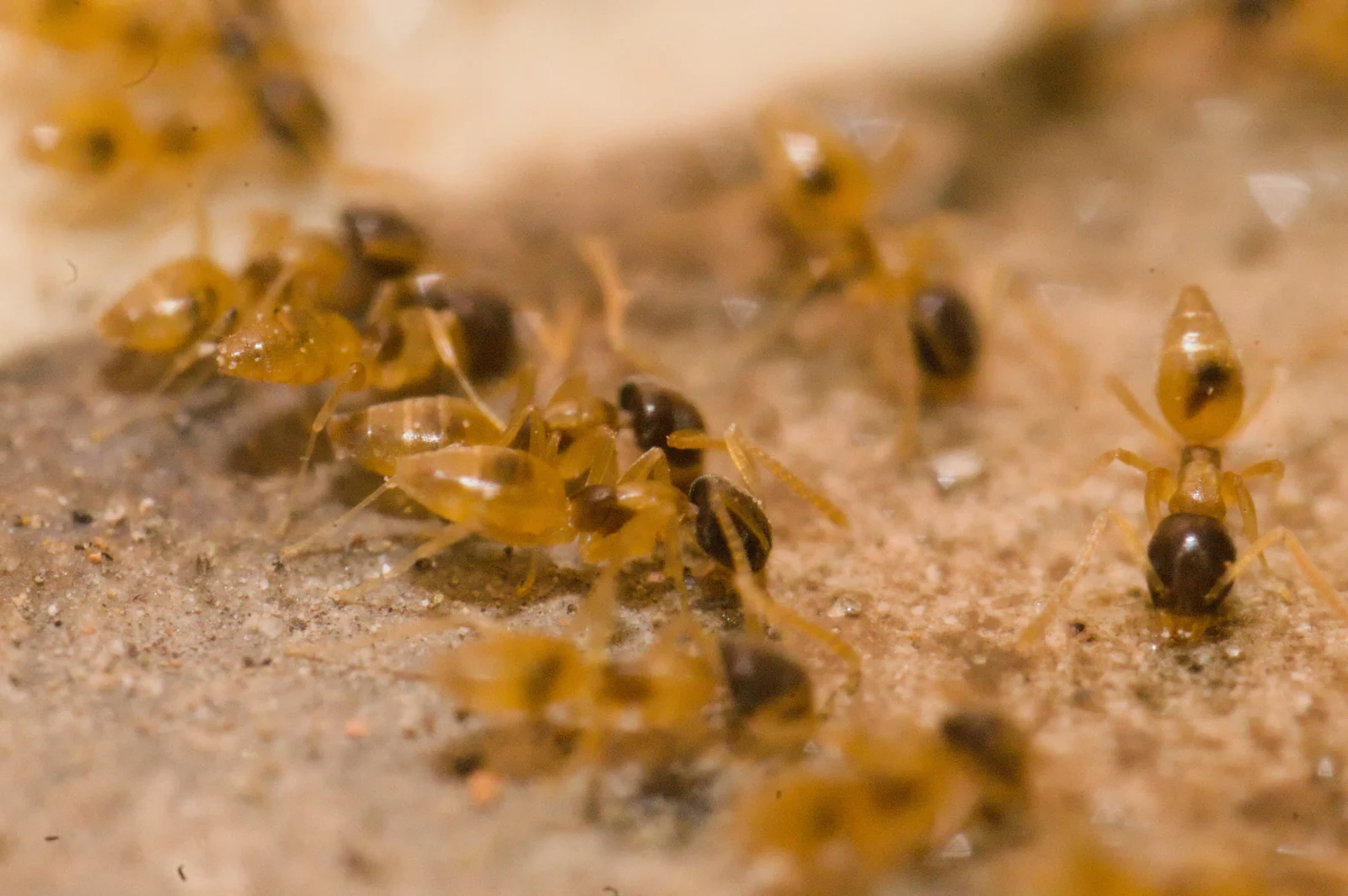
Ghost ants and sugar-seeking species like white-footed and Argentine ants don’t operate off a single nest with one queen you can eliminate by killing the ants you can see. Many of these species have multiple queens and satellite colonies, meaning the ants foraging on your counter are a small fraction of a much larger network, often split across several nesting sites in walls, potted plants, or landscaping right outside. Spraying the visible trail kills the ants in front of you and startles the rest of the colony into budding — splitting into new satellite colonies to avoid the threat. That’s why a lot of Lakeland homeowners report the ants “coming back worse” a week after a store-bought spray. It’s not bad luck; it’s the biology of the species working against a surface-level fix.
Telling ghost ants and sugar ants apart
- Ghost ants are extremely small (about 1.5mm), with a pale, almost translucent abdomen and legs against a darker head and thorax — which is exactly why they’re hard to spot until there’s a visible trail. They favor sweets but will go after grease and protein too, and they’re especially active indoors during and after rainy periods, when outdoor colonies move toward drier ground.
- “Sugar ants” is the catch-all most homeowners use, but in Polk County it usually means white-footed ants or Argentine ants — both slightly larger than ghost ants, dark brown to black, and strongly drawn to sweet residue, fruit, and pet food.
Getting the species right matters because the bait a licensed operator chooses — protein-based versus sugar-based, gel versus granular — depends on what the colony is actually feeding on at that time of year. That’s part of why a professional inspection outperforms a guess-and-spray approach from the hardware store aisle.
Why Lakeland kitchens specifically
A few things about Polk County housing and climate make ant pressure worse here than in a lot of places:
- Year-round humidity. With no real winter in USDA Zone 9b, ant colonies don’t slow down the way they do further north — there’s no dormant season giving your kitchen a break.
- Landscaping right against the foundation. Mulch beds, potted plants, and shrubs touching exterior walls give ghost ants and Argentine ants an easy bridge from soil to siding to a gap around a window or utility line.
- New construction on disturbed soil. Newer subdivisions out toward Auburndale, Davenport, and the I-4 corridor sit on ground that was recently cleared and graded, which tends to favor certain ant species establishing quickly in the disturbed edges.
- Rain-driven migration. After a heavy summer rain band, outdoor ant colonies often move toward higher, drier ground — which frequently means your foundation, your walls, and eventually your kitchen counter.
What a licensed operator typically does differently
Instead of treating the visible trail, a licensed Polk County pest control operator generally starts by identifying the species and tracing the trail back toward the entry point and, where possible, the nesting area. From there, the approach is usually a targeted baiting program — matched to whether the colony is feeding on sugars or proteins that week — placed at entry points and along known trails rather than sprayed indiscriminately. Baiting works with the colony’s own foraging behavior: workers carry the bait back to the nest and share it, which is what actually reaches the queens a surface spray never touches. Depending on the property, this can take a few weeks of monitoring and bait rotation before the trails stop for good — a licensed operator can walk you through the realistic timeline once they’ve seen the extent of it. For species-specific detail, see our ant control guide and our Argentine ant reference.
One call reaches a licensed, local exterminator who covers your address — and a real person answers, 24/7.
What you can do while you wait to get matched
- Leave a short section of the ant trail alone rather than wiping it out completely — it helps the operator trace the path back to the entry point.
- Store sugary and greasy foods, including pet food, in sealed containers rather than open packaging.
- Pull mulch and potted plants back a few inches from the foundation and exterior walls where you can.
- Wipe up spills promptly, but skip the over-the-counter ant spray if you’re planning to get a professional inspection — it can scatter the colony and make the operator’s job harder.
Common questions
Why do the ants keep coming back to the same spot?
That spot is a reliable food or moisture source from the colony’s perspective. Cleaning it removes the immediate temptation, but the trail itself is evidence of an established path from an outdoor or in-wall colony — which is what an inspection and targeted baiting are meant to address.
Is DIY ant bait from the store worth trying first?
It can help in very minor cases, but with species like ghost ants that bud into satellite colonies when threatened, an ill-matched or poorly placed store bait can make the population harder to eliminate later. If it’s been more than a week or two with no improvement, that’s usually the point to get a licensed operator involved.
How long does it take to actually solve an ant problem?
It varies by species, colony size, and how many entry points there are — a licensed operator can give you a realistic timeline after seeing the property, but it’s rarely a one-visit fix for an established multi-queen colony.
One call reaches a licensed, local exterminator who covers your address — and a real person answers, 24/7.