Wings on the windowsill? Mud tubes on the slab? Get a licensed termite pro on the phone now.
One call reaches a licensed, local exterminator who covers your address — and a real person answers, 24/7.
Talk to a licensed exterminator now
Call and we’ll connect you with a licensed, local exterminator who covers your address. It takes about two minutes, and a real person answers.
Free to call. Free to get matched. The licensed operator gives the quote.
24/7 line · A real person answers · Availability of same-day and emergency service depends on the provider.
Quick answer
One call reaches a licensed, local exterminator who covers your address — and a real person answers, 24/7.
First: which termite are you actually dealing with?
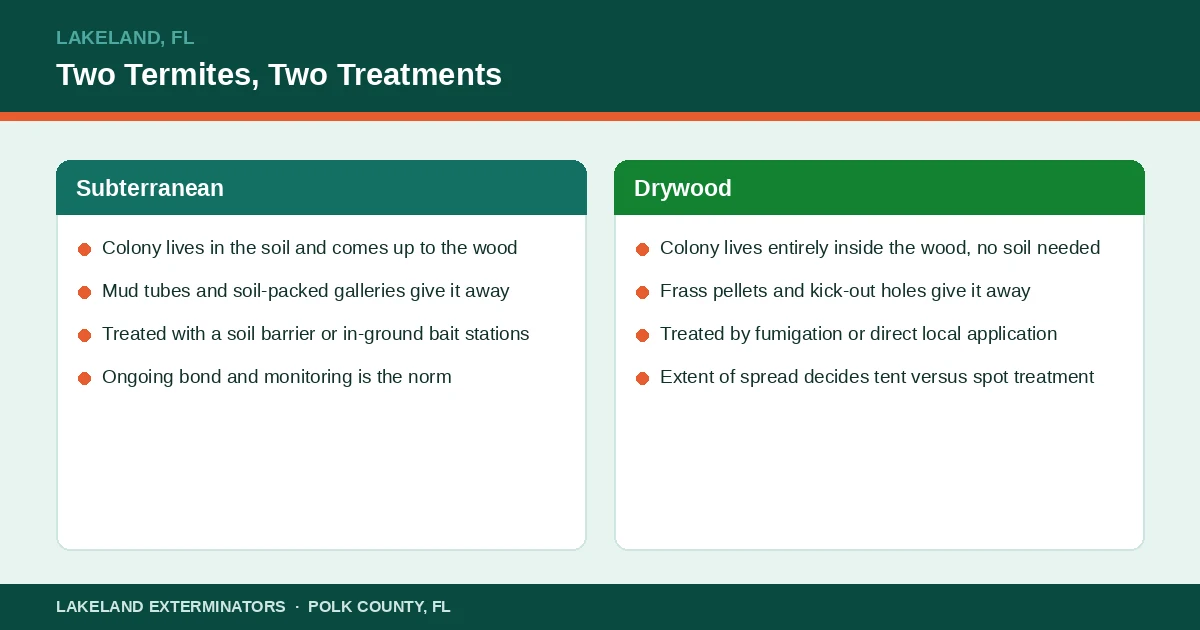
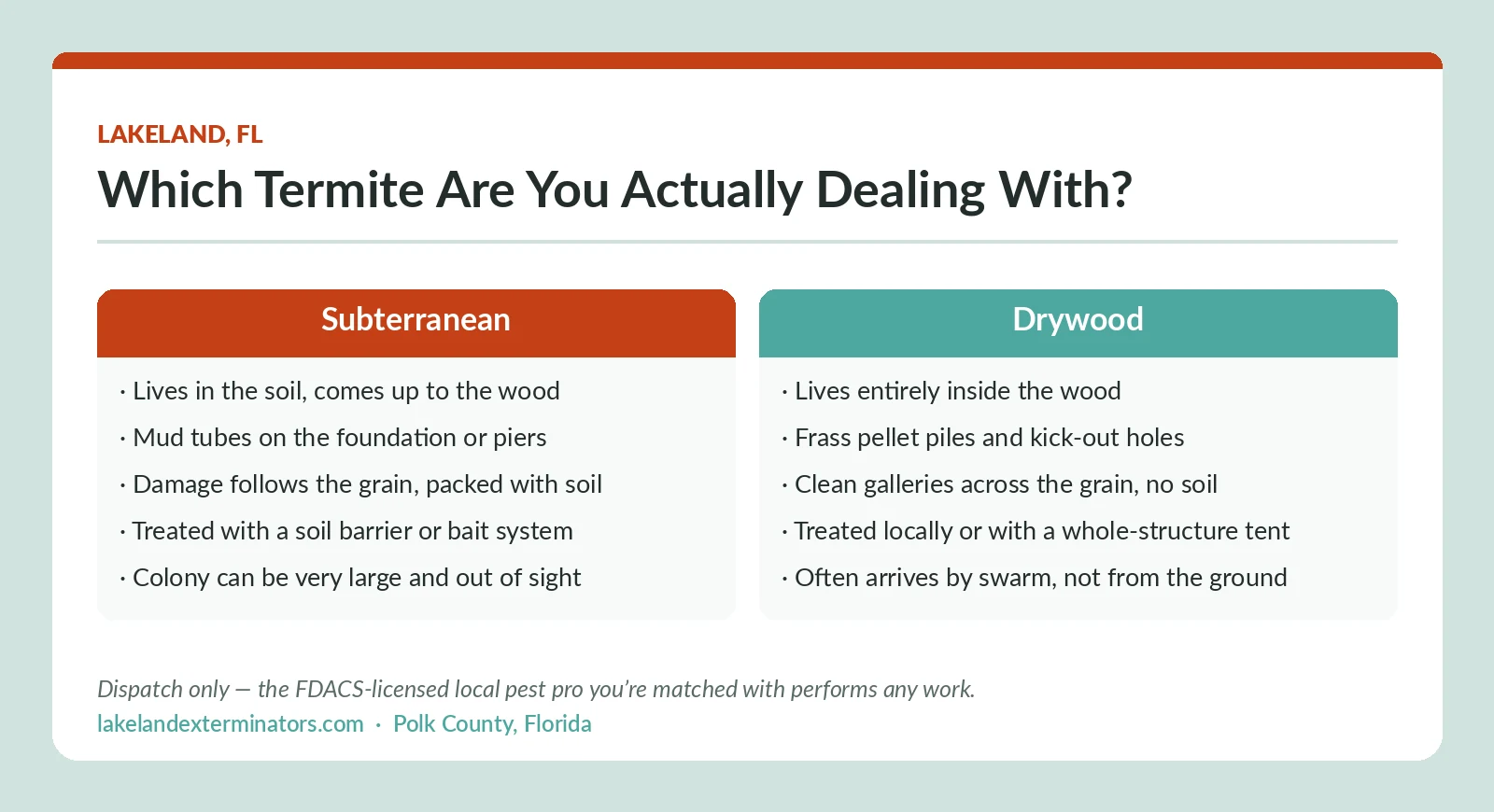
Polk County carries all three of Florida’s major structural termites, and the treatment paths barely overlap. Getting the ID right is the whole game — it is the first thing the licensed inspector confirms, and it is why a sight-unseen phone quote is worthless.
Eastern subterranean
Reticulitermes flavipes. Lives in soil, enters through slab joints and foundation gaps, builds pencil-width mud tubes up stem walls. Swarms February through May, often after warm rain. The most common Polk County termite by far.
Formosan subterranean
Coptotermes formosanus. Established in Lakeland. Colonies run several times larger than native subterraneans, can build above-ground carton nests holding their own moisture, and chew through more wood per month. Swarms on warm, humid evenings in late spring.
Florida drywood
Cryptotermes brevis. Needs no soil contact — swarmers drift through soffit vents May through August and colonize attic rafters, window framing and furniture. Evidence: six-sided frass pellets in little piles. Florida is one of only four states where these are an established structural pest.
The signs, ranked by how urgently to make the call
- Live swarmers indoors or piles of identical discarded wings on windowsills — a reproductive colony is in or against the structure. Call today.
- Mud tubes on the slab edge, stem wall, plumbing penetrations or garage expansion joints — active subterranean travel routes. Call this week.
- Frass pellets (fine, gritty, six-sided — looks like coarse coffee grounds) under attic framing, window sills or furniture — drywood activity overhead. Call this week.
- Hollow-sounding baseboards, blistered paint, doors that suddenly stick — possible established damage. Get it inspected before you repair anything; repainting over it just hides the evidence the inspector needs.
Seeing wings, tubes or frass? That is enough to make the call.
One call reaches a licensed, local exterminator who covers your address — and a real person answers, 24/7.
Free to call. Free to get matched. The licensed operator gives the quote.
Why Lakeland is a termite pressure cooker
Three local facts explain most of the termite calls this line routes.
1. The pre-1960 neighborhoods are built from termite food
Dixieland, South Lake Morton, Cleveland Heights, Beacon Hill, the Garden District — cypress and pine sill plates on pier-and-beam or early slab foundations, stucco over original framing, soffit details with exposed end grain. Subterranean colonies come up from the soil through slab joints; drywood swarmers drift into attic vents. Inspectors in our network find live or past termite evidence in a large share of the pre-1980 Polk County homes they walk. If your home predates 1980 and has never had a termite evaluation, make the call before the next repaint — not after.
2. Zone 9b soil never gets cold enough to stop them
Subterranean termites feed as long as soil stays warm and moist — in Lakeland, that is twelve months a year. There is no winter die-back, no off-season, no month where waiting is free. A colony discovered in November has been eating since last November.
3. Formosan colonies are established and expanding
Formosan subterranean termites are confirmed in Lakeland and around the lake districts. They matter because of scale: a mature Formosan colony can hold millions of workers against the native subterranean’s hundreds of thousands, and their above-ground carton nests mean even a perfect soil barrier is not always the whole answer. Operators who treat Formosans locally know to look for the carton nest — a franchise checklist does not always ask.
The Polk County swarm calendar
| Season | What swarms | What you will see |
|---|---|---|
| February – May | Eastern subterranean | Daytime swarms after warm rain; wings on sills, patios, spider webs near the slab line. |
| April – July | Formosan subterranean | Dusk swarms on humid, windless evenings, drawn hard to porch lights and streetlights. |
| May – August | Florida drywood | Small evening swarms entering through soffit and gable vents; frass piles appear months later. |
| Year-round | Workers of all three | No swarm needed — feeding continues every month. Mud tubes and frass are the tell. |
Full seasonal detail: termite swarming season in Florida.
What treatment paths will a licensed operator discuss?
Which one fits depends on species, spread and structure — that is the licensed operator’s call after a real inspection, and Florida law puts that work squarely with FDACS-licensed companies. Here is what each path actually involves, so the conversation makes sense when you have it.
Liquid soil barrier
A trench-and-treat termiticide barrier around the foundation, plus drilling at slab joints and porches where needed. The standard against subterranean colonies; typically a single day of work for a residential structure. Non-repellent chemistries let foragers carry the active ingredient back into the colony.
In-ground bait systems
Stations placed around the perimeter that intercept foragers and eliminate the colony over weeks to months, with quarterly monitoring. Strong fit for homes where drilling is impractical and for long-term prevention. Bait system guide → · Bait vs. liquid compared →
Whole-house fumigation
The tent. Sulfuryl fluoride gas penetrates every void where drywood colonies hide — the standard answer when drywood activity has spread beyond what anyone can map. Expect 24–72 hours out of the house plus aeration and clearance testing. Tenting guide → · How to prepare →
No-tent localized treatment
Direct wood injection, foam, or spot treatments for drywood colonies that are genuinely bounded to accessible framing. Legitimate when the extent is verifiable — and the honest operator will tell you when it is not. No-tent guide →
What decides the operator’s quote (we never set prices)
- Species and spread — a bounded drywood pocket and a mature Formosan colony are different jobs by an order of magnitude.
- Structure — linear footage of foundation, slab vs. pier-and-beam, attached lanais and additions that complicate barriers or tenting.
- Bond and warranty terms — renewable retreatment bonds and damage warranties carry real value; ask exactly what the number includes.
The termite cost guide, tenting cost guide and termite bond guide break down every factor — without pretending we set the number. The quote belongs to the licensed operator who walks your property.
How the termite dispatch works
Straight up: Lakeland Exterminators is a dispatch and matching service, not a licensed pest control operator. Here is the exact path your call takes.
Describe what you found
Wings, tubes, frass, blistered paint — tell the line what you are seeing and where. A real person answers around the clock.
Your address picks the operator
The call routes to an FDACS WDO-licensed operator covering your part of Polk County — Lakeland, Winter Haven, Bartow, Lake Wales, the I-4 corridor, all of it.
Licensed inspection on site
The operator confirms species, maps the activity, checks conducive conditions (grade, moisture, wood-to-soil contact) and writes the quote. Pricing comes from them, never from us.
Treatment and bond stay with the pro
Barrier, bait, tent or no-tent — plus any retreatment bond or warranty — all owned by the licensed operator under Chapter 482, Florida Statutes.
Verify before you hire — any Florida termite company’s license status, categories and discipline history is public at the FDACS license search. Check the operator you are matched with; the good ones expect it.
Buying or selling? The WDO inspection is where termites meet the closing table
If the inspection turns up active termites, treatment usually becomes a condition of closing on a tight clock. The dispatch line routes WDO requests the same way as treatment calls: by ZIP, to a licensed inspector. Start with the WDO inspection guide or the WDO report guide.
What do Lakeland homeowners ask about termite treatment most?
Is there a termite company near me in Lakeland that can inspect swarmers this week?
Call (888) 295-0220 and describe where you saw the swarmers or wings. You’ll be connected with an FDACS-licensed operator who handles subterranean and drywood termites in Lakeland and the rest of Polk County. Inspections are usually scheduled within days; the operator confirms the time and quotes any treatment after inspecting.
I found wings but no live termites — did they leave?
No — the opposite, usually. Discarded wings mean swarmers landed, paired and shed their wings to start a colony. The reproductives that dropped those wings are likely inside the wall, slab joint or attic framing right now. Wings on the inside of windows are the stronger signal: the swarm originated inside the structure. That is a call-today finding, and it is exactly what the licensed inspector will trace.
How long does termite treatment take?
Liquid soil barrier: typically one day for a residential structure. Bait system install: a few hours, then quarterly monitoring while the colony declines over weeks to months. Whole-house fumigation: 24–72 hours of tent time plus aeration and re-entry clearance. No-tent spot work: usually a day. The operator’s inspection sets the real schedule — full timeline guide here.
Do I really have to tent for drywood termites?
Not always — but sometimes, honestly, yes. No-tent localized treatment is legitimate when the colony is bounded to accessible wood and the operator can verify the extent. Fumigation is the answer when activity has spread through framing in ways nobody can fully map. Be wary of anyone who promises either path before inspecting; the honest answer depends on what the inspection finds.
What does termite treatment cost in Polk County?
Pricing is set by the licensed operator after inspection — species, spread, foundation type and linear footage all move the number, and bond terms change what it includes. We do not set or publish prices. The cost guide explains every factor and the questions that keep a quote honest — like whether a retreatment bond is included and what the warranty actually covers.
Is an annual termite bond worth it in Lakeland?
For most Polk County homes — especially pre-1980 construction and anything near the lake districts — a renewable bond with annual inspection is cheap insurance against the county’s year-round pressure. The details matter: retreatment-only vs. damage-repair bonds are very different products. The bond guide walks through both.
Are the operators this line routes to actually licensed for termite work?
Yes — termite work in Florida legally requires an FDACS license in the WDO (Wood-Destroying Organisms) category, and fumigation requires the separate Fumigation category. Every operator in the network holds the categories their work requires, and you can verify any company at the FDACS license search before you sign anything.
Can I treat termites myself?
You can buy consumer termiticides and bait stakes, and for a fence post they may be fine. For a structure, the math is against you: subterranean colonies forage 100+ feet from the nest, missing one gallery means the colony survives, and DIY treatment usually voids the possibility of a bond while making professional inspection harder. This is one of the few pest categories where the licensed route is defensibly the only sensible one — the DIY guide is honest about where DIY works and where it does not.
Termites do not wait, and neither should the call.
One call reaches a licensed, local exterminator who covers your address — and a real person answers, 24/7.
Free to call. Free to get matched. The licensed operator gives the quote.
Related Polk County termite reading
Deeper background on the species, the swarm calendar and the damage patterns behind the treatment decisions above.
- Winged termites swarming in your Lakeland yard right now — what a live swarm means and what to do in the first hour
- What subterranean termite swarm season actually means for Polk County homeowners — why the swarm is a symptom, not the infestation
- Why subterranean mud tubes get rebuilt overnight after Lakeland’s August rain — how wet-season soil moisture changes foraging behavior
- Florida drywood termite swarm season in Polk County — when swarmers appear and where they enter older soffits
- Signs of drywood termites in a Polk County home — frass, kick-out holes and the sounds that come before visible damage
- Florida termite season: subterranean vs. drywood vs. Formosan — how the three species differ in timing, entry and treatment
- Termite damage or water damage? Telling the difference in a Florida home — the tells that separate a moisture problem from an active colony
- What termite treatment typically costs in Lakeland and Polk County — the variables an FDACS-licensed operator prices against
Disclosure
Lakeland Exterminators is a dispatch and matching service. We connect Polk County callers with FDACS-licensed structural pest control operators. We are not a licensed pest control operator. We do not perform termite treatment, set prices, issue warranties, hold retreatment bonds, or carry pest control trade insurance. All pricing, scheduling, treatment plans, warranties, bonds and service terms are determined by the FDACS-licensed operator dispatched to your address under Chapter 482, Florida Statutes.
Same-day and 24/7 emergency services are subject to provider participation, location, technician availability, and demand. Availability is not guaranteed and may vary by market and appointment capacity.
License status of any operator you connect with is publicly verifiable at the FDACS license search.