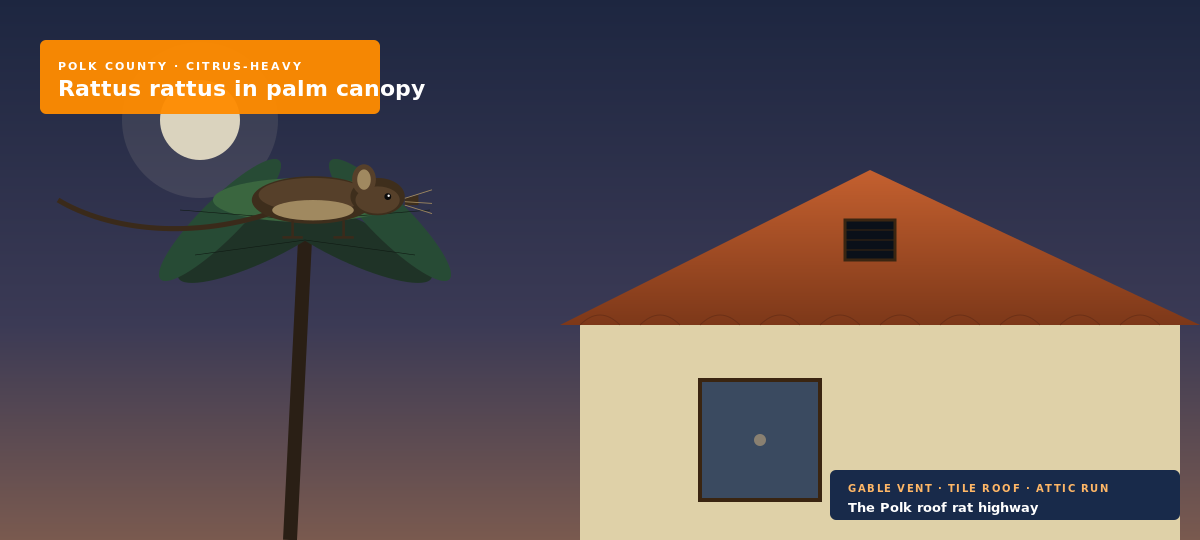
Scratching in the attic at 2 a.m.? That is a roof rat, and traps alone will not end it.
One call reaches a licensed, local exterminator who covers your address — and a real person answers, 24/7.
Talk to a licensed exterminator now
Call and we’ll connect you with a licensed, local exterminator who covers your address. It takes about two minutes, and a real person answers.
Free to call. Free to get matched. The licensed operator gives the quote.
24/7 line · A real person answers · Availability of same-day and emergency service depends on the provider.
Roof rat, Norway rat or house mouse? The fix depends on the tenant.
Three rodents cause essentially all of Polk County’s residential calls, and they behave differently enough that the wrong plan fails completely. The licensed operator confirms which one you have from droppings, rub marks and entry points — here is how to read the early evidence yourself.
Roof rat
Rattus rattus. The Polk County headliner. Climbs stucco, oak limbs and power lines; enters at the tile-roof eave gap and soffit vents; nests in attic insulation. Droppings are spindle-shaped with pointed ends, usually along the attic’s perimeter runs. Noise happens at night, right after sunset and before dawn.
Norway rat
Rattus norvegicus. The burrower. Lives at ground level — under slabs, sheds, wood piles and dense landscaping. Enters low: garage-door gaps, AC chases, foundation penetrations. Droppings are blunt-ended and thicker. Less common than roof rats here, but tougher digs when established.
House mouse
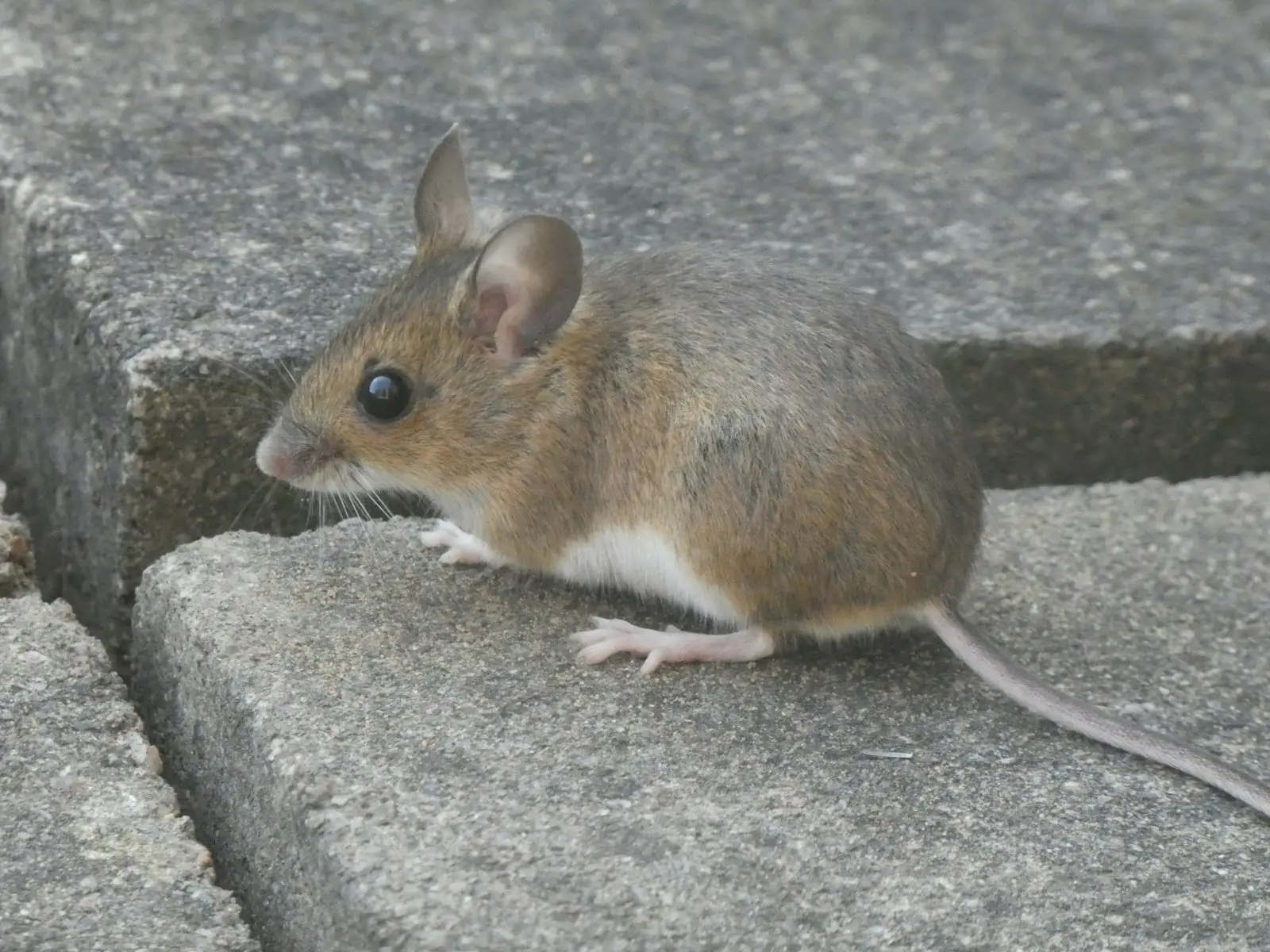
Mus musculus. Needs only a dime-sized gap. Lives inside walls, pantries and garage storage. Rice-grain droppings, gnawed food packaging, a musky smell in closed cabinets. Reproduces fast enough that a “couple of mice” is usually a population.
Evidence checklist — what to note before you call
- Where the noise is — attic perimeter (roof rat), under the floor or in walls near ground level (Norway rat or mouse).
- Droppings and location — photograph them; size and shape are the fastest species ID the operator can make remotely.
- Chew evidence — wire insulation, PVC, wood shavings around soffits or garage corners. Chewed wiring is the reason rodent calls are house-fire prevention, not just nuisance control.
- Grease rub marks — dark smudges along rafters, pipes and entry holes mark the commute routes exclusion work has to close.
Heard it again last night? Stop losing sleep to an attic tenant.
One call reaches a licensed, local exterminator who covers your address — and a real person answers, 24/7.
Free to call. Free to get matched. The licensed operator gives the quote.
Why Polk County is roof rat country
The tile-roof problem
Polk County’s housing stock leans hard on Spanish-tile and Mediterranean rooflines — especially Lakeland Highlands, Christina, the Winter Haven chain-of-lakes neighborhoods and the resort corridors toward Davenport and ChampionsGate. Barrel tile leaves a curved gap at the eave line that a roof rat walks through like an open door. Generic “rodent control” that ignores tile-specific closures (soft-wedge eave closures, screened soffit returns) fails within a season because the entry point never closed.
The oak-and-citrus commute
Roof rats are arboreal. Lakeland’s mature live oaks, palm crowns and the county’s residual citrus edge give them elevated highways onto rooflines — they rarely touch the ground between the neighbor’s oak and your attic. That is why the operator’s exclusion plan includes trimming-back recommendations and why a bait station at ground level does approximately nothing for an attic infestation.
The winter spike
There is no hard winter here, but the food supply still thins from November through February — and that is exactly when attic pressure peaks. If the scratching started when the nights finally cooled, you are on the classic Polk County timeline.
Why this matters beyond the noise
Rodents in Florida attics chew wire insulation (a documented fire risk), tunnel and compress blown insulation (an energy bill you can feel in August), and contaminate stored boxes with droppings and urine. CDC guidance treats rodent droppings as a disease vector — hantavirus is rare in Florida, but leptospirosis and salmonella contamination are not theoretical. Cleanup and sanitation are part of the job the licensed operator quotes, not an optional extra.
What a real rodent job looks like (so you can judge any quote)
The licensed operators this line routes to work a four-phase structure. If a quote you receive — from anyone — skips phases, ask why.
Inspection and entry-point map
Attic walk, roofline check, foundation sweep. The operator maps every entry point at a quarter inch or larger and identifies the species from droppings and rub marks.
Exclusion (the actual fix)
Tile-gap closures, soffit and gable vent screening, pipe-chase collars, garage-door sweeps, hardware-cloth work. Materials matter: steel wool and caulk alone are chew-through items.
Trap-out period
Snap or multi-catch trapping inside the sealed envelope, typically 1–2 weeks with re-checks, so the animals already inside are removed rather than sealed in. Sealing without a trap-out is how you get a dead rat in a wall cavity.
Sanitation and follow-up
Dropping removal, contaminated-insulation remediation where warranted, deodorizing to erase the pheromone trail that recruits the next family, and a quarterly re-check cadence. Full exclusion guide →
What decides the operator’s quote (we never set prices)
- Entry-point count and roof type — tile-eave work is more labor than a single garage gap.
- Attic condition — light droppings vs. contaminated insulation needing removal and re-blow.
- Structure size and access — two-story rooflines and steep pitches change the ladder math.
Pricing is set by the FDACS-licensed operator after the inspection — never by us. Free to call, free to get matched; you owe nothing until you accept the operator’s own quote.
How the rodent dispatch works
Full transparency: Lakeland Exterminators is a dispatch and matching service, not a licensed pest control operator. We connect you with FDACS-licensed operators; they own the work, the pricing and the warranty. Verify any Florida operator’s license — status, categories, discipline history — at the FDACS license search before you hire. Honest companies expect you to check.
Lakeland rodent questions, answered straight
Can a rodent control pro near me in Lakeland come out today for rats in the attic?
Call (888) 295-0220. The dispatcher matches you with an FDACS-licensed operator who does rodent exclusion and trapping in your part of Polk County. Same-day visits depend on the operator’s route; rats or mice in living areas or chewing wiring are worth flagging as urgent when you call.
I hear scratching but have never seen a rat — could it be something else?
Could be — squirrels run the same attic routes by day (roof rats are nocturnal, so timing is the tell), and the licensed operator will confirm from droppings and entry evidence. If it is wildlife rather than a rat or mouse, the operator or a licensed nuisance-wildlife trapper handles that under Florida’s separate wildlife rules. Either way the diagnostic visit sorts it — describe the timing and location when you call.
Why not just put out poison?
Rodenticide alone in an attic is the classic regret purchase: the animal dies somewhere unreachable in a wall cavity or duct chase, and the odor problem outlasts the rodent problem by weeks. It also does nothing about the open entry point, so the next rat moves in. Exclusion plus trap-out is slower on paper and dramatically better in practice — it is the difference between ending an infestation and renting to a rotating cast.
How fast can someone come out?
The line answers around the clock and routes by ZIP immediately. On-site timing belongs to the licensed operator — most in the network keep prompt availability for active-infestation calls, and same-day or emergency availability is subject to provider participation, location, technician availability and demand. Ask the operator for their real ETA when you talk.
What does rodent work cost in Polk County?
Set entirely by the licensed operator after inspection. The honest variables: number and difficulty of entry points, roof type, attic contamination level, and whether insulation remediation is warranted. Beware of any flat number quoted sight-unseen — the inspection is where a real quote comes from. The cost guide covers what to ask so the quote stays honest.
Do mice and rats mean my house is dirty?
No. In Polk County they mean your house is warm, has water somewhere, and sits within a tree-line commute of the last place they lived — which describes every house in the county. Sanitation affects how long they stay, not whether they arrive. The entry points are the variable you control, and that is exactly what exclusion work closes.
Will sealing the house trap rats inside?
Done right, no — that is what the trap-out phase is for. The operator seals the envelope, then traps inside it for one to two weeks so everything already in the structure is removed. One-way exclusion doors on active runs are the standard tool where a live route needs to keep working during the trap-out. Sealing everything in one visit with no follow-up is the shortcut that creates wall-cavity problems — a reason to prefer operators who quote the full sequence.
The attic noise does not fix itself. The line answers now.
One call reaches a licensed, local exterminator who covers your address — and a real person answers, 24/7.
Free to call. Free to get matched. The licensed operator gives the quote.
Related Polk County rodent reading
Which rodent you have changes where the exclusion work goes. These cover identification, seasonal timing and the damage that shows up first.
- Mouse or rat in your Lakeland home? — droppings, sounds and damage compared side by side
- Storm-drain Norway rats vs. attic roof rats after heavy Lakeland rain — telling the ground-level species from the climber
- Rats chewing car wires in Lakeland — the signs, and the fixes that actually hold
- When do rats move indoors in Florida? — reading the fall surge before it reaches the attic
Disclosure
Lakeland Exterminators is a dispatch and matching service. We connect Polk County callers with FDACS-licensed structural pest control operators. We are not a licensed pest control operator. We do not perform rodent control work, set prices, issue warranties, or carry pest control trade insurance. All pricing, scheduling, treatment plans, warranties and service terms are determined by the FDACS-licensed operator dispatched to your address under Chapter 482, Florida Statutes.
Same-day and 24/7 emergency services are subject to provider participation, location, technician availability, and demand. Availability is not guaranteed and may vary by market and appointment capacity.
License status of any operator you connect with is publicly verifiable at the FDACS license search.