Quick answer: Florida homes see roach activity in every month of the year because the state never has a real winter die-off. German cockroaches live entirely indoors and breed continuously wherever there’s warmth, moisture, and food — conditions a Florida kitchen provides 365 days a year — while American cockroaches and other outdoor species keep moving in from the yard whenever it’s hot, whenever it rains, and whenever a cold snap sends them looking for shelter. The species and the trigger change with the season; the roaches themselves never really stop.
Why doesn’t winter slow roaches down here?
In most of the country, a hard freeze knocks back outdoor insect populations every year, and indoor pests lose a steady stream of new arrivals from outside. Florida rarely gets that reset. Central Florida’s mildest winter nights still sit well above the temperature where cockroach activity actually stops, and a German cockroach population living inside wall voids and cabinet gaps never experiences winter at all — the indoor climate stays warm, humid, and food-rich in December exactly as it does in July. That’s the core reason pest control companies across the state field about the same volume of roach calls in January as they do in August, just for different reasons.
How do German and American roaches differ in what drives them?
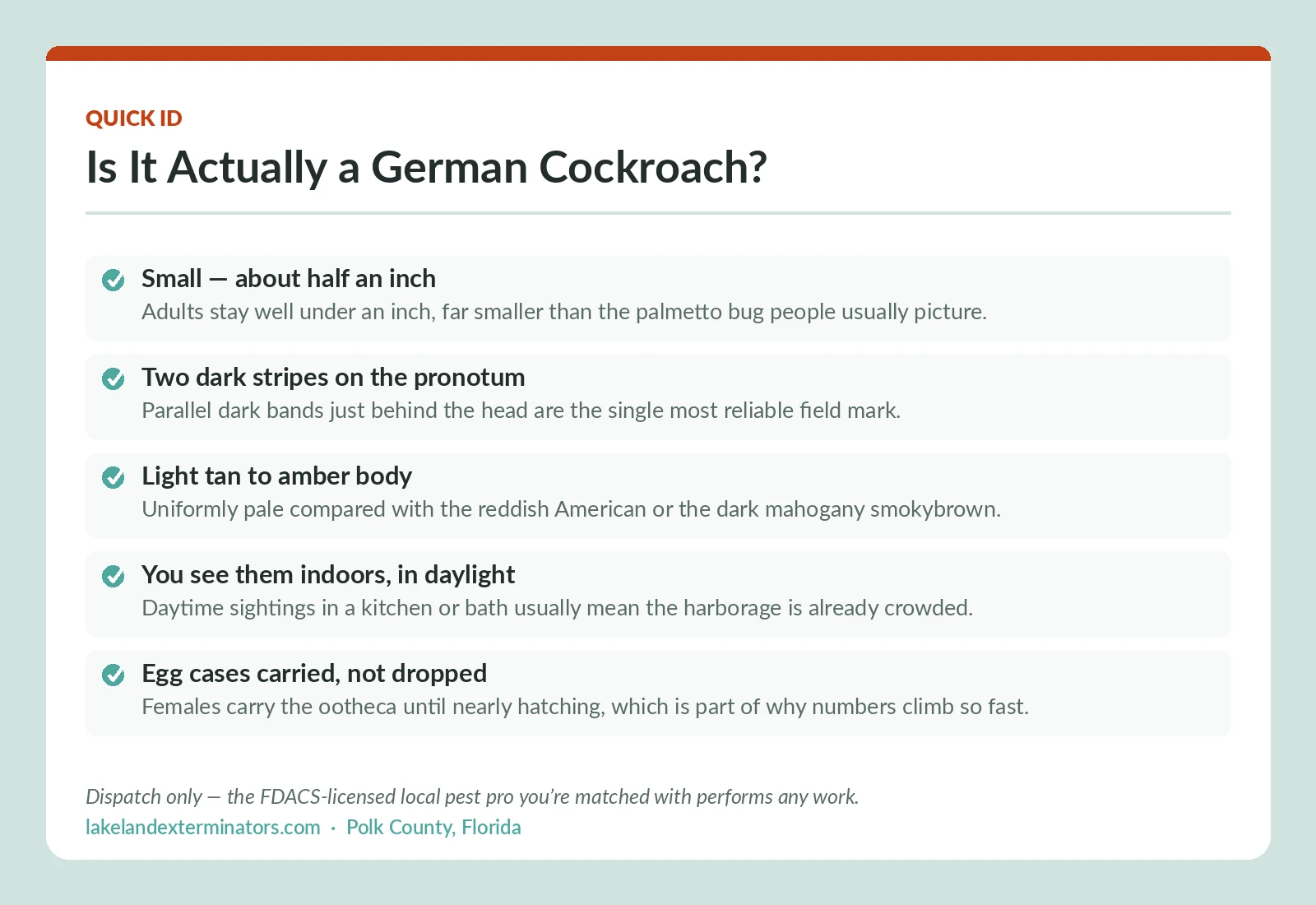
The two species people call about most often behave almost like separate problems wearing the same name. German cockroaches (Blattella germanica) are small, tan, marked with two dark stripes just behind the head, and they never willingly go outside — their entire life cycle happens in the warm, moist harborage behind a refrigerator, under a sink, or inside a cabinet hinge. A single female produces an egg case carrying 30–40 eggs roughly every three to four weeks, and that reproduction rate barely slows down regardless of the calendar. Once established, a German roach population is a year-round indoor problem, full stop.
American cockroaches, often called palmetto bugs in Florida, are a different story. They’re much larger, reddish-brown, capable of flight, and they live mostly outdoors — in mulch beds, storm drains, palm fronds, and woodpiles — only coming inside when conditions push them to. That means their indoor appearances track the weather: a heavy summer rain floods their outdoor harborage and sends them looking for a dry doorway; a rare cold snap does the same thing in reverse, pushing them toward a warm structure. Florida delivers both triggers on a regular schedule, which is why palmetto bug sightings never fully disappear either — they just shift reason.
What does Florida’s climate specifically contribute?
Three factors compound on top of each other almost everywhere in the state. First, humidity: cockroaches need consistent moisture to survive, and Florida’s average relative humidity rarely drops low enough to stress a population indoors or out. Second, the rainy season itself, roughly June through September, floods ground-level harborage for outdoor species and drives a predictable indoor surge as roaches, along with ants and other pests, look for the nearest dry structure. Third, building style: slab-on-grade construction, common across Central Florida, puts a home’s plumbing penetrations, expansion joints, and utility chases close to ground moisture, giving roaches (and other pests) more entry opportunity than a home with a fully sealed, elevated foundation.
Add a fourth factor specific to fast-growing parts of the state: high rental turnover. A German roach population doesn’t leave when a tenant does — it stays in the walls and cabinets, waiting for the next household’s food and moisture habits to feed it again. That’s a major reason apartment and rental-heavy areas tend to report more chronic roach problems than owner-occupied neighborhoods with more stable, longer-term residents.
Why doesn’t a can of spray solve it?
Contact sprays and foggers kill roaches they directly touch, which is a small fraction of a German roach population living deep in cabinet voids and wall gaps at any given time. Foggers in particular can scatter a concentrated population into new hiding spots throughout a kitchen and adjoining rooms, turning a contained problem into a spread-out one. There’s also a resistance issue specific to this species: some German roach populations have developed an aversion to the glucose used in older bait formulas, meaning a bait that worked in a different house, or worked in this one years ago, can be entirely ignored by the current population. A licensed operator identifies the right bait type and placement through inspection, then follows up with monitoring to confirm the population trend is actually dropping — not just assumes it.
Does sanitation actually matter if roaches feed on nearly anything?
It matters, but it’s not the whole answer. A spotless kitchen can still develop a German roach infestation because the population only needs a crumb and a drop of water to sustain itself, and roaches feed on grease film, pet food residue, and even glue and paper in a pinch. Good sanitation removes the easy food sources that let a small population grow fast, but it won’t remove roaches already established in a wall void, and it won’t stop a new introduction from a grocery bag, a delivered package, or a neighboring unit. Sanitation is a supporting habit, not a substitute for actually addressing an existing colony.
Does it matter where in Florida you live?
Somewhat. Coastal and lake-adjacent areas generally run more humid than inland ones, which keeps both German and American roach populations a little more active a little later into any given evening, and supports a broader range of outdoor species overall. Inland Central Florida still gets plenty of pressure — the rainy season and slab construction are statewide realities — but a home two blocks from open water or a canal typically deals with more outdoor-species pressure at the door than one further from any standing water. Neither situation is roach-free; the difference is mainly which species shows up more often and how late into the night activity continues.
For a full breakdown of the species and the treatment approach that actually works, see the German cockroach guide for Lakeland and the German roach vs. palmetto bug identification guide. If you’re dealing with an active kitchen infestation right now, the German roach control dispatch page can get you matched with a licensed operator today.
Roaches showing up in daylight, or a bait that used to work stopped working?
A dispatch coordinator can match you with an FDACS-licensed roach control operator in your Florida city — inspection first, targeted program second.
Free to call · 24/7 · The licensed operator you’re matched with gives the quote.
Disclosure: Lakeland Exterminators is a dispatch and matching service. We connect callers with FDACS-licensed structural pest control operators. We are not a licensed pest control operator and do not perform treatment, set prices, or issue warranties. All pricing, scheduling and treatment plans are determined by the FDACS-licensed operator dispatched to your address under Chapter 482, Florida Statutes.