Call (904) 943-3349

The Snowbird Return: A Pest Checklist for Reopening Your Florida Home

Seasonal Homes · Florida Field Notes · Updated August 2026

A Florida house does not pause while you summer up north. Six quiet months is exactly how long several pests need to turn a closed home into an occupied one.

Every October and November, tens of thousands of seasonal residents unlock Florida doors that have not opened since spring — in Naples and Sarasota, on the Space Coast, across the golf communities of the interior. Most reopenings are uneventful. The bad ones share a pattern: the problem started in June, ran undisturbed all summer, and announced itself at the door — a smell, a drift of wings on a windowsill, droppings down a hallway. The fix is not anxiety; it is a sequence. Here is the reopening checklist operators wish every returning owner ran, in the order that catches things fastest.

Walked in and found something already?

Describe what you are seeing — droppings, wings, spotting, a smell — and get matched with an FDACS-licensed operator near your Florida home.

(904) 943-3349Tap to call — 24/7 dispatch

Free to call. Free to get matched. The licensed operator you’re matched with gives the quote.

Quick answer

Reopening a Florida home after the summer? Run the checks in this order before unpacking: smell test at the door, attic and garage scan for droppings, windowsill sweep for termite wings and drywood pellets, bedroom seam check before the first night’s sleep, then exterior walk for mud tubes and gnawed entries. Twenty minutes total — and call (904) 943-3349 for a licensed operator if any check comes up positive.

What can actually establish itself in six empty months?

The vacancy all-stars, in order of frequency. Rodents lead: a roof rat pair entering in June is a multi-generation colony by November — empty homes are incubators because nobody hears week one, which is why seasonal-home rodent jobs run bigger than occupied-home jobs everywhere from Naples to Boca Raton. Termites work silently in any season: a spring subterranean swarm you were not there to see leaves its evidence as shed wings on sills, and drywood colonies pushed pellets all summer with nobody to sweep them — which is exactly what makes the windowsill sweep diagnostic gold after a vacancy. German roaches only persist where food does (a cleaned-out kitchen starves them), but American roaches need nothing you control — they hold plumbing lines and garages happily. And bed bugs answer the trick question: an infestation seeded by a spring guest can still be alive in fall, because adults survive many months without feeding in a climate-controlled home. A quiet house is not a clean bill of health; it is a paused tape.

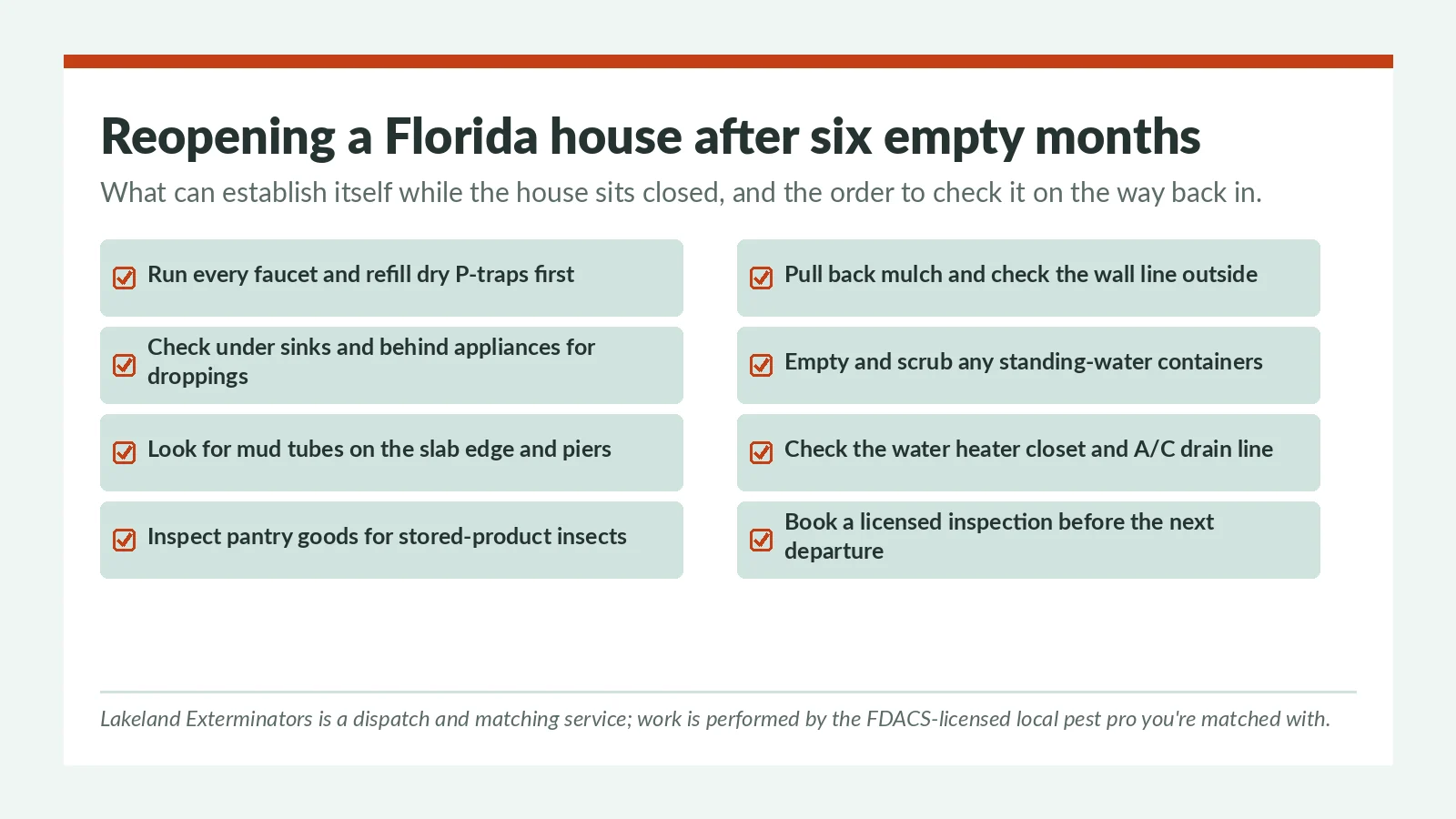
Snowbird reopening pest checklist for a Florida home — dry P-traps, rodent evidence, slab-edge mud tubes and stored-product insects, verified by the licensed local pest pro you're matched with
Six closed months is enough time for a small problem to become an established one.

The reopening checklist, room by room

  • At the door — the smell test: musty-sweet or ammonia notes mean rodents; a general sour mustiness means moisture (and moisture means roach and termite comfort). Trust your nose before the AC dilutes the evidence.
  • Garage and laundry first: the two most common rodent beachheads — scan wall lines and the water-heater platform for droppings and gnawed boxes before carrying luggage through.
  • Windowsill sweep: shed termite wings (all the same size, translucent) mean a swarm happened inside; coarse sand-like pellet cones under sills or frames mean drywood activity overhead. Photograph before cleaning — the evidence pattern helps the inspector.
  • Kitchen and baths: run every faucet and flush every toilet (refilling dry P-traps closes the roach highway from the sewer), then check under sinks for droppings and roach specks.
  • Bedrooms before the first night: pull fitted sheets and check mattress seams and box-spring corners for rust-colored spotting — two minutes that beats discovering a spring guest’s souvenir at 2 a.m. The full protocol is in the Sarasota and Melbourne bed bug guides.
  • Exterior walk: mud tubes on the slab edge and garage returns, gnawed soffit corners, displaced vent screens, and the state of the canopy gap over the roofline. Tile-roof homes: scan the eave arches.
  • The AC check: if the air handler smells when it first runs, the return may be pulling from a contaminated attic — stop and get the attic inspected before running it for days.

What should next spring’s departure look like?

The reopening you want next fall is built the week you leave. The departure protocol that operators see working: a pre-departure exclusion pass (eave-line entries sealed, vents screened, canopy trimmed off the roof — the same list detailed in the Naples seasonal-home guide); kitchen stripped of everything a roach or rodent can eat, fridge emptied and propped, traps unset but interceptor cups left under bed legs as passive monitors; water off at the main with P-traps topped (a splash of mineral oil slows evaporation); and one or two mid-summer walk-throughs on the house-watch calendar with a specific pest brief — look for droppings, tubes, pellets and interceptor hits, photograph anything found. Owners in termite-prone stock should also note the calendar: spring swarm season happens while you are away, so a house-watch photo of wings in May is your cue to book a licensed inspection for — not after — your return. A seasonal home with sealed entries, empty pantry, monitored beds and briefed eyes is a house that reopens in twenty boring minutes. That is the goal.

Sealing those eave-line entries and vent screens is repair work, not pest work — if your exterior walk turns up gnawed soffit corners, torn screens, or rotted trim that needs fixing before it can be sealed, a local handyman closes that gap first. Polk County homeowners can start with Best Lakeland Handyman, a local repair pro we point neighbors to for exactly this kind of pre-departure fix.

Want the reopening inspection done professionally this year?

The dispatch line matches seasonal homes statewide with FDACS-licensed operators — including coordination with your house-watch service.

One tap. One call. Matched.

(904) 943-3349Tap to call — 24/7 dispatch

Free to call. The licensed operator gives the quote.

Reopening questions, answered straight

The house smells fine and looks clean. Are we done?
Mostly — but run the windowsill sweep and the bedroom seam check anyway; both catch problems that produce no smell and no mess in living areas. The twenty-minute full checklist exists because the two worst reopening surprises (drywood evidence and bed bugs) are exactly the quiet ones.
We found a drift of insect wings on a windowsill. How bad is that?
It means a termite swarm emerged inside while you were away — the colony is in or under the house, and the swarm was its population surplus. It is not an overnight emergency, but it is a this-month item: photograph the wings, do not vacuum every sill (leave evidence), and book a licensed WDO inspection to identify species and location.
Our house-watch service checked monthly. Why did something still establish?
Because a standard house-watch visit checks water, power and storm damage — not eave lines, attic corners or mattress seams. The fix is a specific pest brief: give the service the checklist above, or have a licensed operator do one mid-summer walk-through and send the house-watch the written findings to monitor against.
Does the checklist differ for a condo?
The interior checks are identical; the exterior walk becomes an association question — ask management what building-level termite and rodent monitoring exists and when common areas were last inspected. For coastal towers, add the balcony: standing water in planters and drains is the container-mosquito source nine floors up.

Disclosure

Lakeland Exterminators is a pest control dispatch and referral service, not a licensed pest control operator. All pest inspections, treatments and quotes are performed by independent pest control operators licensed by the Florida Department of Agriculture and Consumer Services (FDACS) and insured in their own name. Calling the dispatch line is free and creates no obligation; the licensed local operator you’re matched with sets their own pricing and terms.

Go deeper: Naples termite treatment (the seasonal tent window), Clearwater bed bug treatment, Signs of termites, The rodent dispatch guide · All pest control services

Leave a Comment

📞 Tap to call (904) 943-3349