Waking up to itchy welts in a row, or spotting rust-colored specks along a mattress seam in your Auburndale home? Bed bugs don’t care how clean a house is — they travel in on luggage, used furniture, and visitors, and Polk County’s warm interiors let them breed year-round. This page explains how bed bug treatment works in Auburndale so you know what to expect.
Dealing with a pest problem right now?
📞 Call now — get matched with a licensed local exterminator: (888) 295-0220When you call, stay on the line for a few seconds while we match you with the licensed local exterminator for your area. Have your address and a quick description of the problem ready.
Licensed local pros · Fast response, subject to availability · No obligation
Why Auburndale gets year-round bed bug pressure
Auburndale sits between Lakeland and Winter Haven on US 92, wrapped around Lake Ariana and Lake Whistler, and its position on the county’s northeast corridor is part of the story. This is a working community with substantial warehouse, distribution, and logistics employment in and around the CSX intermodal corridor, which means a lot of shift work, a lot of travel, and a steady flow of people between job sites, motels, and multi-family housing. Every one of those movements is a potential introduction route, because bed bugs travel on belongings rather than under their own power.
The climate does the rest. Bed bugs are indoor insects whose development rate tracks temperature, and a Central Florida home holds comfortable indoor temperatures twelve months a year. In a colder climate, an infestation slows through the winter. Here it does not. A population introduced in February develops at essentially the same rate it would in July, which is why Auburndale sees a year-round baseline rather than a summer-only spike.
The housing mix matters too. Auburndale runs from an older core near downtown and the lakes — mid-century frame and block homes, converted duplexes, small apartment buildings — out to newer subdivision product on the edges. Older multi-family stock is the harder scenario, because shared walls, shared plumbing chases, and shared laundry give a population routes between units that no single tenant controls.
The signs Auburndale homeowners notice first
Almost nobody finds bed bugs first. What people notice is a pattern of bites, and bites are the least reliable evidence there is: reactions vary enormously between individuals, two people in the same bed can have completely different experiences, and a meaningful share of people show no visible reaction at all. Before you accept a treatment plan, look for the physical evidence that actually confirms it.
Fecal spotting
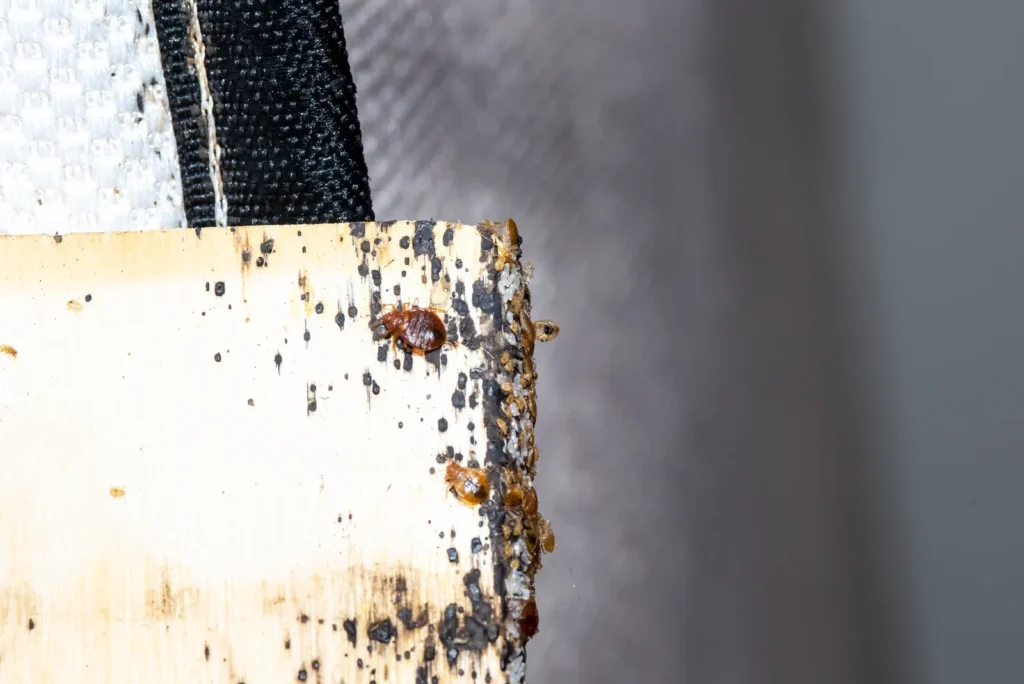
Dark, ink-like dots that bleed slightly into fabric, concentrated where bugs rest rather than where they feed — mattress piping, the seams and staples of a box spring, the underside of the bed frame, and the corners of the headboard where it meets the wall.
Cast skins and eggs
Bed bugs pass through five nymph stages and shed a translucent amber shell at each one, so an established population leaves a scatter of empty skins near its harborage. Eggs are about a millimetre, pearly white, and cemented in place in clusters — they do not roll loose when you tip the surface.
Live insects
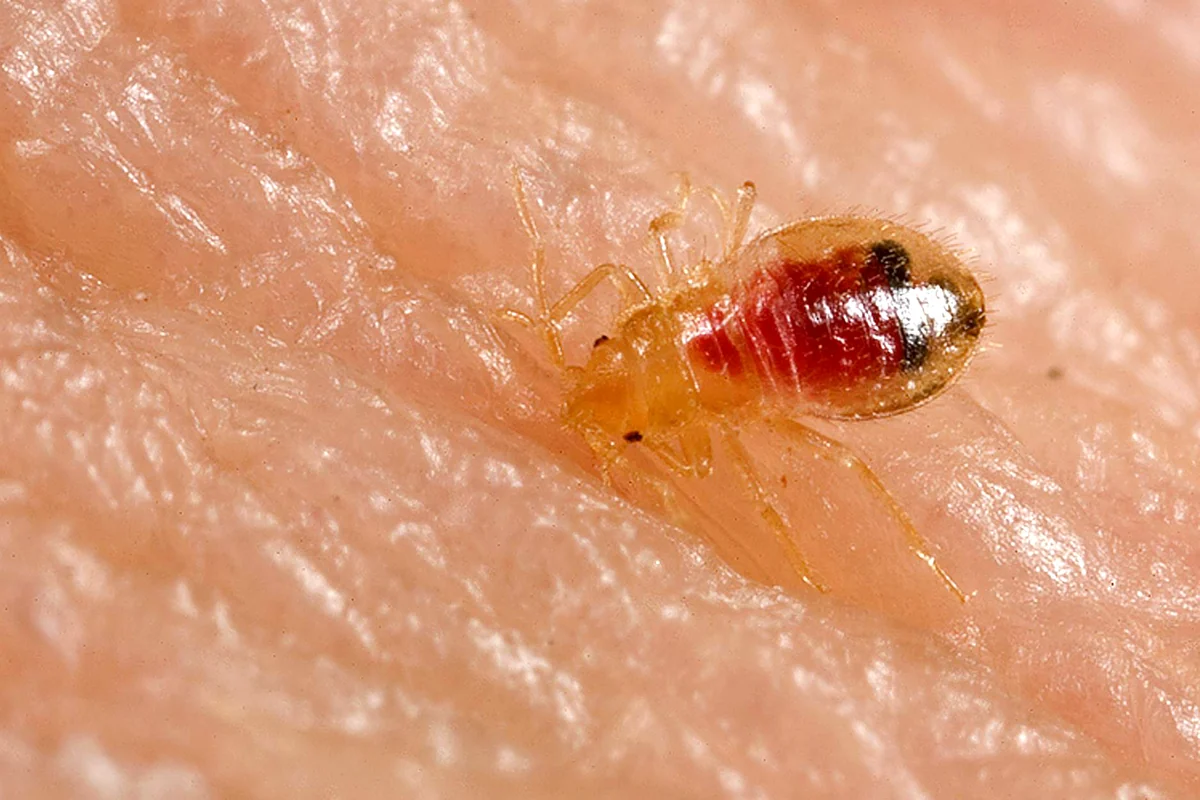
Adults are flat, oval, and reddish-brown, roughly the size and shape of an apple seed. A recently fed bug is rounder and much darker. Nymphs are smaller and pale enough to be easy to miss against light fabric.
Check the room, not just the bed
In an established infestation the bed is the epicentre but not the whole picture. Check the seams of upholstered chairs, the underside of nightstand drawers, behind headboards mounted to the wall, along baseboard and shoe molding within a few feet of the bed, behind loose wallpaper and outlet plates, and inside the folds of curtains that touch the bed. In an apartment or duplex, also check the wall shared with the neighbouring unit — that is the route a population uses to move between addresses.
Bed bugs vs. what people mistake for them
Several other things produce marks and small insects that get called bed bugs in Auburndale homes:
- Carpet beetle larvae — fuzzy and bristled rather than smooth, found in lint, stored wool, and undisturbed closets; their bristles can irritate skin and produce a rash that gets blamed on bites
- Bat bugs — visually near-identical to bed bugs and a genuine trap, because they point to a roost in the attic or a wall void rather than to the bed; treating the bedroom alone will not resolve them
- Spider beetles — rounded, shiny, and often mistaken for engorged bed bugs
- Fleas — bites cluster around the ankles and lower legs rather than on areas exposed while sleeping, and there is almost always a pet or a recent pet in the history
- Non-insect causes — contact dermatitis, folliculitis, and drug reactions all produce marks that people reasonably read as bites
This is why a licensed inspection is worth doing before you commit to an expensive treatment method: identifying the actual organism determines whether the correct work is in the bedroom, in the attic, or on the dog.
How treatment works here
Heat
Whole-room or whole-structure heat raises the space above the lethal threshold for every life stage including eggs, in one session. It suits cluttered homes and reaches voids a technician cannot open. The constraints: heat-sensitive items come out first, the structure has to tolerate the temperature, and there is no residual afterward, so re-introduction is untouched by the treatment that already happened.
Targeted chemical with an insect growth regulator
A residual program applies labeled products precisely to harborage and travel routes, normally alongside vacuuming, mattress and box-spring encasements, and an IGR to disrupt development. Because eggs are the most protected stage, follow-ups are timed to catch nymphs after hatch. At the indoor temperatures Auburndale homes hold year-round, that window is short — commonly about a week to ten days — which is why the second visit generally lands around the two-week mark.
Combination, and why multi-family changes it
In an apartment or duplex, treating one unit in isolation frequently fails, because the population simply retreats along the shared wall and returns. A licensed company working a multi-family building will normally want to inspect and often treat adjoining units, which is a scheduling and access problem as much as a technical one. If you rent, this is the single most useful thing to raise with the property manager early.
Encasements are a tool, not a cure
A quality mattress and box-spring encasement does two things well: it traps anything already inside so it cannot feed, and it removes the seams and buttons that make a mattress ideal harborage, so future monitoring is far easier. What it does not do is treat the room. Encasements are part of a plan and need to stay on and intact — a tear reopens the harborage.
What to do before the inspection
- Run washable bedding and clothing through a dryer on high heat for at least 30 minutes — the dryer does the killing, not the wash cycle
- Place interceptor cups under bed and furniture legs so you have dated, physical evidence of activity and of decline after treatment
- Keep sleeping in the same bed if it is the confirmed harborage; relocating to the couch usually creates a second infestation site
- Bag and seal anything you remove from the room and keep it sealed until it has been laundered or treated
- Photograph and date what you find, especially if you rent
- Do not use over-the-counter foggers — they disperse bugs into wall voids, miss eggs, and make the professional job harder
- Do not discard the mattress reflexively; dragging it through the house spreads bugs on the way out, and encasement is usually the better call
Travel, work bags, and keeping it from coming back
Given how much of Auburndale’s employment involves movement, a small routine pays off. Keep luggage off the bed and off upholstered furniture, and unpack into the dryer rather than into the closet after a trip. Store a work bag somewhere hard-surfaced rather than on a bed or sofa. When you buy secondhand upholstery — and it moves quickly here — inspect the seams, tufting, staple lines, and underside frame with a bright flashlight before it enters the house. The same introduction routes run north into Polk City and north Polk County, where the older frame and manufactured-home stock changes what treatment has to reach.
If you rent in Auburndale
Florida Statute 83.51(2)(a) requires the landlord of a dwelling unit other than a single-family home or duplex to make reasonable provisions during the tenancy for extermination of rats, mice, roaches, ants, wood-destroying organisms, and bed bugs. For a single-family home or duplex, those obligations can be reassigned by written agreement, so the lease controls. Report in writing as soon as you have evidence, keep copies, and keep dated photographs. Any company doing the work should hold a current Chapter 482 pest control license from the Florida Department of Agriculture and Consumer Services, which publishes a license lookup you can check before treatment starts.
Get matched with a licensed Auburndale bed bug pro
Lakeland Exterminators is a dispatch and matching service, not a licensed pest control operator. We do not inspect, treat, price, or warranty the work. Tell us what you are seeing and where, and we route it to an independent, FDACS-licensed company covering Auburndale and northeast Polk County; that company inspects and sets its own scope, pricing, and terms. For the wider county picture, start at pest control in Polk County.
Auburndale bed bug FAQs
Does heat treatment kill bed bug eggs?
Yes, when it is executed properly. Heat is lethal to every life stage including eggs, which is its main advantage over most residual products. The caveat is coverage: eggs survive in cold spots, so a licensed company uses multiple remote sensors and fans to confirm the lethal temperature actually reaches voids, wall bases, and closets rather than just the middle of the room.
Can I stay in my Auburndale home during treatment?
Not during the active service. Heat requires the structure to be vacated while temperature is held, and residual applications require a re-entry interval set by the product label. A licensed company gives you the specific timing in writing before the visit; it is a label requirement, not a preference.
I got bed bugs from a hotel trip. Whose responsibility is the treatment?
In an owner-occupied home, yours. In a rental, Florida Statute 83.51(2)(a) puts extermination duties on the landlord for dwelling units other than single-family homes and duplexes, regardless of how the bugs arrived; for a single-family home or duplex the lease can reassign them. Report it in writing and keep dated records either way.
How do I know it is bed bugs and not carpet beetles or bat bugs?
Go by physical evidence, not bites. Bed bugs leave ink-like fecal spotting along mattress piping and frame seams, translucent cast skins, and pearly eggs cemented in clusters. Carpet beetle larvae are fuzzy and bristled and live in lint and stored wool. Bat bugs look nearly identical to bed bugs and indicate a roost in an attic or wall void, which changes the treatment entirely.
I live in a duplex or apartment. Will treating my unit be enough?
Often not. Bed bugs move between units along shared walls, plumbing chases, and outlet boxes, so a population can retreat next door during treatment and return afterward. Licensed companies working multi-family buildings normally want to inspect and frequently treat adjoining units, which usually requires the property manager’s involvement.
Why do bed bugs seem active all year here rather than just in summer?
Because bed bugs are indoor insects and their development rate tracks indoor temperature, not outdoor season. Central Florida homes hold comfortable indoor temperatures twelve months a year, so a population introduced in winter develops at close to the same rate it would in July. There is a year-round baseline rather than a seasonal pause.
Should I throw out my mattress?
Usually not, and rarely as a first move. Encasing the mattress and box spring traps anything inside so it cannot feed and removes the seams that make monitoring hard. Dragging an infested mattress through the house also spreads bugs along the route out. Discard only if the inspector says the item is beyond salvage.
How long before I know the treatment worked?
Give it through the follow-up cycle. Because eggs hatch roughly a week to ten days after treatment at Florida indoor temperatures, a single quiet week means little. Interceptor cups under the bed and furniture legs give you dated evidence over the following several weeks, which is far more reliable than whether anyone got bitten last night.
Last reviewed August 2026 · reviewed on a quarterly cycle. Lakeland Exterminators is a dispatch and matching service that connects Polk County homeowners with independent, FDACS-licensed pest-control companies; we are not a licensed pest control operator and do not perform treatments ourselves.
Disclaimer: Lakeland Exterminators is a local dispatch and referral service, not a licensed pest-control operator. We connect Polk County, Florida homeowners with independent, FDACS-licensed and insured pest-control companies. All inspections and treatments are performed by those independent providers, who set their own pricing, scheduling, and service terms.
Any reference to same-day, emergency, or 24/7 service describes the typical scheduling of matched independent providers and is not guaranteed; actual response times vary by provider, season, location, and demand.