Found bed bugs in a Polk City home near the Van Fleet Trail or out toward Mount Olive, and not sure who covers this corner of the county? North Polk’s mix of older frame houses, mobile homes, and seasonal rentals gives bed bugs plenty of harborage. Here’s what licensed bed bug treatment looks like here in 33868.
Dealing with a pest problem right now?
📞 Call now — get matched with a licensed local exterminator: (888) 295-0220When you call, stay on the line for a few seconds while we match you with the licensed local exterminator for your area. Have your address and a quick description of the problem ready.
Licensed local pros · Fast response, subject to availability · No obligation
Why north Polk County is its own bed bug situation
Polk City sits at the top of the county, closer to the Green Swamp and the Van Fleet Trail trailhead than to anything in Lakeland, and that distance shapes the problem in two ways. First, the housing stock here is not the stucco-and-slab subdivision product that dominates the I-4 corridor: north Polk runs heavily to older wood-frame houses, manufactured and mobile homes, and a share of seasonal and agricultural-worker housing. Every one of those construction types offers bed bugs more void space, more seams, and more unsealed penetrations than a modern sealed build does. Second, a smaller community moves furniture around differently, which changes how infestations spread from address to address.
None of that makes Polk City unusually infested. Bed bugs are indifferent to income, cleanliness, and ZIP code — they are hitchhikers that go where people and belongings go. What the local building stock changes is where they hide and how a treatment has to be executed to actually reach them, and that is worth understanding before you compare approaches.
Where bed bugs hide in Polk City housing stock
Manufactured and mobile homes
In a manufactured home, the classic harborage points are not the ones people check. The seam where the floor decking meets the wall panel, the underside of built-in cabinetry and bench seating, the hollow cores of interior doors, and the wiring chases running behind outlets and switch plates all give bed bugs protected voids within a few feet of a sleeping human. Because these homes are built as assemblies of panels rather than poured and framed on site, the joints between those panels are continuous highways.
This matters enormously for treatment. A heat job in a manufactured home is not the same job as a heat job in a block house, and a chemical program that treats only the bed and the baseboards will miss the chases entirely.
Older wood-frame houses
North Polk’s older frame homes bring a different set of voids: gaps behind original baseboard and shoe molding, separations where wood flooring meets the wall, picture rail and door casing that has pulled slightly away from plaster or panel, and any wall the house has accumulated over sixty or seventy years of small repairs. Antique and heirloom wooden bed frames are especially good harborage, because the joinery gives bugs cracks that a modern metal or platform frame does not.
Rentals, guest rooms, and rooms that get used occasionally
A spare bedroom that gets slept in twice a year is a common blind spot. Bed bugs can persist for months without feeding, so a low-level population in a guest room can go unnoticed until a visitor stays and reports bites — by which point it has had a long time to spread into adjoining rooms along the same wall.
Why heat is harder in a manufactured home
Manufactured homes heat unevenly. Metal skirting, thin wall assemblies, and floor voids that are open to outside air all create cold spots where eggs can survive a treatment that looked successful on the thermostat. A licensed company running heat in a Polk City manufactured home should be placing multiple remote sensors — in floor voids, in exterior wall bases, inside closets and cabinetry — and moving air with fans so the lethal temperature actually arrives everywhere, not just in the center of the room where the equipment sits.
How bed bugs get into a north Polk home
In a tight community, secondhand furniture moves fast — church sales, yard sales, estate cleanouts, hand-me-downs between relatives across a few streets. A single infested recliner or upholstered headboard can seed three households before anyone connects the bites to the couch. If you have recently brought in used upholstery, inspect the seams, tufting, staple lines, and the underside of the frame with a bright flashlight before it comes through the door, and keep it out of the bedroom until you have looked.
The other routes are the ordinary ones: luggage returning from travel, a guest’s overnight bag, a work bag that gets set down in an infested location, and shared laundry facilities where an infested load and a clean one sit on the same folding table. Moving between rentals carries populations too — boxes and mattresses packed in an infested unit arrive intact at the new address.
For the wider county picture and the seasonal pattern behind it, see why Polk County bed bug calls spike in summer.
Confirming that it is actually bed bugs
Bites alone are not a diagnosis. People react to bed bug bites very differently — some show welts in a row within hours, others show nothing at all for weeks — and several other things produce similar marks. Before you commit to a treatment plan, look for physical evidence:
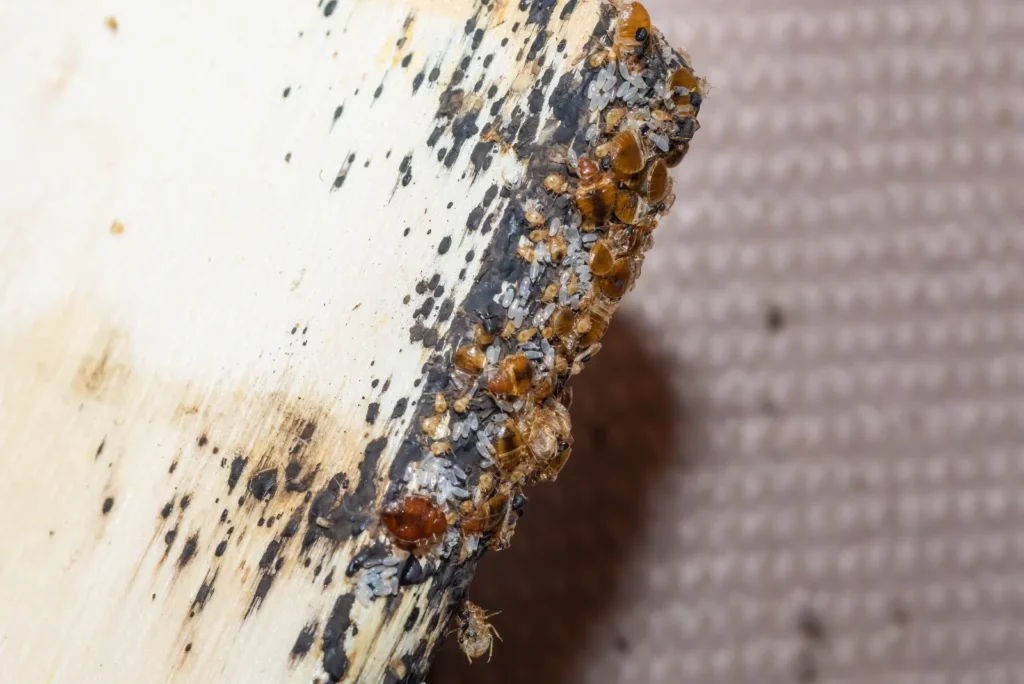
- Fecal spotting — dark, ink-like dots that bleed slightly into fabric, concentrated along mattress piping, box-spring seams, and the underside of the bed frame
- Cast skins — translucent amber shells left behind at each of the five nymph molts, often in cracks near the harborage
- Eggs — roughly a millimetre, pearly white, cemented in place in clusters rather than loose
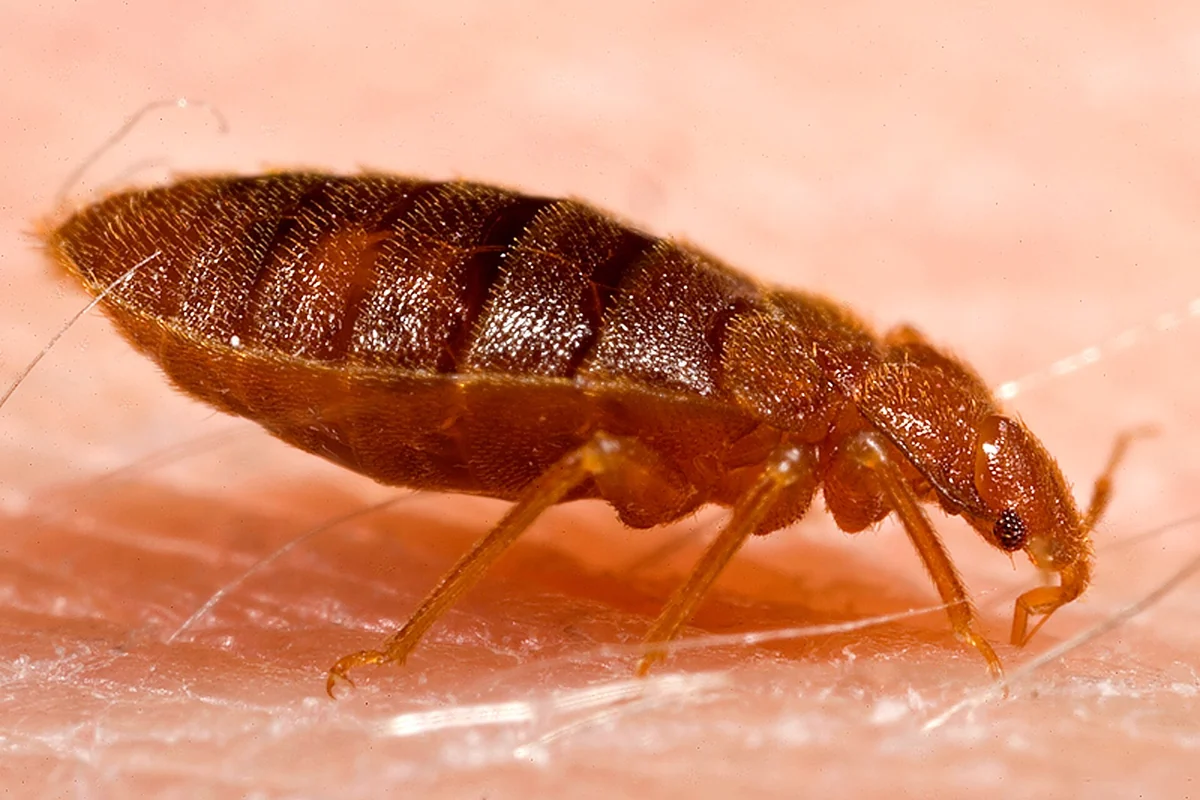
- Live insects — flat, oval, reddish-brown adults about the size of an apple seed; nymphs are smaller and paler, and a recently fed bug is rounder and darker
Common look-alikes include carpet beetle larvae (fuzzy, bristled, found in lint and stored wool), spider beetles, and bat bugs, which are nearly identical to the naked eye and point to a roost in the attic or wall rather than the bed — a distinction that completely changes the treatment. Interceptor cups under each bed and furniture leg are a cheap, honest monitoring tool: they catch bugs moving to and from the bed and give you dated evidence of whether a population is present and whether it is declining after treatment.
What licensed treatment looks like here
Whole-room or whole-structure heat
Heat raises the entire space above the lethal threshold for every life stage, eggs included, in a single session. Its advantages in Polk City are real: it works in cluttered homes, it reaches into furniture and voids that a technician cannot open, and it does not require the occupant to discard belongings wholesale. Its constraints are equally real — heat-sensitive items (aerosols, medications, candles, vinyl records, some electronics and musical instruments) come out first, the structure has to be able to take the temperature, and heat leaves no residual, so anything that walks back in afterward is untouched.
Targeted chemical with mechanical removal
A chemical program uses labeled residual products applied precisely to harborage and travel routes, usually combined with vacuuming, mattress and box-spring encasements, and an insect growth regulator to disrupt development. It is staged: because eggs are the hardest stage to kill, follow-up visits are timed to catch nymphs after they hatch. At the indoor temperatures Florida homes hold year-round, eggs commonly hatch within about a week to ten days, which is why a follow-up roughly two weeks after the first service is standard rather than optional.
Combination
The practical answer in a lot of Polk City homes is both: heat the rooms with confirmed heavy activity, then residual-treat the perimeter, adjoining rooms, and travel routes to catch stragglers. Which combination fits your home is an inspection question, not a phone question. For the underlying trade-offs, compare heat vs. chemical bed bug treatment. The same decision plays out somewhat differently in the older subdivisions to the southeast — see bed bug treatment in Auburndale, FL for how that housing stock shifts the approach.
Preparation is part of the treatment, not a formality
Whichever method is chosen, the outcome depends heavily on prep: laundering and drying textiles on high heat, decluttering harborage, pulling furniture off walls, and giving the technician access to closets, outlet plates, and the perimeter of every room. A licensed company will give you a written prep sheet specific to the method it is using. Following it exactly is the single largest variable you personally control.
What to do — and not do — before an inspection
- Do run washable bedding and clothing through a dryer on high heat for at least 30 minutes; the dryer, not the wash, is what kills
- Do place interceptors under bed and sofa legs so you have dated evidence of activity
- Do keep sleeping in your own bed if it is the confirmed harborage — moving to the couch or a spare room usually spreads the infestation rather than escaping it
- Do bag and seal anything you remove from the room, and keep it sealed until it has been treated or laundered
- Don’t use over-the-counter foggers or bug bombs; they scatter bed bugs deeper into wall voids, rarely reach eggs, and routinely make the professional job longer and harder
- Don’t throw out the mattress reflexively; encasement is usually the better call, and dragging an infested mattress through the house spreads bugs on the way out
- Don’t apply unlabeled products or agricultural chemicals indoors — it is unsafe, and in Florida it is a licensing matter
Renting in Polk City: who is responsible for treatment
Florida landlord-tenant law addresses this directly. Under Florida Statute 83.51(2)(a), the landlord of a dwelling unit other than a single-family home or duplex must make reasonable provisions during the tenancy for the extermination of rats, mice, roaches, ants, wood-destroying organisms, and bed bugs. For a single-family home or duplex, the statute allows those obligations to be shifted by a written agreement, so what your lease says matters. Notify your landlord or property manager in writing as soon as you have evidence, keep copies, and keep dated photographs.
Whoever ultimately schedules the work, the company doing it should hold a current pest-control license from the Florida Department of Agriculture and Consumer Services under Chapter 482, and FDACS maintains a public license lookup you can use to verify a business before treatment begins.
Get matched with a licensed Polk City bed bug pro
Lakeland Exterminators is a dispatch and matching service, not a licensed pest control operator — we do not inspect, treat, price, or warranty the work. Tell us what you are seeing and where in the home you are seeing it, and we route it to an independent, FDACS-licensed company that covers Polk City, the 33868 area, and north Polk County. That company inspects, sets its own scope and pricing, and stands behind its own service terms. For the full county picture, start at pest control in Polk County.
Polk City bed bug FAQs
Do licensed companies actually cover Polk City and 33868?
Yes. Independent, FDACS-licensed Florida pest-control companies service north Polk County, including the 33868 area, so coverage extends well past the Lakeland city line.
Is bed bug heat treatment safe in a mobile or manufactured home?
It can be, but it takes care. Manufactured homes heat unevenly because of metal skirting, thin wall assemblies, and floor voids open to outside air, so a licensed company places multiple remote sensors and moves air with fans to confirm lethal temperatures reach floor voids and exterior walls. Heat-sensitive items are removed first.
I bought a used couch. Could that be the source?
Very possibly. Secondhand upholstery is one of the most common bed bug introduction routes, and in a small community furniture changes hands quickly. Inspect seams, tufting, staple lines, and the underside frame with a bright flashlight before bringing used furniture indoors.
How many treatments will I need?
Heat can resolve a contained infestation in one session. Chemical programs typically run two to three visits, spaced so a follow-up lands after eggs hatch — usually about two weeks. The inspector sets the plan after seeing how far the population has spread.
Will DIY foggers handle it?
Generally no. Over-the-counter foggers scatter bed bugs deeper into wall voids and rarely reach eggs, which routinely makes the professional treatment longer and more difficult. A licensed inspection first is the faster path.
How do I know it is bed bugs and not something else?
Look for physical evidence rather than relying on bites: dark ink-like fecal spotting along mattress piping and frame seams, translucent amber cast skins, pearly eggs cemented in clusters, or live apple-seed-sized adults. Carpet beetle larvae, spider beetles, and bat bugs are the usual look-alikes, and bat bugs in particular point to a roost rather than the bed.
Should I sleep in another room until it is treated?
Usually not. If the bed is the confirmed harborage, moving to the couch or a spare room tends to spread the infestation to a second location rather than escape it. Keep sleeping in the same place, use interceptors under the legs, and let the inspector see the actual activity centre.
I rent in Polk City. Is my landlord responsible?
It depends on the property type. Florida Statute 83.51(2)(a) requires the landlord of a dwelling unit other than a single-family home or duplex to make reasonable provisions for extermination, including bed bugs. For a single-family home or duplex those duties can be shifted by written agreement, so the lease governs. Notify in writing and keep dated records either way.
Last reviewed August 2026 · reviewed on a quarterly cycle. Lakeland Exterminators is a dispatch and matching service that connects Polk County homeowners with independent, FDACS-licensed pest-control companies; we are not a licensed pest control operator and do not perform treatments ourselves.
Disclaimer: Lakeland Exterminators is a local dispatch and referral service, not a licensed pest-control operator. We connect Polk County, Florida homeowners with independent, FDACS-licensed and insured pest-control companies. All inspections and treatments are performed by those independent providers, who set their own pricing, scheduling, and service terms.
Any reference to same-day, emergency, or 24/7 service describes the typical scheduling of matched independent providers and is not guaranteed; actual response times vary by provider, season, location, and demand.