One call reaches a licensed, local exterminator who covers your address — and a real person answers, 24/7.
Ready to be matched with a vetted local pro?
One call reaches a licensed, local exterminator who covers your address — and a real person answers, 24/7.
How we vet the pros we match you with
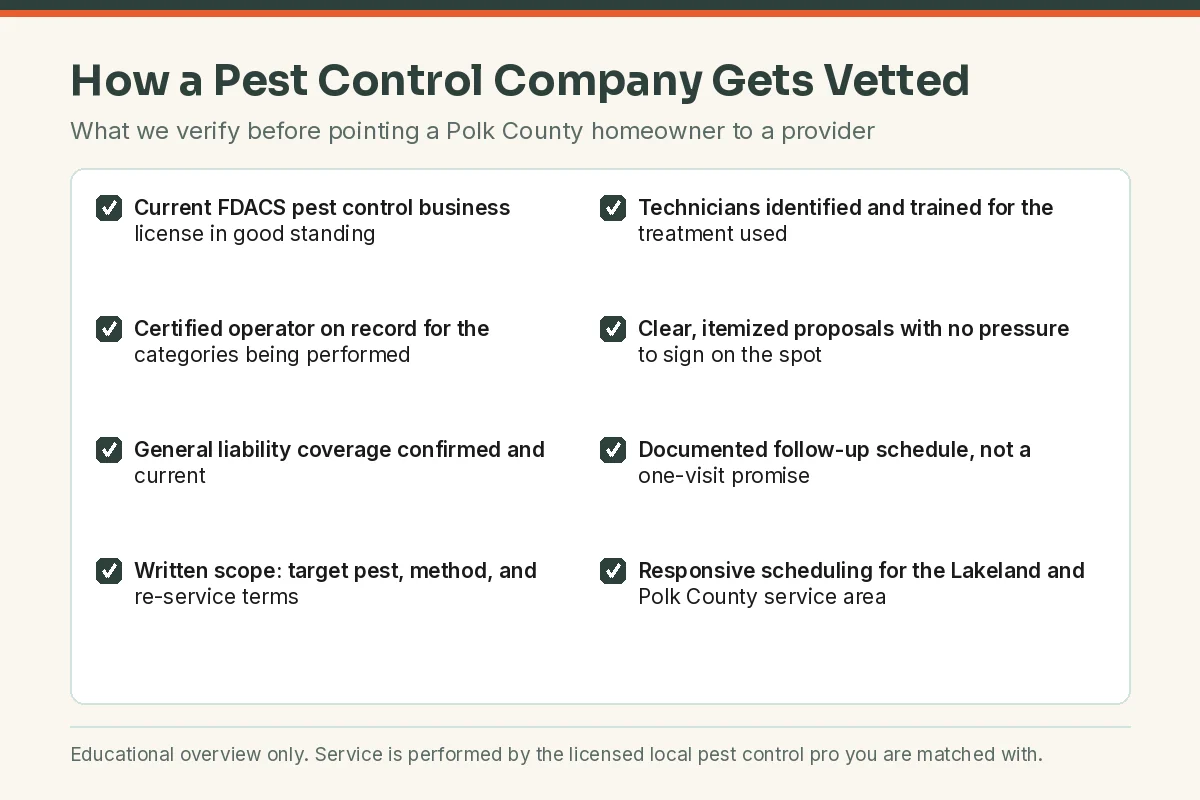
Before a company can receive a homeowner match from us, we check the things that actually protect you — license, insurance, and scope. Florida regulates this industry tightly, which gives us clear, verifiable standards to hold pros to.
1. Structural pest control license (FDACS, FL Statute Ch. 482)
In Florida, any business performing structural pest control — termites, general household pests, lawn and ornamental, or fumigation — must hold a license issued by the Florida Department of Agriculture and Consumer Services (FDACS) Bureau of Entomology and Pest Control under Chapter 482, Florida Statutes. Each licensed business operates under a Certified Operator in the relevant category. We confirm a company carries the FDACS license for the category of work it advertises — a general household pest license does not authorize termite or fumigation work, and we don’t route those jobs to a company that isn’t certified for them.
2. Liability insurance and workers’ coverage
We match only companies that carry current general liability insurance, and we expect appropriate workers’ coverage for their staff. Florida pesticide regulations also require licensed firms to maintain financial responsibility. If a company can’t show it’s insured, it doesn’t get your job.
3. Right credential for the work — CPCO / ACE where relevant
For technical and identification-heavy jobs, we look for the appropriate professional credential. In pest control that means a Certified Pest Control Operator (CPCO) standing behind the license, and for complex identification or IPM work, an Associate Certified Entomologist (ACE) credential from the Entomological Society of America. (There is no ISA arborist certification in this field — that’s a tree-care credential; the pest-control equivalents are the CPCO and ACE.)
4. Honest scope — matched to your actual problem
We route your job to a company that does that work in your area, not whoever is closest. A bed bug heat job, a WDO real-estate inspection, and an armadillo trapping job are different specialties; we match accordingly so you aren’t sold a service that doesn’t fit.
What we DON’T do
- We don’t perform inspections or treatments ourselves — ever.
- We don’t quote prices. Pricing is set by the independent company after an inspection, based on the pest, infestation level, property size, and plan.
- We don’t publish reviews, star ratings, or testimonials, and we use no Review or AggregateRating schema.
- We don’t collect payment for treatments or take a cut of your invoice.
- We don’t use high-pressure phone tactics — you enter a ZIP and the matched pro contacts you.
From ZIP to inspection — what happens
- You tell us what you’re seeing. Call the dispatch line and describe the pest (the checker below can help you name it).
- We match. We route the request to a vetted, FDACS-licensed, insured company that services your ZIP and does that type of work.
- You get an inspection. The pro contacts you, inspects on site, identifies the species, and gives you a written quote.
- You decide. The treatment relationship is entirely between you and that independent company.
Which pest do I have? (quick self-check)
Use this to help describe your problem before an inspection. It’s guidance, not a diagnosis — species ID is confirmed on site by the licensed pro.
Quick check: which pest am I likely dealing with?
Pick the clue that most closely matches what you’re seeing. This is general guidance to help you describe the problem — a licensed inspector confirms the species on site.
Sources we rely on
Our pest information is grounded in university extension science and state and federal regulatory guidance, not marketing copy. Primary sources:
- UF/IFAS Extension (EDIS) — University of Florida peer-reviewed guidance on Florida pests, IPM, and treatment.
- UF Featured Creatures (Entomology & Nematology) — species profiles for termites, roaches, ants, and nuisance wildlife.
- FDACS Bureau of Entomology & Pest Control — Florida structural pest control licensing under Chapter 482, F.S.
- CDC — Mosquitoes & mosquito-borne disease — public-health guidance on Aedes/Culex risk and prevention.
- EPA — Pesticide safety & safe pest control — federal label-use and safety standards.
- Polk County, FL — local government resources for Polk County residents.
Our editorial standard
We write to inform a homeowner decision, not to sell fear. We don’t invent prices, fabricate reviews, or claim to be “the top choice.” Where a number matters — a swarm season, a lethal temperature, an FDACS rule — we tie it to the sources above. Content on this site is reviewed on a quarterly cycle and dated so you can see how current it is. See our FDACS licensing explainer, WDO inspection guide, Lakeland pest control overview, and why Polk County sits in a high pest-pressure zone.
Get matched with a vetted Polk County pro
One call reaches a licensed, local exterminator who covers your address — and a real person answers, 24/7.
Last reviewed June 2026 · reviewed on a quarterly cycle. Lakeland Exterminators is a dispatch and matching service that connects homeowners with independent, licensed and insured pest-control pros; we don’t perform treatments ourselves.
Disclaimer: Lakeland Exterminators is a local dispatch and referral service, not a licensed pest-control operator. We connect Polk County, Florida homeowners with independent, FDACS-licensed and insured pest-control companies. All inspections and treatments are performed by those independent providers, who set their own pricing, scheduling, and service terms.
Any reference to same-day, emergency, or 24/7 service describes the typical scheduling of matched independent providers and is not guaranteed; actual response times vary by provider, season, location, and demand.