Ants are the one pest where the wrong treatment literally multiplies the problem.
One call reaches a licensed, local exterminator who covers your address — and a real person answers, 24/7.
Talk to a licensed exterminator now
Call and we’ll connect you with a licensed, local exterminator who covers your address. It takes about two minutes, and a real person answers.
Free to get matched. No obligation. The licensed operator gives the quote.
24/7 line · A real person answers · Availability of same-day and emergency service depends on the provider.
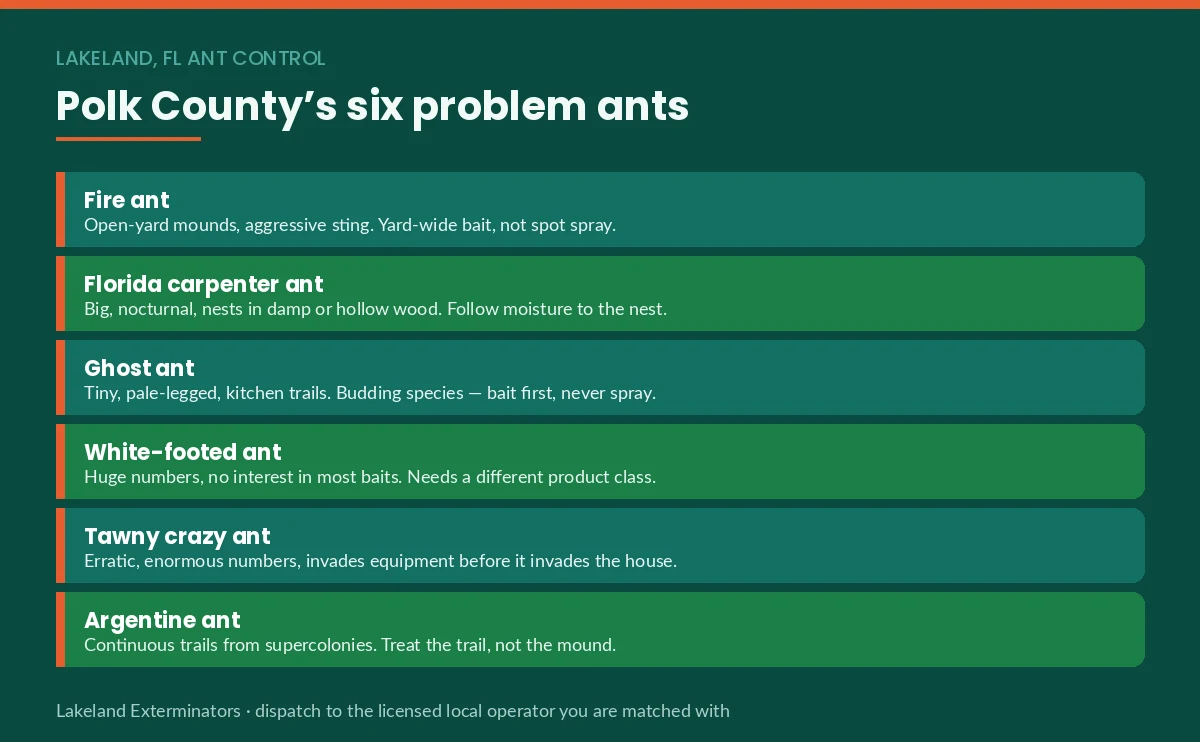
Polk County’s six problem ants — know your enemy before anyone treats
The operator confirms the ID on site, but you can usually narrow it from where you found them and how they behave. It matters, because the bait that collapses one species is ignored by another.
Red imported fire ant
Open, sunny lawn mounds with no visible entry hole; boiling swarm when disturbed; painful stings that welt. Polk’s citrus-edge neighborhoods get steady re-invasion pressure from adjacent groves and pasture.
Florida carpenter ant
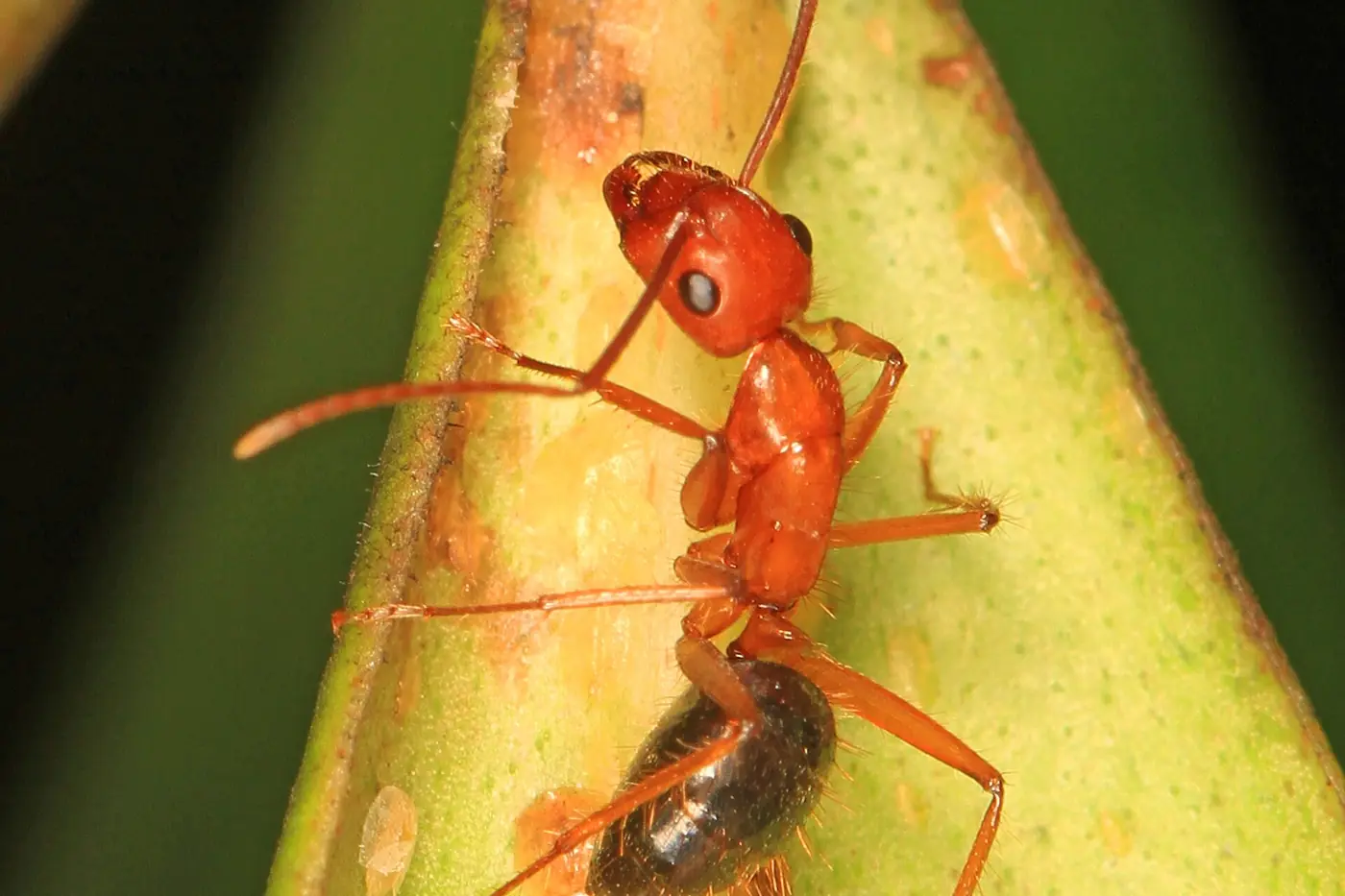
Big (up to half an inch), reddish-and-black, most active at dusk. Nests in moisture-damaged wood — fascia, window frames, deck posts. Frass piles that look like sawdust are the tell. They excavate wood; they do not eat it like termites, but the moisture problem underneath is real.
Ghost ant
Tiny, pale, nearly invisible legs — the classic Florida kitchen-and-bathroom trail ant. Multiple queens, colonies that split (“bud”) when stressed — which is exactly what repellent spray does. Sweet-bait programs work; spray cans backfire.
Tawny crazy ant
Erratic, fast, overwhelming numbers — established in eastern Polk County and moving west. Notorious for swarming into AC units, pool pumps and electrical boxes. Standard baits underperform; this one genuinely needs a licensed program.
White-footed ant
Black body, pale feet, enormous colonies (up to millions) that trail along fence tops, eaves and irrigation lines into soffits. Mostly a nuisance trail ant — but the colony sizes make one-off treatments pointless.
Argentine ant
Uniform brown, slow steady trails, super-colonies that span property lines. Thrives on new-construction disturbed soil along the I-4 corridor. Neighborhood-scale pressure that rewards coordinated perimeter baiting.
Trail in the kitchen or mounds in the yard — either way, the line is open.
One call reaches a licensed, local exterminator who covers your address — and a real person answers, 24/7.
Free to get matched. No obligation. The licensed operator gives the quote.
Why Lakeland is an ant town
Fire ants own the citrus edge
Polk County’s ag-urban boundary — Lakeland’s south side, Mulberry, Bartow, Lake Wales, the grove edges around Winter Haven — delivers constant fire ant re-invasion. A single treatment of your yard buys a season; the mated queens fly back in from adjacent pasture with every spring rain. That is why licensed operators quote fire ant work as a program (broadcast bait on a spring/fall cadence plus mound response) rather than a one-off, and why the yard next to a grove needs a different plan than a yard in Dixieland.
New construction feeds the invasives
The I-4 corridor growth — Lakeland Highlands, Christina, Auburndale, Davenport — sits on freshly disturbed soil, the exact niche tawny crazy ants, Argentine ants and white-footed ants exploit. New-build owners routinely see heavy trail pressure in year one; the new construction guide explains what a first-year defense actually looks like.
Moisture makes carpenter ants a building problem
Zone 9b humidity plus summer rain bands keep fascia boards, window sills and deck posts damp enough for carpenter ant nests. Finding one is half pest issue, half maintenance flag: the operator treats the colony, and the moisture-damaged wood that attracted it needs a carpenter. Fix both or the next colony moves into the same soft wood.
Ghost ants never leave on their own
Multi-queen, indoor-nesting, budding colonies — a Lakeland kitchen with a ghost ant trail in June still has it in December without a bait program. The good news: sweet-bait programs are among the most reliable fixes in residential pest control when a licensed operator places them and leaves the trail undisturbed to carry the bait home.
What the licensed operator does differently
Species ID first
Body size, node count, trail behavior, nest location. Five minutes of ID prevents the classic failure: fire ant bait on a ghost ant trail, or repellent spray on a budding species.
Bait matched to the biology
Sweet baits for ghost and white-footed ants, protein-and-oil broadcast baits for fire ants, moisture-void treatments for carpenter ants, specialized programs for tawny crazy ants. The colony feeds itself the fix.
Source work, not just symptom work
Mound mapping, trail-line tracing to the nest, moisture flags for carpenter ants, and re-invasion pressure honestly assessed — grove-edge yards get grove-edge plans.
Cadence that matches Polk County
Year-round activity means spring/fall broadcast cycles for fire ants and quarterly perimeter programs for trail ants. The quarterly vs. monthly guide covers which cadence fits which pressure.
What decides the operator’s quote (we never set prices)
- Species and colony pressure — a single fire ant mound and an established tawny crazy ant invasion are different orders of work.
- Lot size and edge exposure — broadcast baiting scales with acreage; grove-edge and lakefront lots carry re-invasion pressure.
- One-time vs. program — most Polk County ant work performs better on a cadence; the operator will be straight about which yours needs.
Pricing is set by the FDACS-licensed operator after inspection — never by us. Free to get matched; you owe nothing until you accept the operator’s own quote. Details in the cost guide.
How the ant dispatch works
Full transparency: Lakeland Exterminators is a dispatch and matching service, not a licensed pest control operator. Your request routes by ZIP to an FDACS-licensed operator covering your part of Polk County; they own the inspection, treatment, pricing and any service warranty under Chapter 482, Florida Statutes. Verify any operator at the FDACS license search before you hire — honest companies expect it.
Lakeland ant questions, answered straight
Why do the ants come back a week after I spray?
Two reasons. First, over-the-counter sprays kill the workers you see — maybe 5% of the colony — while the queens keep producing. Second, several Florida species (ghost ants especially) respond to repellent spray by budding: the colony splits into multiple colonies and spreads through new wall voids. Licensed operators use non-repellent baits the workers carry back to the queens, which is why professional ant work looks slower for a week and then actually ends.
Are fire ant stings actually dangerous?
For most people they are painful welts that pustule overnight. For the allergic minority, fire ant venom can trigger anaphylaxis — and children playing in yards are the classic exposure. If anyone in the house has reacted badly to stings before, treat visible mounds as a priority, keep kids off the lawn near them, and mention the allergy when you talk to the operator so they prioritize accordingly.
Carpenter ants or termites — how do I tell before the operator arrives?
Look at the debris and the wings. Carpenter ants push out coarse, sawdust-like frass with insect parts in it; termites leave either mud (subterranean) or smooth six-sided pellets (drywood). Winged carpenter ants have pinched waists and elbowed antennae; termite swarmers are straight-waisted with equal-length wings. Either way the inspection is the same request — and if it turns out to be termites, the termite guide covers what happens next.
What does ant treatment cost in Polk County?
Set by the licensed operator after inspection. Species, lot size, colony pressure and one-time vs. program service move the number — and grove-edge fire ant work is honestly a different quote than a kitchen ghost ant program. We do not set or publish prices; the cost guide explains the factors and the questions worth asking.
Is ant bait safe around kids and pets?
Ask the operator about placements when you talk — that is the honest protocol. Licensed Florida operators apply EPA-registered products per label, and residential ant baits go into stations, voids and trail points chosen to be inaccessible to children and pets. Tell the operator about dogs that dig, outdoor cats, or kids who play in the yard — broadcast bait timing and placement change accordingly.
Can I just treat the mounds myself?
Individual mound treatments are the most DIY-viable job on this page, and the DIY guide says so honestly. Where DIY loses: yards with recurring multi-mound pressure (the colony network is bigger than the visible mounds), indoor trail species that bud under spray, and anything near grove edge where re-invasion is structural. If you have treated the same yard three times this year, the math already favors the licensed program.
Get the species right. Get the treatment right. One ZIP.
One call reaches a licensed, local exterminator who covers your address — and a real person answers, 24/7.
Free to get matched. No obligation. The licensed operator gives the quote.
Related Polk County ant reading
Species identification decides the bait, the placement and whether the treatment works at all. These go deeper on the four ants Polk County calls about most.
- Ghost ants and sugar ants taking over a Lakeland kitchen — why sprays scatter a colony instead of ending it
- Ghost ants in your Lakeland kitchen: why they return — budding colonies and the repeat-visit pattern
- Florida carpenter ants vs. termites in Lakeland — how to tell them apart before you pay for the wrong treatment
- Why Lakeland’s lakefront homes see more carpenter ants after heavy summer rain — moisture-damaged wood as the entry point
- Fire ants after flooding in Lakeland — floating rafts, and why a flooded yard gets more dangerous, not less
- Why tawny crazy ants short out electronics and AC units in Polk County — the one ant that shows up as an equipment failure first
Disclosure
Lakeland Exterminators is a dispatch and matching service. We connect Polk County callers with FDACS-licensed structural pest control operators. We are not a licensed pest control operator. We do not perform ant treatment, set prices, issue warranties, or carry pest control trade insurance. All pricing, scheduling, treatment plans, warranties and service terms are determined by the FDACS-licensed operator dispatched to your address under Chapter 482, Florida Statutes.
Same-day and 24/7 emergency services are subject to provider participation, location, technician availability, and demand. Availability is not guaranteed and may vary by market and appointment capacity.
License status of any operator you connect with is publicly verifiable at the FDACS license search.