Hialeah’s 1950s block houses were built to last — and they have now given drywood termites seventy years to find the wood inside the block.
Hialeah is one of the densest, hardest-working housing stocks in Florida: mile after mile of postwar concrete-block-and-stucco homes, most of them added onto, subdivided or intensively occupied across three generations. The block walls create a durable myth — “concrete houses don’t get termites” — while the roof framing, fascia, door frames, kitchen cabinets and every addition built since carry exactly the seasoned wood drywood colonies colonize, and seventy years is a long exposure window. Around the houses, the densest mango and avocado canopy in the county feeds roof rats, backyard efficiencies complicate every treatment plan, and the apartment corridors run classic building-level German roach dynamics that unit-by-unit spraying never solves. The dispatch line matches Hialeah homes, landlords and tenants with FDACS-licensed operators who work this stock — and who put findings in writing, because in a renter-heavy city the paper matters as much as the treatment.
Talk to a live dispatch coordinator now
Pellets under a window frame, roaches in an apartment kitchen, rats in the mango tree — describe it and get matched with a licensed operator working Hialeah.
(888) 295-0220Tap to call — 24/7 dispatch
Free to call. Free to get matched. The licensed operator you’re matched with gives the quote.
24/7 line · A real person answers · Availability of same-day and emergency service depends on the provider.
Need pest control in Hialeah, FL? Call (888) 295-0220 and a dispatch coordinator matches you with an FDACS-licensed operator serving 33010, 33012, 33013 and 33016 — drywood and subterranean termite inspection on postwar block homes, building-level roach programs for apartment corridors, fruit-canopy rodent exclusion, and ant and mosquito work citywide. Lakeland Exterminators is a dispatch service: the licensed local operator inspects, treats and quotes.
Why do block houses still get termites?
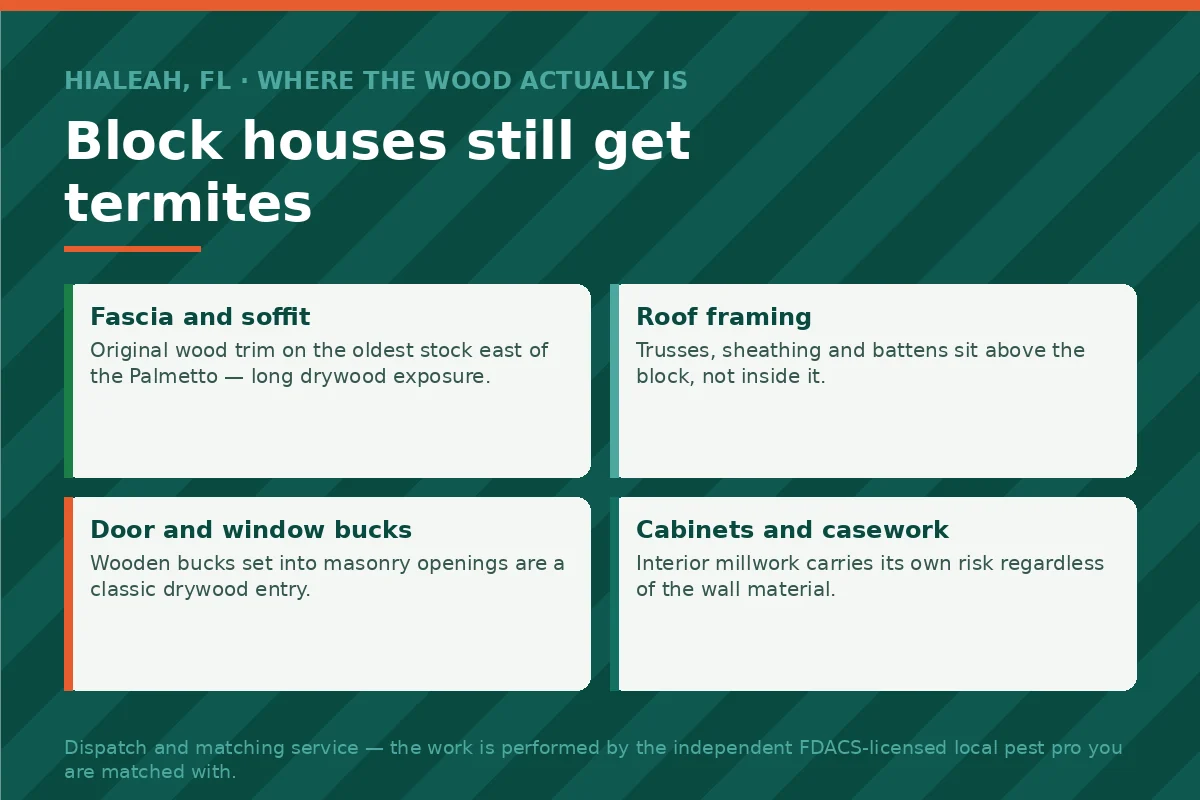
Because the block is the shell, not the skeleton. Inside a classic Hialeah CBS house, wood does all the fine work: roof trusses and decking, fascia and soffit framing, window and door bucks, baseboards, cabinets, and the framed additions and enclosed porches that generations of owners have built. Drywood termites need no soil contact — swarmers land at a vent or an eave gap, bore into dry wood, and build small slow colonies that show up years later as coarse, sand-like pellets under kick-out holes and blistered paint on fascia boards. After seven decades of annual swarm seasons, the question on an original-roof Hialeah house is less “if” than “where and how much.” Subterranean termites run a parallel track from the ground: the county canal network keeps soil moisture generous, and additions poured against original slabs create cold joints — the exact seams mud tubes exploit. The two species demand different treatments (targeted wood treatment or tenting for drywood; liquid barrier or bait for subterranean), which is why the identification step — a licensed WDO inspection that names the species — is the only sane starting point, and also the document any future sale or refinance will demand.
What is each part of Hialeah actually dealing with?
- Original core east of the Palmetto (33010, 33013): the oldest stock and longest drywood exposure; fascia, soffit and window-buck evidence checks belong on every maintenance calendar.
- Central Hialeah (33012): dense fruit canopy — mango, avocado, mamey — feeding roof rat populations that travel yard to yard on fences and power lines; hollowed fruit on the tree is the classic early sign.
- Hialeah Gardens edge & the 33016 corridors: newer townhome and apartment stock — German roach pressure runs on lease turnover; move-in documentation protects deposits and forces timely treatment.
- Apartment corridors citywide (W 4th to W 12th Ave): building-level roach and rodent dynamics through shared plumbing walls — coordinated treatment or a repeating cycle; Florida practice puts established-infestation treatment in multifamily on the landlord in most standard leases.
- Backyard efficiencies everywhere: a main house plus an occupied casita is two dwellings on one treatment plan — scope both, or the untreated one reseeds the treated one.
What should tenants and landlords in Hialeah each do?
The split is simpler than the arguments it causes. In most standard Florida leases, extermination of an established infestation in multifamily housing is the landlord’s job; day-to-day sanitation and prompt reporting are the tenant’s. What makes the split work is writing: a tenant who reports roaches with dated photos in week one — and keeps a copy — has both triggered the landlord’s duty and protected their own deposit; a landlord who responds with a licensed operator’s inspection report and treatment invoice has met theirs and has the paper to prove it. The expensive versions all start with delay: a month-three report means an established, spreading population, and a spray-can response instead of a licensed treatment means the building cycle continues. For owners of the classic Hialeah rental — a main house with an efficiency behind it — one more rule: both units go on the same treatment scope, same visit. Half-treated properties stay infested, and the operator who quotes only the unit that complained is quoting a failure.
Call the line
Tap (888) 295-0220 any hour. Describe what you are seeing and the property — house, house-plus-efficiency, or apartment building.
Get matched to the problem
Termite identification, building-level roach programs and rodent exclusion route to different specialists — the coordinator matches the right one.
A licensed operator takes over
An independent, FDACS-licensed and insured operator working Hialeah inspects, quotes and treats — with findings in writing. No obligation — the dispatch call costs nothing.
Sand-like pellets on the windowsill again after sweeping yesterday?
The line answers 24/7 and matches you with a licensed operator who can tell drywood pellets from debris — and name what the house actually needs.
One tap. One call. Matched.
(888) 295-0220Tap to call — 24/7 dispatch
Free to call. The licensed operator gives the quote.
Hialeah pest questions, answered straight
The fruit trees bring the rats — do we have to cut them down?
Our building sprays monthly but the roaches never leave. Why?
Does the efficiency in the back need its own treatment plan?
What does pest control cost in Hialeah?
Disclosure
Lakeland Exterminators is a pest control dispatch and referral service, not a licensed pest control operator. All pest inspections, treatments and quotes in Hialeah are performed by independent pest control operators licensed by the Florida Department of Agriculture and Consumer Services (FDACS) and insured in their own name. Calling the dispatch line is free and creates no obligation; the licensed local operator you’re matched with sets their own pricing and terms.
More Miami-Dade help: Pest control in Miami, Miami roach control, Miami termite treatment, Pest control in Westchester · Roach extermination guide · All pest control services