Fort Lauderdale roof rats commute by palm frond, dock line and seawall ledge. Sealing the house means thinking like a sailor.
The scratching over a Fort Lauderdale ceiling is a roof rat — and in this city it arrived along a route most exterminators never map. The 165 miles of navigable canals that make the Venice of America are lined with exactly what roof rats love: seawall ledges to run, dock pilings and mooring lines to climb, boat canvas to nest under, and royal palms whose untrimmed boot skirts are furnished apartments. From the palm crown or the boat lift, your soffit is one jump. A bait box by the pool deck doesn’t interrupt any of that. The dispatch line matches you with FDACS-licensed operators who work waterfront rodent jobs the durable way — trap out the attic, seal the structure, and break the marine and canopy routes that feed it.
Talk to a live dispatch coordinator now
Night noise overhead, droppings in the cabana bath, chewed boat canvas, gnaw marks at the soffit — describe it and get routed to a licensed Fort Lauderdale rodent operator.
(863) 445-9190Tap to call — 24/7 dispatch
Free to call. Free to get matched. The licensed operator you’re matched with gives the quote.
24/7 line · A real person answers · Availability of same-day and emergency service depends on the provider.
Need rodent control in Fort Lauderdale, FL? Call (863) 445-9190 and a dispatch coordinator matches you with an FDACS-licensed operator serving your Fort Lauderdale ZIP — attic inspections, trap-out programs, roofline and dock-side exclusion, and monitoring for waterfront and multifamily properties. Lakeland Exterminators is a dispatch service: the licensed local operator inspects, maps the entries, and quotes the work.
What does the canal network change about rodent work?
It adds a marine flank that inland cities never deal with. Roof rats are strong swimmers and better climbers; a canal system is simultaneously a water barrier they cross easily and a linear highway lined with food (dropped mango and sea grape, dock fish scraps, unsecured trash) and shelter (rip-rap voids, seawall weeps, boat covers). Operators who work the Isles add dock-side items to the standard checklist: rat guards — cone or disc barriers — on mooring and shore-power lines, boat canvas kept taut and periodically opened (a winter-stored bimini is a nest site), lift cradles checked for droppings, and dock boxes treated like outdoor pantries. On the house itself the priorities are familiar but tilted seaward: soffit returns over the pool deck, AC chase penetrations on the canal side, and barrel-tile eave arches — standard on the Mediterranean revivals of Rio Vista and Las Olas Isles — mortared or combed shut.
Inside, the sequence doesn’t change: snap-trap the runways until catches stop, then seal with quarter-inch hardware cloth, sheet metal and mortar. Poison in a Fort Lauderdale attic is a special mistake — August heat plus a carcass in a ceiling void is an odor event no owner forgets, and secondary poisoning follows the food chain to the ospreys and owls that hunt the canals.
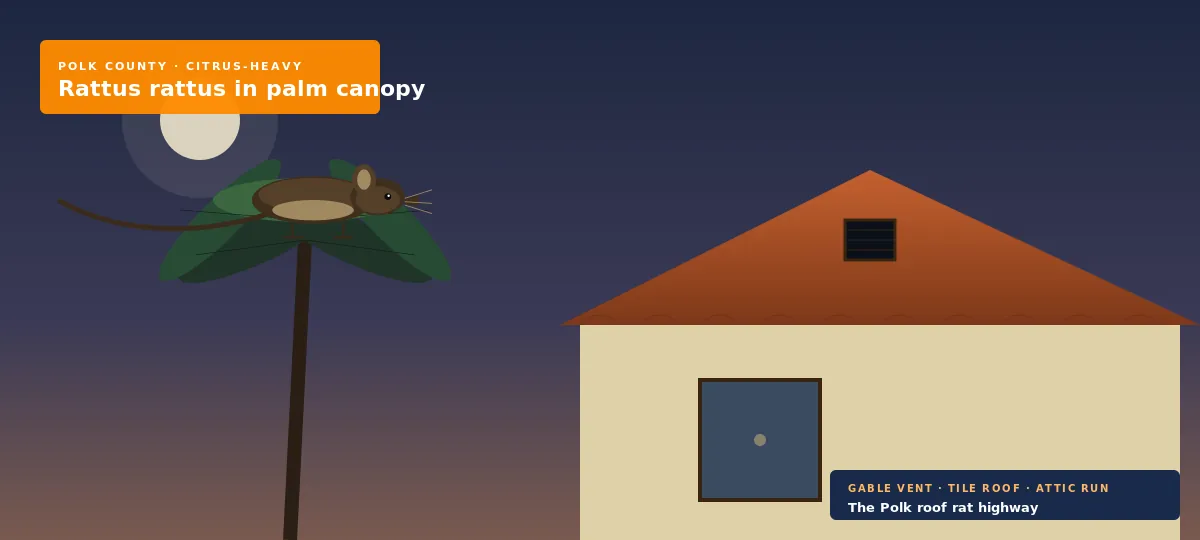
Where does rodent pressure concentrate in Fort Lauderdale?
- Las Olas Isles & Rio Vista (33301, 33316): the full waterfront package — docks, palms, tile roofs and canal-side plantings.
- Coral Ridge & Bay Colony (33306, 33308): mid-century waterfront ranches whose original soffits and vents predate rodent-proofing standards.
- Victoria Park & Colee Hammock (33301, 33304): mature oak and ficus canopy — classic limb-to-roof pressure blocks from the water.
- Harbor Beach & the barrier island (33316): sea grape thickets and beach-dune food sources alongside dock infrastructure.
- Sailboat Bend & Riverside Park (33312): older raised structures with crawl-space and porch-skirt entries at ground level.
- Marina and yard districts along the 17th Street causeway (33315, 33316): commercial-scale harborage — boats in storage, pallet stacks, bait-resistant populations.
What does a finished waterfront exclusion actually include?
A written entry map with photos — every soffit return, gable vent, tile arch, roof-to-wall junction, garage corner and plumbing chase — each closed with materials rats can’t chew: hardware cloth, metal flashing, mortar; never foam alone. A trap-out log showing catches declining to zero before sealing (nothing gets entombed). The marine flank handled: rat guards fitted, canvas and lift checked, dock box cleared. A habitat pass: palm skirts trimmed, fruit drops managed, sea grape cut back off the roofline. And a follow-up visit with monitors confirming no new activity. If a proposal is a bait-station subscription with none of the above, it manages the symptom while the building stays open — on the water, that means a new colony every season.
Call the line
Tap (863) 445-9190 any hour. Describe what you’re hearing and finding, and your Fort Lauderdale ZIP.
Get matched by job type
Attic and waterfront exclusion calls route to operators who do sealing and dock-side work; commercial, marina and multifamily calls route to monitoring-program providers.
A licensed operator takes over
An independent, FDACS-licensed and insured Fort Lauderdale operator inspects, maps entries, and quotes. No obligation — the dispatch call costs nothing.
Scratching over the primary suite? Droppings in the dock box?
The line answers 24/7 and matches you with a licensed Fort Lauderdale rodent operator.
One tap. One call. Matched.
(863) 445-9190Tap to call — 24/7 dispatch
Free to call. The licensed operator gives the quote.
Fort Lauderdale rodent questions, answered straight
Can rats really get aboard a boat on a lift?
Do the canals mean the problem can never be fixed?
Rats or raccoons on the roof at night?
What does rodent control cost in Fort Lauderdale?
Disclosure
Lakeland Exterminators is a pest control dispatch and referral service, not a licensed pest control operator. All rodent inspections, quotes, trapping and exclusion work in Fort Lauderdale are performed by independent pest control operators licensed by the Florida Department of Agriculture and Consumer Services (FDACS) and insured in their own name. Calling the dispatch line is free and creates no obligation; the licensed local operator you’re matched with sets their own pricing and terms.
More Fort Lauderdale help: Pest control in Fort Lauderdale, Roach control in Fort Lauderdale, Termite treatment in Fort Lauderdale · Rodent dispatch guide · All pest control services