Florida law requires soil pre-treatment or a physical termite barrier on almost every new home built in Polk County. So why do brand-new Lakeland-area houses still turn up active subterranean termite infestations within a few years of the certificate of occupancy? The pre-treatment isn’t the failure — what happens to it afterward usually is.
Dealing with a pest problem right now?
📞 Call now — get matched with a licensed local exterminator: (888) 295-0220When you call, stay on the line for a few seconds while we match you with the licensed local exterminator for your area. Have your address and a quick description of the problem ready.
Licensed local pros · Fast response, subject to availability · No obligation
Pre-construction treatment is a genuinely effective, code-required layer of protection, built into the Florida Building Code for good reason. But it’s a chemical or physical barrier applied at one moment in the construction timeline, and Polk County’s soil, climate, and post-construction activity all work against that barrier staying intact indefinitely.
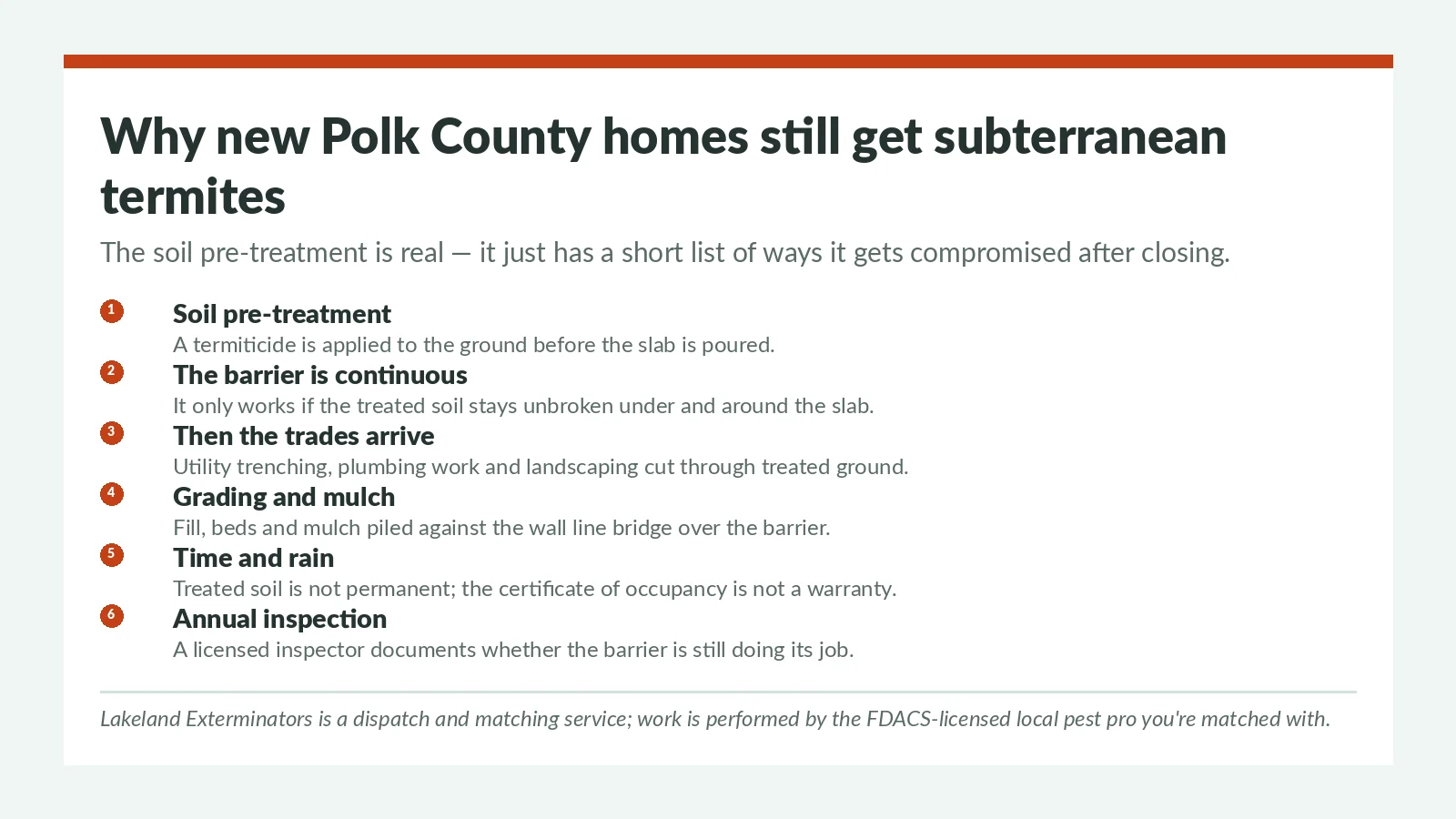
How pre-treatment actually works — and where it’s vulnerable
Soil pre-treatment creates a continuous treated zone in the soil beneath and around the slab, engineered so subterranean termites can’t tunnel through it undetected. Physical barriers (stainless steel mesh or treated materials at slab penetrations) work differently, blocking entry points mechanically rather than chemically. Both approaches share the same weakness: they only protect the soil that was actually treated or barriered at the time of construction, in the condition it was in that day.
Why the barrier gets compromised after the certificate of occupancy
Plumbing and utility penetrations added later
Any trenching through the treated zone after initial construction — a sprinkler line, a new plumbing run, a fence post, a pool installation — can break the continuity of a soil barrier. The original pre-treatment doesn’t follow the disturbed soil back into place; whoever does that work isn’t typically re-treating it unless someone specifically asks.
Landscaping and grading changes
Polk County’s sandy soils drain fast, which is good for termiticide longevity in undisturbed soil, but new sod, raised beds, mulch berms, or regrading around the foundation after move-in can shift soil in ways that create fresh, untreated pathways right where landscaping now touches the slab edge.
Termiticide breakdown over time
Liquid termiticide barriers are not permanent. Depending on the product and application, effective soil barrier life is commonly discussed in terms of years rather than decades, and Central Florida’s heavy seasonal rain accelerates breakdown compared to drier climates. A five- or eight-year-old home is chemically in a very different position than the day it was inspected for the builder’s termite certification.
New construction concentrated in former grove and pasture land
Much of Polk County’s recent new-construction growth sits on land that was previously agricultural — citrus groves, pasture, or timberland. That land can carry an existing subterranean termite population in old root systems, stumps, and buried organic debris well before a single house is framed on it, giving colonies a head start that a slab-perimeter treatment doesn’t necessarily reach.
What this means for new homeowners
None of this means pre-treatment failed or was done wrong — it means a one-time treatment needs backup over a multi-decade homeownership. The practical options:
- A baiting system as a second layer. Bait stations installed around the perimeter continuously monitor for termite activity year-round, catching a colony that finds a gap in the original soil barrier rather than relying on that barrier alone. See Sentricon installation in Lakeland.
- Re-inspection after any trenching or major landscaping work. If a sprinkler system, pool, or addition disturbed soil near the foundation after your original treatment, that’s a reasonable trigger for a follow-up check, not just your annual inspection.
- An annual WDO inspection, not just the builder’s one-time certificate. The initial builder termite certification documents a moment in time. See WDO inspection for what an ongoing annual check actually covers.
- Knowing your termite bond’s actual terms. Some new-construction termite bonds cover retreatment only, others cover repair — worth confirming rather than assuming. See is an annual termite bond worth it.
For the full picture of what pre-construction treatment includes and its limits, see our pre-construction termite treatment guide, and for background on the species most active locally, see subterranean termite treatment in Polk County.
Frequently asked questions
Is my builder’s termite treatment a warranty against future infestation?
Typically no — it certifies that pre-treatment or a physical barrier was installed to code at the time of construction. Ongoing protection against a future infestation generally requires a separate, renewable termite bond or monitoring contract.
How soon after moving into a new home should I get an independent inspection?
Many Polk County homeowners schedule their first independent WDO inspection around the one-year mark, then annually after that, rather than relying solely on the builder’s original certification.
Does a new home built on former grove land carry more risk?
It can. Old root systems and buried organic material left from prior agricultural use can support existing termite activity that a slab-perimeter treatment wasn’t necessarily designed to address at that depth or distance.
Get a licensed inspection for your Polk County home
One call reaches a licensed, local exterminator who covers your address — and a real person answers, 24/7.
One call reaches a licensed, local exterminator who covers your address — and a real person answers, 24/7.
Lakeland Exterminators is a free referral and dispatch service. We connect Polk County callers with FDACS-licensed pest control operators under Chapter 482, Florida Statutes. We are not a licensed pest control operator and do not perform treatment ourselves.