Quick answer: If you knocked down a mud tube on your slab and it’s back within a day or two after a heavy August rain, the colony is still active – subterranean termites rebuild fastest when soil moisture is highest, which in Lakeland means right after Central Florida’s rainy-season downpours. A rebuilt tube is not a false alarm; it is the clearest field confirmation that the colony is alive and worth a licensed inspection.
Dealing with a pest problem right now?
📞 Call now — get matched with a licensed local exterminator: (888) 295-0220When you call, stay on the line for a few seconds while we match you with the licensed local exterminator for your area. Have your address and a quick description of the problem ready.
Licensed local pros · Fast response, subject to availability · No obligation
Why do mud tubes reappear so fast after rain?
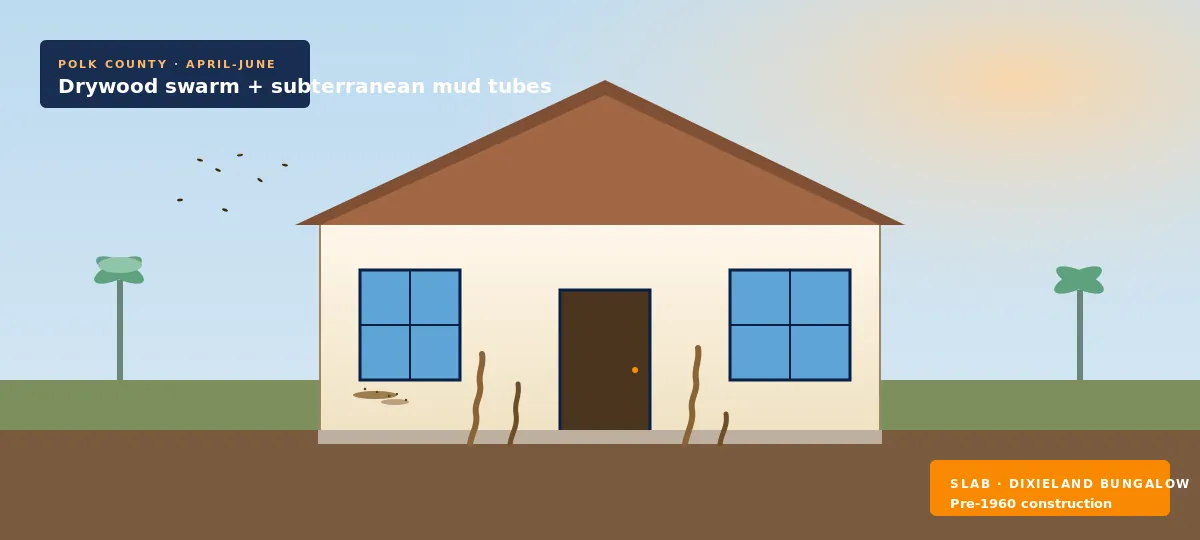
Subterranean termites build their mud tubes from soil, saliva and their own waste, and the whole structure exists to keep the colony’s foraging workers from drying out as they travel between the ground and the wood they’re feeding on. That means tube-building is directly tied to soil moisture: the wetter the soil, the faster and more freely the colony can build. Central Florida’s rainy season – roughly June through September, with Lakeland’s afternoon storm pattern feeding the water table hard – creates exactly the conditions subterranean colonies use to expand fastest.
A tube that gets knocked down and rebuilds within 24 to 48 hours after a rain event is doing the opposite of what a dead or abandoned tube does. An inactive tube left broken stays broken, often turning brittle and gray. A tube that comes back thicker, wetter-looking, or extended further up the wall means foragers are actively moving through it right now.
Where do rebuilt tubes show up first in Lakeland?
- Slab edges and expansion joints – the classic spot, especially on the shaded side of the house where the block stays damp longer after a storm.
- Porch and lanai slab seams – cold joints where two pours meet are a common entry point, and Lakeland’s covered lanais keep that soil moist between storms.
- Around irrigation heads and downspouts – anywhere water concentrates against the foundation gives a colony an easier, wetter route to the structure.
- Garage expansion joints – often overlooked because the garage floor rarely gets a visual check the way exterior walls do.
Does knocking down a tube get rid of the colony?
No, and this is the mistake that costs the most time. Breaking a mud tube open is a useful diagnostic – it tells you whether the colony rebuilds, which confirms activity – but it does nothing to the colony itself, which can hold hundreds of thousands of workers living in the soil, well beyond the reach of anything a homeowner can do with a garden hose or a broom. The University of Florida’s IFAS Extension entomology program covers subterranean termite biology and the soil-based colony structure that makes surface disruption alone ineffective; see the UF/IFAS Featured Creatures termite resources for the underlying biology.
What should you do when a tube rebuilds after a storm?
Photograph it before and after knocking it down, note the date and the amount of rain that fell, and get a licensed inspection scheduled rather than waiting for a dry spell. Rainy-season activity is exactly when a Polk County WDO-licensed operator wants to see the tube intact, not swept away, because an active tube confirms the colony location and helps target treatment.
One call reaches a licensed, local exterminator who covers your address — and a real person answers, 24/7.
Related Lakeland termite guides
- Termite treatment in Lakeland, FL – the full service overview for subterranean, Formosan and drywood termites.
- Subterranean termites in Polk County – barrier and bait treatment options.
- Signs of termites in a Lakeland, FL home – the full visual sign checklist beyond mud tubes.
FAQ
How fast can a mud tube rebuild after rain?
An actively foraging colony can rebuild a knocked-down section of tube within 24 to 48 hours during warm, wet conditions – Central Florida’s rainy season provides exactly that combination most afternoons from June through September.
Should I keep knocking the tube down myself?
One knock-down to confirm activity is a reasonable diagnostic step. Repeatedly destroying tubes does not reduce the colony and can make it harder for an inspector to find and assess the active travel routes when they arrive.
Does a rebuilt tube mean the damage is worse than a tube that stays broken?
Not necessarily worse – it means the colony is currently active at that location. A tube that stays broken for a week or more usually means the colony has abandoned that specific route, though it may still be active elsewhere on the structure.
Is rainy season really worse for subterranean termites in Lakeland than the rest of the year?
Subterranean termites feed year-round in Central Florida’s climate since the soil rarely gets cold enough to slow them down, but visible surface activity like mud tube building is most noticeable during the wettest months, when moisture makes tube construction fastest and easiest to spot.
Disclosure: Lakeland Exterminators is a dispatch and matching service. We connect Polk County callers with FDACS-licensed structural pest control operators. We are not a licensed pest control operator and do not perform treatment, set prices, or issue warranties. All pricing, scheduling and treatment plans are determined by the FDACS-licensed operator dispatched to your address under Chapter 482, Florida Statutes.