Quick answer: After a heavy Lakeland rain event floods low ground, two different rats move indoors for two different reasons – the ground-burrowing Norway rat pushed out of a flooded storm drain or canal bank, and the tree-climbing roof rat that was already living in your attic and is now more active because the wet canopy pushed it to forage sooner. Where you’re seeing activity – garage floor and slab edge versus attic and soffit – is the fastest way to tell which one you have.
Dealing with a pest problem right now?
📞 Call now — get matched with a licensed local exterminator: (888) 295-0220When you call, stay on the line for a few seconds while we match you with the licensed local exterminator for your area. Have your address and a quick description of the problem ready.
Licensed local pros · Fast response, subject to availability · No obligation
Why do both rat species show up more after heavy rain?
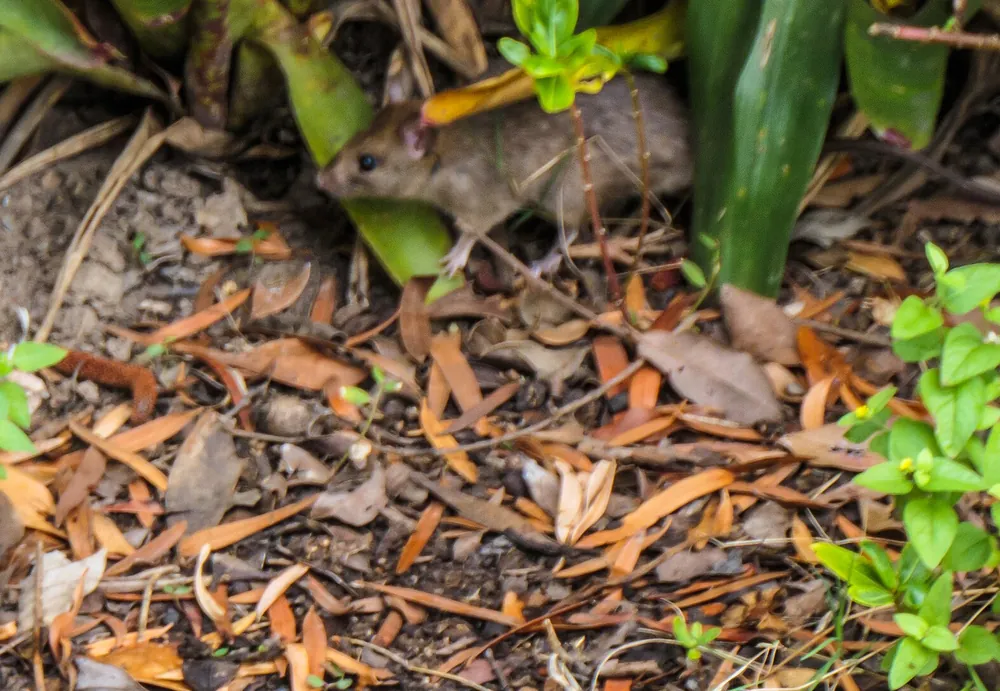
Polk County’s two commensal rats respond to a flood event from opposite directions. Norway rats (Rattus norvegicus) live at ground level – storm drains, canal banks, retention pond edges, burrows under sheds and debris piles – and a hard rain that floods those spaces pushes them out and toward the nearest dry structure, often a garage or crawl space. Roof rats (Rattus rattus) are already living overhead in attics and soffit spaces reached by tree limbs and utility lines; heavy rain doesn’t flood them out, but it does saturate the fruit and insects they’d normally forage outdoors, which can push a hungrier colony to forage more aggressively indoors once the rain lets up.
Ground signs: is it a Norway rat?
- Burrow openings near the foundation, under sheds, along fence lines or landscape timbers, often close to a storm drain or low-lying wet area.
- Activity concentrated at slab level – garage corners, crawl space vents, gaps under doors – rather than up in the attic.
- Heavier, thicker droppings with blunt ends, typically found along a ground-level travel path rather than scattered in an attic.
- Gnawing at the base of doors or low vents rather than at roofline vents.
Overhead signs: is it a roof rat?
- Scratching or scurrying sounds at night coming from the attic or ceiling void rather than the garage floor.
- Gable vent or soffit damage – torn screening, chewed vent covers, gaps where a tree limb or power line meets the roofline.
- Hollowed citrus or fruit in the yard, a classic Lakeland roof rat calling card given the area’s backyard citrus trees.
- Droppings with pointed ends, usually found in the attic rather than at ground level.
Why does the distinction actually matter?
Exclusion work is species-specific. A Norway rat program focuses on sealing at grade – slab penetrations, garage door seals, crawl space vents, burrow elimination around the foundation. A roof rat program focuses on the roofline – gable vents, soffit returns, trimming canopy back from the structure. Sealing only the roofline while a Norway rat is actively burrowing at the foundation solves half the problem, and vice versa. A licensed operator’s inspection identifies which species (sometimes both) is present before recommending a plan. The University of Florida’s IFAS Extension wildlife program maintains identification and biology references distinguishing Florida’s commensal rodent species; see the UF/IFAS Wildlife Extension resources for species-level detail.
What should you do after a flood event pushes rodent activity indoors?
Note where the activity is concentrated – ground level or overhead – since that detail speeds up the licensed operator’s inspection. Avoid sealing any gaps yourself until an inspector has confirmed whether rodents are still active inside, since sealing a structure with rats already trapped inside just relocates the problem into your walls.
One call reaches a licensed, local exterminator who covers your address — and a real person answers, 24/7.
Related Lakeland rodent guides
- Rodent control in Lakeland, FL – the full service overview for roof rats, Norway rats and mice.
- Rodent exclusion in Lakeland, FL – seal-out and trap-out sequencing.
- Roof rat species guide – biology and ID detail for Polk County’s dominant attic rodent.
FAQ
Can I have both Norway rats and roof rats at the same time?
Yes, and after a major flood event it’s common – ground-level Norway rat activity from displaced storm-drain or canal populations alongside pre-existing roof rat activity in the attic. A licensed inspection checks both zones rather than assuming one species explains all the activity.
Do house mice show up after rain too?
Yes, house mice follow the same displacement pattern as Norway rats since they’re also ground-level foragers, though their entry points are much smaller – about a dime-width gap versus a quarter-width gap for rats.
Is it safe to handle a rat I find in the garage after a flood?
No. Displaced wild rodents can carry disease risk regardless of species, and handling them directly isn’t recommended. A licensed operator’s trap-out program handles removal safely.
How long after a storm does displaced rodent activity typically last?
Ground-level displacement activity from a single flood event often settles within one to two weeks as water recedes and rodents either move on or get excluded, but an active indoor infestation won’t resolve on its own and needs inspection and exclusion regardless of the timeline.
Disclosure: Lakeland Exterminators is a dispatch and matching service. We connect Polk County callers with FDACS-licensed structural pest control operators. We are not a licensed pest control operator and do not perform treatment, set prices, or issue warranties. All pricing, scheduling and treatment plans are determined by the FDACS-licensed operator dispatched to your address under Chapter 482, Florida Statutes.