Quick answer: Florida has three termite problems wearing one name. Subterranean termites swarm in daylight from roughly February through May, drywood termites swarm at dusk from April through July, and Formosan subterranean termites swarm on humid May and June evenings around lights. Which species you have decides everything that follows — soil treatment, tent fumigation, or colony-scale baiting — so the single most useful thing you can do during a swarm is note the date, the time of day, and where the wings piled up.
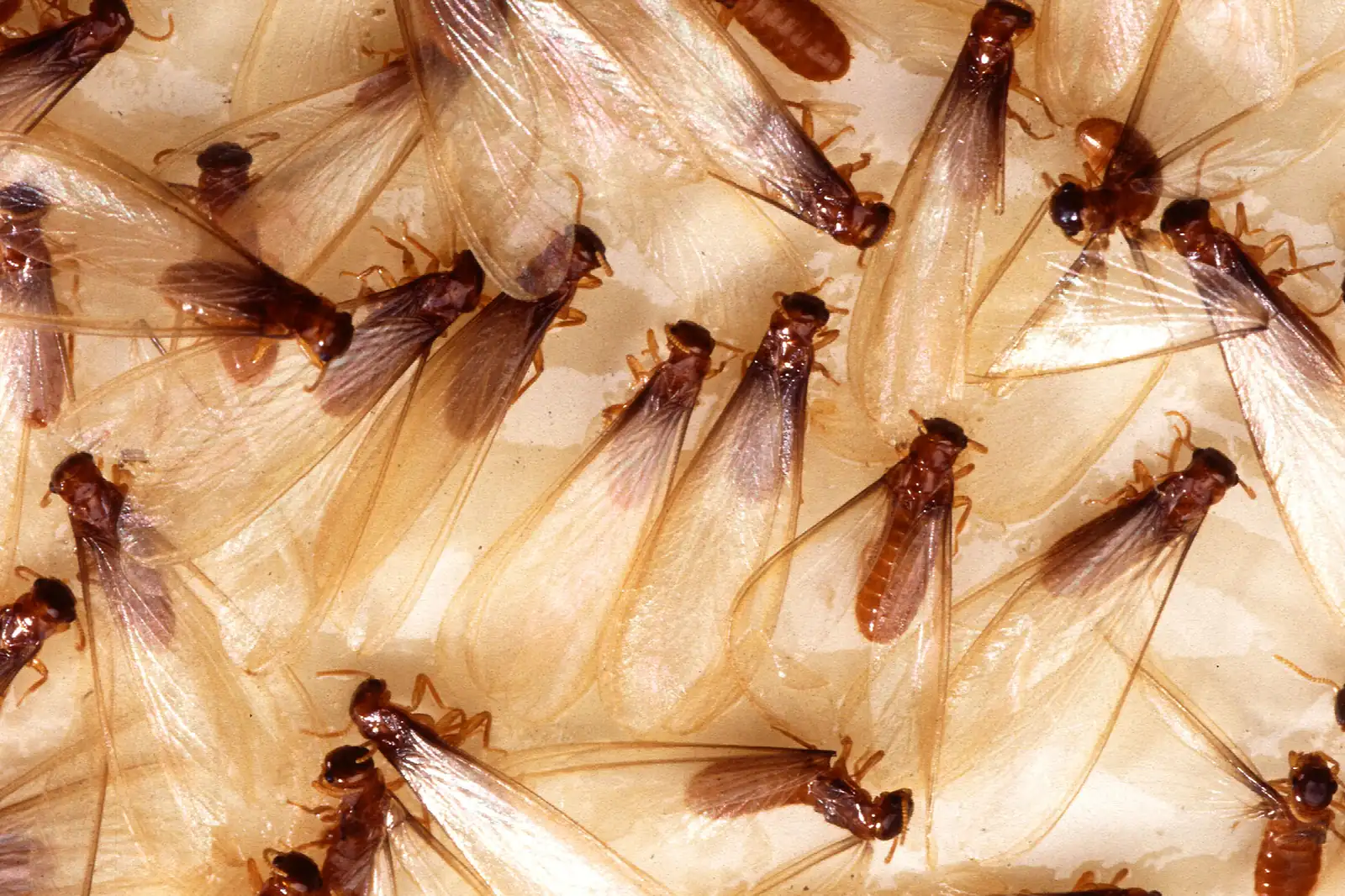
Why does Florida have three termite seasons instead of one?
Because it has three ecologically different termites, each on its own clock. A swarm is a colony’s reproduction event: once a colony matures — usually three to five years old or more — it releases winged reproductives called alates, and each species times that release to the conditions its offspring need to survive. Get the species wrong and homeowners make expensive mistakes in both directions: tenting a house for what was actually a soil-based subterranean colony (the tent gas never touches the soil), or spot-treating a wall for what was actually a Formosan colony with a million foragers underground.
- Eastern subterranean termites live in the soil and commute into structures through mud tubes. They swarm on warm, sunny mornings after rain, mostly February through May — the classic “flying ants in the kitchen on a Saturday morning” call.
- Drywood termites live entirely inside sound, dry wood — no soil contact, no mud tubes. They swarm at dusk and early evening, April through July, often in smaller, quieter flights that homeowners miss entirely until pellets appear.
- Formosan subterranean termites are the aggressive invasive cousin of the eastern subterranean. They swarm en masse on humid, windless evenings in May and June, drawn hard to porch lights and streetlights — a Formosan swarm around a lit gas station canopy can look like snow.
How do I tell which species just swarmed in my house?
You usually will not have the insect in hand — you will have wings on a windowsill and a memory of when it happened. Three clues sort most Florida swarms:
1. Time of day. Daylight swarm, especially mid-morning after rain: think eastern subterranean. Dusk or after dark around lights: drywood or Formosan. Massive volume at lights on a muggy late-spring night: Formosan until proven otherwise.
2. The calendar. February and March swarms in Florida are almost always eastern subterranean. May and June evening swarms are where drywood and Formosan overlap, and a licensed identification matters most.
3. Where the evidence sits. Subterranean swarms erupt from floor level — slab cracks, baseboards, garage expansion joints — and leave mud tubes nearby. Drywood swarms exit small kick-out holes higher on walls, window frames and fascia, and the tell is six-sided fecal pellets like coarse coffee grounds beneath the hole. Formosan evidence runs bigger: carton nest material in walls or attics, and shelter tubes that can climb multiple stories.
One more distinction worth knowing: termite swarmers vs. flying ants. Termite alates have straight antennae, equal-length wings, and a thick waist. Ants have elbowed antennae, unequal wings, and a pinched waist. Wings alone can tell you — termite wings are all the same size; ant wings are not.
What does each species mean for treatment?
This is why identification is worth a licensed inspection rather than a guess:
- Eastern subterranean — treated at the soil line: liquid termiticide barriers, in-ground bait systems, or both. Tenting a house for subterranean termites is the classic mismatch — fumigant gas does not persist in soil, so the colony simply re-enters after the tent comes off.
- Drywood — treated in the wood itself: whole-structure tent fumigation when colonies are widespread or inaccessible, or localized wood treatment when an inspection can confirm the infestation is contained. Soil treatment does nothing for drywoods, because they never touch soil.
- Formosan — treated at colony scale: baiting systems or extensive liquid work, sometimes combined with removal of carton nests. A Formosan colony can run into the millions of individuals, and because it can build moisture-holding carton nests above ground, even fumigation plus soil work may both be on the table. Coastal and urban Florida — Tampa Bay, Orlando, and South Florida especially — carry the heaviest Formosan pressure.
If you are in a swarm right now, do not spray the swarmers — they die on their own within hours and cannot bite or sting. Instead, collect a few in a zip bag, photograph the exit point, vacuum the rest, and get an identification. The Polk County playbook lives on our Lakeland termite control page.
Saw a swarm and want it identified?
A dispatch coordinator can match you with an FDACS-licensed termite operator in your Florida city — describe the swarm and they take it from there.
Free to call · 24/7 · The licensed operator you’re matched with gives the quote.
Does “termite season” mean termites are only active in spring?
No — and this is the most costly misunderstanding in the state. Swarm season is when colonies are visible; feeding happens year-round. Florida’s mild winters mean a subterranean colony that swarmed from your slab in March had already been eating for years, and it keeps eating straight through December. Drywood colonies grow slowly but never pause in conditioned Florida homes. The swarm is the smoke alarm, not the fire — by the time a colony is mature enough to swarm from inside a structure, it has been established in or near that structure for years.
That is also why a swarm at the neighbor’s house matters to you. Alates are weak fliers — most land within a few hundred feet of the release point — so a heavy swarm on your street means mature colonies in your immediate soil or block, and the year’s new colonies are being founded now. A pre-emptive inspection after a neighborhood swarm event is cheap information; more on what a full swarm-season check covers is in our Florida termite swarming season guide.
Month-by-month: the Florida termite calendar
- January–February: earliest eastern subterranean flights in South and Central Florida on warm fronts.
- March–April: peak subterranean swarm window statewide; first drywood flights begin in the south.
- May–June: the crowded month — late subterranean, peak drywood, and the Formosan evening swarms. Evening + lights + volume = get it identified.
- July–August: trailing drywood flights; rainy-season moisture accelerates subterranean foraging and mud-tube building even with no swarms in sight.
- September–December: little swarming, uninterrupted feeding. The quiet season is inspection season — operators have availability and evidence is undisturbed.
Disclosure: Lakeland Exterminators is a dispatch and matching service. We connect callers with FDACS-licensed structural pest control operators. We are not a licensed pest control operator and do not perform treatment, set prices, or issue warranties. All pricing, scheduling and treatment plans are determined by the FDACS-licensed operator dispatched to your address under Chapter 482, Florida Statutes.