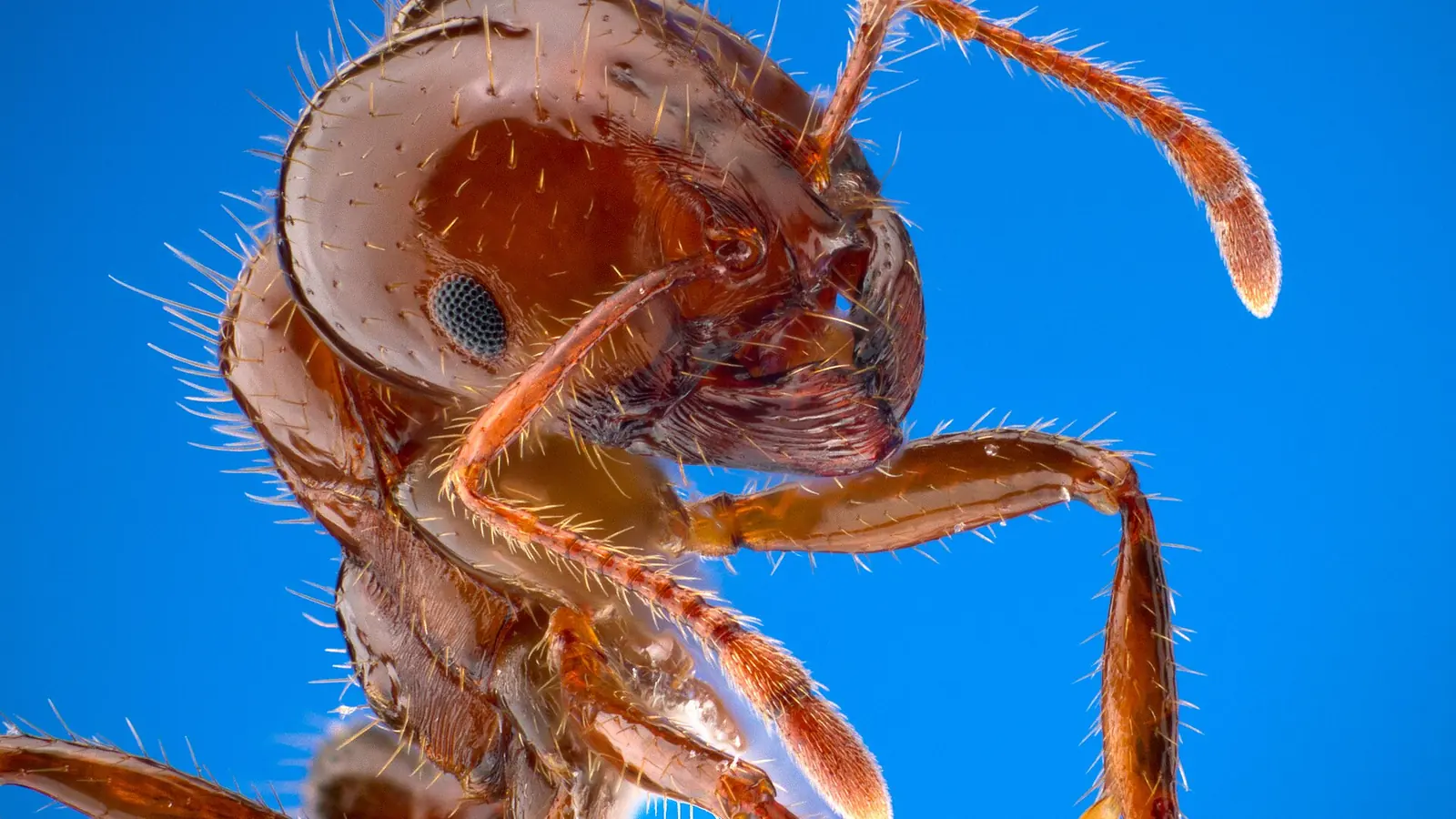
Lines of loose dirt along the edge of the driveway, little piles of soil pushed up between pavers, and soil streaks along the base of the house: in Lakeland yards, that’s often bigheaded ants, not fire ants. They’re one of the most common ants around Polk County homes, and they’re regularly mistaken for fire ants and even termites. The difference matters. Fire ants sting and need a yard-wide plan; bigheaded ants don’t sting but can be stubborn around slabs, sidewalks and indoors. Here’s how to tell them apart.
The quick difference
- Bigheaded ants leave loose soil along hard edges like sidewalks, driveways, slab edges, pavers and pool decks. They don’t usually build a single obvious mound. They bite but don’t sting.
- Fire ants build domed mounds of fluffy soil in open, sunny parts of the lawn, with no entrance hole on top. They pour out fast when disturbed and sting, leaving white pustules a day later.
How to identify bigheaded ants
The name comes from the “major” workers, which have a head that looks too big for the body. According to UF/IFAS, the majors make up only about 1 percent of the ants out foraging, so you’ll mostly see the small minor workers, which are about 2 millimeters long (under a tenth of an inch) and reddish brown. To find the majors, gently scrape or disturb the soil pile and look for the few larger ants with oversized heads.
Key clues:
- Two sizes only. Bigheaded ant colonies have small minors and much larger majors, with not much in between. Fire ant colonies have a continuous range of sizes.
- Soil along edges. Fine, loose soil kicked out along cracks and edges, sometimes forming soil-covered foraging trails that look a little like termite tubes.
- No sting. They may bite if you put your hand in the nest, but there’s no burning sting and no pustule.
- Duller color. UF/IFAS describes bigheaded ants as slightly smaller, darker and less shiny than fire ants.
How to identify fire ants
- Workers of many different sizes in the same colony, reddish brown to dark brown.
- Domed mounds in open turf and along sunny edges, especially after rain. Mounds have no single opening on top.
- Aggressive swarming and stinging when disturbed.
- Small white pustules within about a day of being stung.
The fire ant control guide for Lakeland covers mound treatment and yard programs in detail.
Dirt piles along the slab or ants in the kitchen?
Call to get connected with a licensed local pest pro who covers your Polk County address. The call and the match cost nothing. The pro inspects and gives the quote.
Why Lakeland yards see so many bigheaded ants
Bigheaded ants thrive in the warm, irrigated landscapes common across Polk County: sod lawns edged by concrete, mulch beds against block homes, potted plants on lanais and paver patios. They nest under slabs, sidewalks and pavers, around tree bases and along foundations, and colonies can spread across a whole yard and into neighboring ones. Homes near lakes and retention ponds, where soil stays moist, often see heavier activity.
They also come indoors. Bigheaded ants trail into kitchens, bathrooms and pantries through slab cracks, expansion joints and gaps around plumbing, looking for food, especially protein and greasy crumbs, and water. Pet food bowls are a common target.
A two-minute check you can do
- Find a fresh soil pile along a sidewalk or slab edge and gently scrape it with a stick.
- Look closely at the ants that come out. A handful of noticeably larger ants with oversized heads among many tiny ones points to bigheaded ants.
- Now check an open patch of sunny lawn for domed mounds. If tapping one sends a flood of mixed-size ants up the stick within seconds, those are fire ants.
- Take a close-up photo of each. Many yards in Polk County have both, and a pest pro can confirm from photos or samples.
Is it ants or termites?
Soil-covered trails along a slab edge can look like termite mud tubes. Termite tubes are firm, pencil-width tunnels made of soil and saliva that climb walls and don’t fall apart easily. Bigheaded ant soil is loose and crumbly. If you break a section and find tiny ants, it’s ants. If you find soft, pale, slow-moving insects, call for a termite inspection.
What works on each
Bigheaded ants
- Bait, don’t spray. Spraying repellent products on trails tends to scatter colonies. Slow-acting baits that workers carry back to the nest are the main tool.
- Match the bait. Bigheaded ants often prefer protein or oily baits over sweet ones. If ants ignore a bait, it’s the wrong formula.
- Fix entry points and moisture. Seal slab cracks and plumbing gaps where possible, pull mulch back from the foundation and fix irrigation that soaks the slab edge.
- Treat the perimeter. Licensed operators often combine baiting with targeted non-repellent perimeter treatments around the foundation.
Fire ants
- Broadcast a fire ant bait over the lawn when ants are foraging, then treat individual problem mounds about a week later.
- Fall is a good time to bait while ants are still actively feeding.
If ants are trailing inside your kitchen, they may not be either of these. The guide to ghost ants vs. sugar ants covers the tiny kitchen ants. For general service, see ant control in Lakeland.
Frequently asked questions
How do I know if I have bigheaded ants or fire ants?
Bigheaded ants leave loose soil along sidewalks, driveways and slab edges, have two distinct worker sizes including a few with oversized heads, and do not sting. Fire ants build domed mounds in open lawn, have workers of many sizes and sting aggressively.
Do bigheaded ants sting?
No. Bigheaded ants may bite if their nest is disturbed, but they do not sting the way fire ants do.
Why are there dirt lines along my driveway in Lakeland?
Lines of loose soil along driveways, sidewalks, pavers and slab edges are a common sign of bigheaded ants nesting underneath. Firm, pencil-width tubes that climb walls are more likely termite mud tubes and should be inspected.
What kills bigheaded ants?
Slow-acting baits that workers carry back to the colony are the main tool, and bigheaded ants often prefer protein or oily baits. Spraying repellent products on trails tends to scatter them.
Does it cost anything to call the dispatch line?
No. The call and the match cost nothing. You get connected with a licensed local pest pro, who inspects and gives you their own quote.
Not sure which ant you’re dealing with?
One call reaches a licensed local pro who serves Lakeland, Winter Haven, Bartow, Auburndale, Mulberry and the rest of Polk County. A real person answers, 24/7.
Before you go
Lakeland Exterminators is a dispatch service. We connect Polk County homeowners with licensed local pest control operators. We are not a pest control company and we don’t perform treatments ourselves.