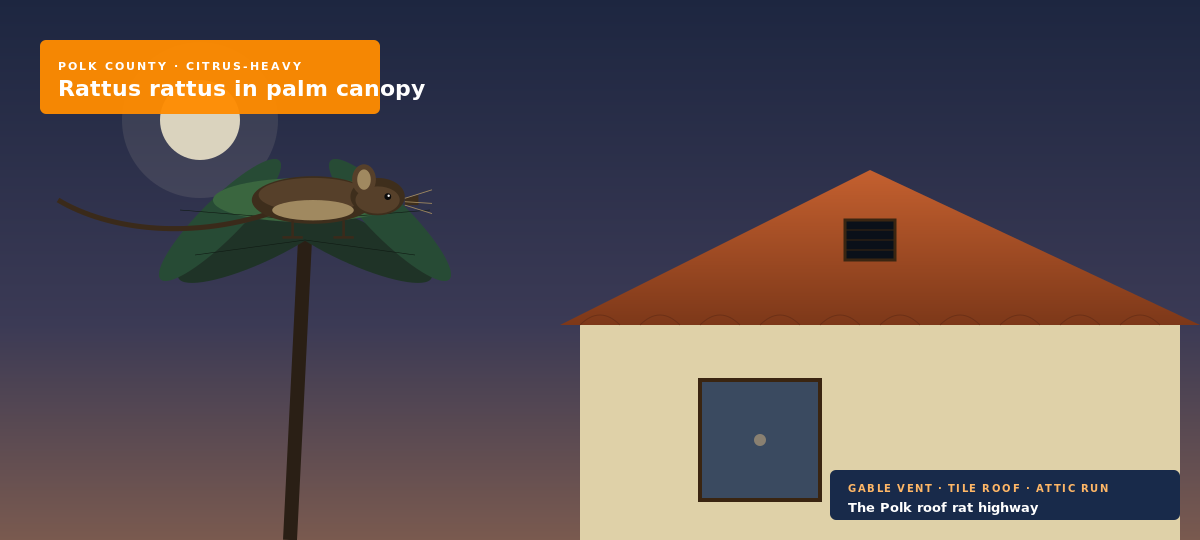
Hearing scratching in the ceiling after dark, or finding gnaw marks and droppings in a Winter Haven attic? In a city wrapped around the Chain of Lakes and shaded by mature oaks and citrus, the culprit is almost always the roof rat — an agile climber that travels the canopy and slips into soffits. Here’s how control works here and how to get matched with a licensed rodent pro.
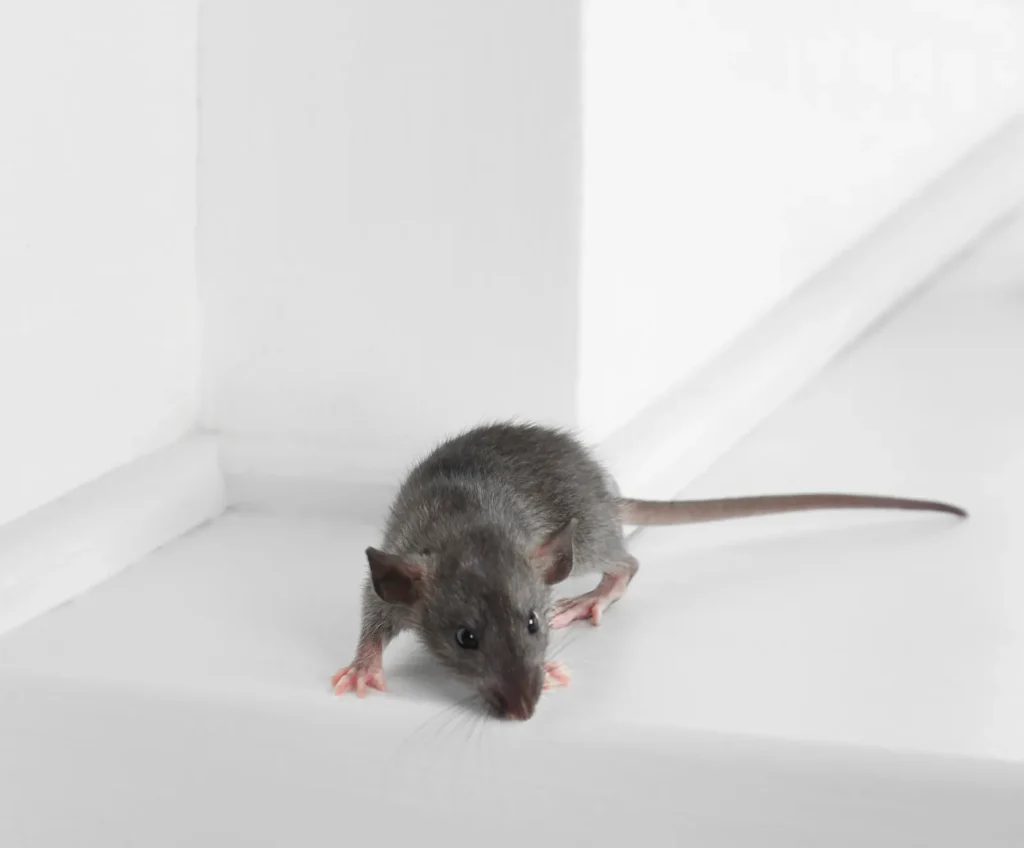
Get matched with a Winter Haven rodent pro
One call reaches a licensed, local exterminator who covers your address — and a real person answers, 24/7.
Why roof rats own the Winter Haven canopy
Winter Haven is a city of mature trees and open water. It grew up around the Chain of Lakes with decades-old live oaks over its established neighbourhoods, dooryard citrus in a great many yards, ornamental palms along the streets and around the lakes, and shoreline vegetation that never fully stops growing. For a roof rat, that is close to ideal, and it explains why this species — not the ground-dwelling Norway rat — is the animal in almost every Winter Haven attic.
Roof rats are arboreal. They are agile climbers with excellent balance that nest high and prefer to travel above the ground, using tree limbs, fence tops, utility lines, trellises, and dense vine growth as a connected network. A roof rat can move from a canopy tree to a roofline without ever crossing open ground, which matters because crossing open ground is where a rat is exposed to owls, hawks, and cats. A property with limbs touching or overhanging the roof has effectively been handed a covered walkway to the soffit.
The palm problem
Untrimmed palms with heavy frond skirts are one of the most reliable roof rat harborage sites in Central Florida, and one of the most consistently overlooked. The dead frond skirt of an unmaintained palm is a dry, sheltered, elevated cavity with excellent cover — a purpose-built nest site sitting directly beside a house. Where a skirted palm is close to the structure, it is frequently both the nest and the launch point.
Food on the ground and in the trees
Dooryard citrus, loquat, mango, and other fruit trees supply a seasonal food source, and fallen fruit left on the ground extends it. Roof rats also take pet food left outside, bird seed from feeders and the spill beneath them, and food residue around outdoor kitchens and grills.
How they get into a Winter Haven attic
Roof rats enter high, and the entry points are consistent across the housing stock:
- Soffit returns and corners — the junction where a soffit meets a wall or turns a corner is frequently left with a gap
- Roof-to-wall intersections, especially at dormers and where two roof planes meet at different heights
- Gable and ridge vents with damaged, missing, or inadequate screening
- Roof penetrations — plumbing stacks, chimney chases, exhaust vents — where the boot or flashing has degraded
- Tile roofs, where the space beneath barrel tile at the eave or hip gives access if the closures are missing or broken
- Fascia and drip edge gaps on older or settled construction
They need remarkably little. A rat can pass through an opening around the size of a quarter, and can enlarge a smaller one by gnawing, because rodent incisors grow continuously and gnawing is constant behaviour rather than a response to hunger. The tile-roof version of this problem is common enough in the county’s older neighbourhoods to be worth its own read: roof rats in tile-roof neighbourhoods.
Is it a rat or a mouse?
Roof rat droppings run roughly half an inch long with pointed ends; house mouse droppings are about an eighth of an inch and shaped like a grain of rice. Location is the other tell — activity in the attic, along the tops of walls, and at roofline entry points is roof rat behaviour, while activity confined to the garage, pantry, and slab edge is more typical of mice. It matters practically: entry points, trap size, and placement height are all different, and a plan built for the wrong species catches nothing.
What Winter Haven homeowners report
Roof rats are most active in the hours after dusk and again before dawn, which is when most people first notice them. The usual reports are scratching or a rolling, scurrying sound overhead after dark; droppings along attic joists, on top of ductwork, or behind the range; dark greasy rub marks where fur repeatedly contacts a travel edge such as a truss chord or a wall top plate; shredded insulation gathered into nests; gnawed food packaging; and a persistent ammonia odour from accumulated urine. Noise directly above a ceiling generally means the attic. Noise inside a wall generally means a vertical route from the soffit down a stud bay.
The consequence that matters most is not noise. Rodents gnaw the insulation off electrical conductors, and an attic combines exposed wiring with blown insulation and nesting material. That is a genuine fire risk and it is the reason to treat attic rodent activity as something to resolve promptly rather than tolerate through a season.
The control sequence that works here
1. Inspection
The result of the whole job is determined here. A competent inspection covers the full roofline and soffit run, every roof penetration, gable and ridge vents, tile closures where present, the attic interior for travel routes and nesting, and the surrounding vegetation for the access routes feeding the structure. It should end with specific, sealable entry points rather than a general confirmation that rats exist.
2. Trim the highways
Cutting tree limbs back several feet from the roofline, skirting palms, clearing vines off walls, and removing fence-line and trellis routes that lead into the structure takes away the approach. On a mature Winter Haven lot this is real tree work rather than a quick prune, and it is frequently the highest-value step on the property.
3. Exclusion
Sealing entry points is the step that makes the result permanent, and it is the step most often skipped. Materials matter: quarter-inch hardware cloth, sheet metal, copper mesh packed into irregular gaps, and proper vent screening hold up against gnawing. Expanding foam and steel wool alone do not — foam is chewed through readily and plain steel wool rusts away. See rodent exclusion for how that work is scoped.
4. Trapping inside
Trapping is the controlled way to remove the animals already in the structure: it accounts for what has been removed, confirms when activity stops, and avoids leaving a rodent to die in a wall or duct chase. Snap traps set on active travel routes — along joists and top plates rather than in open floor space — are the standard approach. Glue boards are inhumane and produce exactly the trapped-animal-in-a-void outcome you want to avoid.
5. Sanitation and monitoring
Heavily contaminated insulation may warrant removal and replacement, both for air quality and because residual scent and pheromone attract the next animal. A follow-up confirms the sealing held and the trapping has gone quiet.
Why bait alone is the wrong first answer
Exterior rodenticide has a role, but as the whole plan it fails on this species in this setting. It does not seal anything, so the population is replaced. Loose bait placed in an attic or wall void is generally contrary to the product label and produces dead rodents inside the structure. And second-generation anticoagulants carry real secondary-poisoning risk to the owls, hawks, and cats that are otherwise doing free rodent control on your property — a genuine consideration around the Chain of Lakes. Where exterior baiting is appropriate, licensed applicators use tamper-resistant stations to label.
Keeping it from coming back
- Pick up fallen citrus and other fruit rather than leaving it on the ground
- Bring pet food in overnight and store bulk pet food in rigid sealed containers
- Move or manage bird feeders, and clean up spilled seed
- Skirt palms and keep limbs several feet clear of the roof
- Secure bins with tight-fitting lids and keep grills and outdoor kitchens clean
- Keep the garage floor perimeter clear so the wall base is visible rather than providing harborage
- Re-check seals annually — sun, storms, and settling reopen gaps, and a sealed house is not permanently sealed
Rodent pressure across the county shifts seasonally and around storms; see why Polk County rodent activity migrates indoors before storms. The same roofline pattern drives the problem in the fast-growing northeast of the county, where new construction supplies its own entry points — see rodent control in Davenport — and rodent control in Lakeland for the county-wide picture. For everything else, pest control in Winter Haven.
Winter Haven roof rat FAQs
How do roof rats get into a Winter Haven attic?
High, and through a consistent set of openings: soffit returns and corners, roof-to-wall intersections at dormers, gable and ridge vents with damaged screening, degraded boots and flashing at plumbing stacks and chimney chases, gaps beneath barrel tile where closures are missing, and fascia or drip edge gaps. A rat can pass through an opening about the size of a quarter and enlarge a smaller one by gnawing.
Why is trapping alone not enough?
Because it removes the animals inside without changing why they could get in. Roof rats have overlapping ranges and a structure with open soffit returns and unsealed penetrations simply gets re-entered by the next animal. Exclusion — sealing with hardware cloth, sheet metal, and copper mesh rather than foam — plus cutting the canopy and fence-line access routes is what makes the result durable.
Do citrus and fruit trees make my rat problem worse?
Yes, in two ways. Dooryard citrus, loquat, mango, and similar trees supply a seasonal food source, and fallen fruit left on the ground extends it well past harvest. The trees themselves also provide elevated cover and travel routes, so a fruit tree close to the house is often both the food and the road. Picking up fallen fruit and keeping limbs several feet clear of the roof addresses both.
Are roof rats a fire risk?
Yes, and it is the most underrated part of the problem. Rodent incisors grow continuously and gnawing is constant behaviour, so rodents strip insulation off electrical conductors. An attic combines that exposed wiring with blown insulation and nesting material. It is the main reason to resolve attic rodent activity promptly rather than tolerate it through a season.
How long does it take to clear an attic?
Typically a sequence over weeks rather than a single visit: inspection, then trimming access routes and sealing entry points, then trapping inside until activity stops, then sanitation and a follow-up to confirm the sealing held. The trapping phase depends on how many animals are present and how quickly they encounter the sets, which is why a competent company schedules a return rather than declaring it finished on day one.
Why do palms matter so much?
Untrimmed palms with heavy dead frond skirts are among the most reliable roof rat harborage sites in Central Florida and among the most consistently overlooked. The skirt is a dry, sheltered, elevated cavity with excellent cover, effectively a purpose-built nest beside the house. Where a skirted palm sits close to the structure it is frequently both the nest and the launch point onto the roof.
Should I just put out bait?
Not as the whole plan. Bait seals nothing, so the population is replaced by the next animal. Loose bait in an attic or wall void is generally contrary to label and produces dead rodents inside the structure. Second-generation anticoagulants also carry secondary-poisoning risk to owls, hawks, and cats, which around the Chain of Lakes are doing free rodent control. Where exterior baiting is appropriate, licensed applicators use tamper-resistant stations.
Once it’s sealed, is the house permanently rodent-proof?
No, and treating it that way is how problems recur. Sun, storms, settling, and roof and gutter work reopen gaps over time, and vegetation grows back into contact with the roofline within a season or two. Re-checking seals annually and keeping limbs and palms trimmed is a maintenance item, not a one-time project.
Get the rats out and keep them out
Tell us your address and where you’re hearing activity. We’ll match you with a licensed, insured Winter Haven company to schedule an inspection.
Last reviewed August 2026 · reviewed on a quarterly cycle. Lakeland Exterminators is a dispatch and matching service that connects Polk County homeowners with independent, FDACS-licensed pest-control companies; we are not a licensed pest control operator and do not perform treatments ourselves.
Disclaimer: Lakeland Exterminators is a local dispatch and referral service, not a licensed pest-control operator. We connect Polk County, Florida homeowners with independent, FDACS-licensed and insured pest-control companies. All inspections and treatments are performed by those independent providers, who set their own pricing, scheduling, and service terms.
Any reference to same-day, emergency, or 24/7 service describes the typical scheduling of matched independent providers and is not guaranteed; actual response times vary by provider, season, location, and demand.