Polk County sits in one of the heaviest termite-pressure zones in Florida, and most homeowners here go years without thinking about it — until a swarm shows up in the living room or a real-estate closing suddenly requires proof. This guide covers the actual signs worth acting on, how swarm timing works in Central Florida, and when it’s time to get a licensed operator out to look rather than waiting for the next one.
Dealing with a pest problem right now?
📞 Call now — get matched with a licensed local exterminator: (888) 295-0220When you call, stay on the line for a few seconds while we match you with the licensed local exterminator for your area. Have your address and a quick description of the problem ready.
Licensed local pros · Fast response, subject to availability · No obligation
Seeing pellets, mud tubes, or swarmers? Get matched with a licensed Polk County termite operator for a no-obligation inspection.
The signs that mean it’s time to call, not wait
- Frass (pellets) — tiny, hard, six-sided pellets the color of the wood, piling up under a window sill or in a small cone on the floor. This is the classic drywood termite tell, and it’s common in Lakeland’s older wood-trim neighborhoods.
- Mud tubes — pencil-width dirt tunnels climbing a foundation wall or slab edge. That’s subterranean activity coming up from the soil, common in the newer slab-on-grade construction across South Lakeland and Highland City.
- Swarmers indoors — timing is the tell in Polk County. Subterranean swarms cluster February through May, usually the day or two after a warm rain. Florida drywood swarms run later, roughly May into August, often at dusk.
- Blistered or rippled paint on trim — drywood termites eat right up to the paint film and leave it as a thin skin. Press it; if it gives like a bruise, there’s a gallery underneath.
- Hollow-sounding wood — tap a fascia board or door jamb. A papery tone where it should sound solid is worth a second look.
Any one of these is reason enough to get a licensed operator to look at the wood. Multiple signs, or activity spread across more than one room, usually means the situation is bigger than a spot check.
Why Lakeland’s housing stock makes this a two-species question
A big share of Lakeland’s older neighborhoods — Dixieland, the Garden District around Lake Morton, Cleveland Heights, streets ringing Lake Hollingsworth — have exposed wood trim, deep eaves, and real fascia boards, which is exactly where a drywood pellet pile announces itself early. Meanwhile the newer slab-on-grade construction across South Lakeland, Highland City, Christina, and the Grasslands shifts the risk toward subterranean pressure coming up through sandy Central Florida soil and expansion joints. The species driving the call changes depending on which part of town you’re in, and the treatment conversation is different for each. Our no-tent termite treatment in Lakeland page breaks down which method applies to which situation, including when tenting is still the honest answer for scattered or hidden drywood activity.
| Sign | Usually points to |
|---|---|
| Frass / pellet piles under a window | Drywood termite — localized, often treatable without a tent |
| Mud tubes on the foundation | Subterranean termite — soil-contact colony, different treatment path entirely |
| Daytime swarm, Feb–May, after rain | Eastern subterranean termite |
| Dusk swarm, May–Aug | Florida drywood termite |
What an inspection actually covers
A licensed Polk County operator walks the exterior perimeter for mud tubes and conducive conditions, checks foundation walls and slab joints, and works through the interior — baseboards, window frames, attic access — probing anything questionable with an awl or moisture meter. Findings get documented with photos, and if activity is found, the operator lays out the treatment options: localized drill-and-inject, borate, dust, heat, or, for widespread or hidden activity, whole-structure fumigation. Nothing gets decided over the phone — the inspection is what determines the method, not the ad.
Buying or selling? The timeline changes the urgency
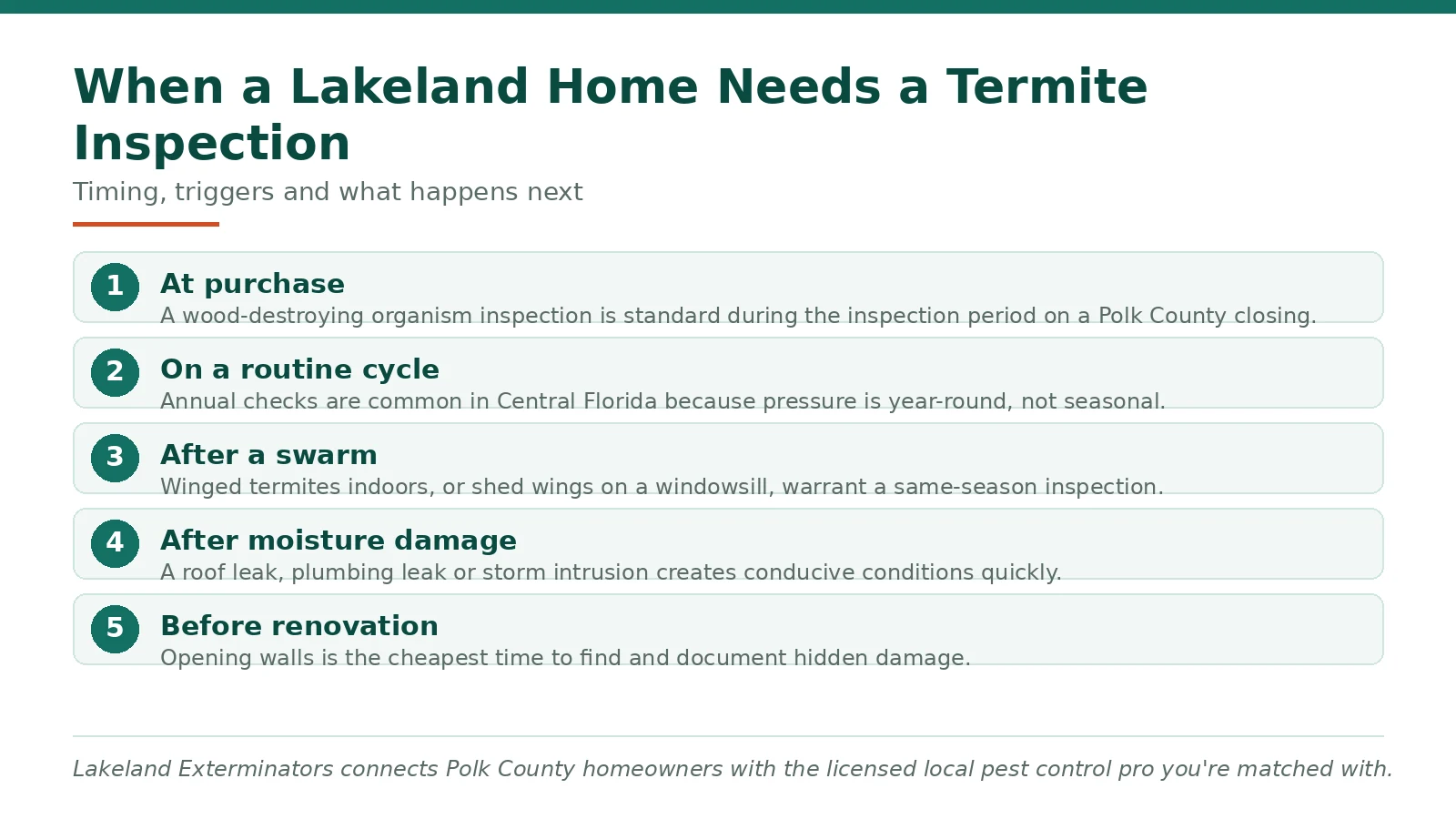
A WDO inspection is the document most lenders and buyers actually want at closing, and it’s a different scope than a routine treatment visit. If a closing date is on the calendar, say so when you reach out — those requests typically get handled with the timeline in mind.
Not sure which termite you’re dealing with, or whether it’s urgent? A licensed operator can tell you in one visit.
For pest and termite pressure specific to your part of Polk County, the Lakeland Exterminators dispatch network routes requests to FDACS-licensed operators covering Lakeland, Kathleen, Lake Hamilton, Loughman, Eagle Lake, and the rest of the county.
FAQ
How do I know if I need a termite inspection or can just keep watching it?
Any single sign — pellets, mud tubes, a swarm indoors, hollow wood — is reason enough for a no-obligation inspection. If it’s just old paint or a stray bug you can’t identify, comparing it against the signs above usually settles it.
Does a termite inspection cost anything in Lakeland?
Residential inspections are typically free in the Polk County market; the licensed operator confirms this when you reach out.
Can drywood termites really be treated without tenting?
Sometimes, when the activity is localized and the operator can physically reach the infested wood. Scattered or hidden activity across multiple rooms usually means fumigation is the more honest answer.
What’s the difference between subterranean and drywood termites?
Subterranean termites live in the soil and travel up through mud tubes; they’re treated with a soil barrier or bait stations. Drywood termites live entirely inside the wood with no soil contact and are identified by frass pellets rather than mud tubes.
How fast can someone come look at it?
Depends on the operator, your ZIP, and demand, especially during spring swarm season. Availability is not guaranteed and varies by provider.
Lakeland Exterminators is a dispatch and matching service. We connect Polk County callers with FDACS-licensed pest control operators. We are not a licensed pest control operator, and we do not perform treatment, set prices, or issue warranties.