Quick answer: If German cockroach gel bait worked at first and then stopped, the colony hasn’t necessarily “gotten smart” – some German cockroach populations develop a genetic aversion to glucose, a common sweetener in bait matrices, so they detect and avoid it without touching the actual insecticide. Rotating to a non-glucose bait formulation – something a licensed operator carries as standard practice – usually solves it fast.
Dealing with a pest problem right now?
📞 Call now — get matched with a licensed local exterminator: (888) 295-0220When you call, stay on the line for a few seconds while we match you with the licensed local exterminator for your area. Have your address and a quick description of the problem ready.
Licensed local pros · Fast response, subject to availability · No obligation
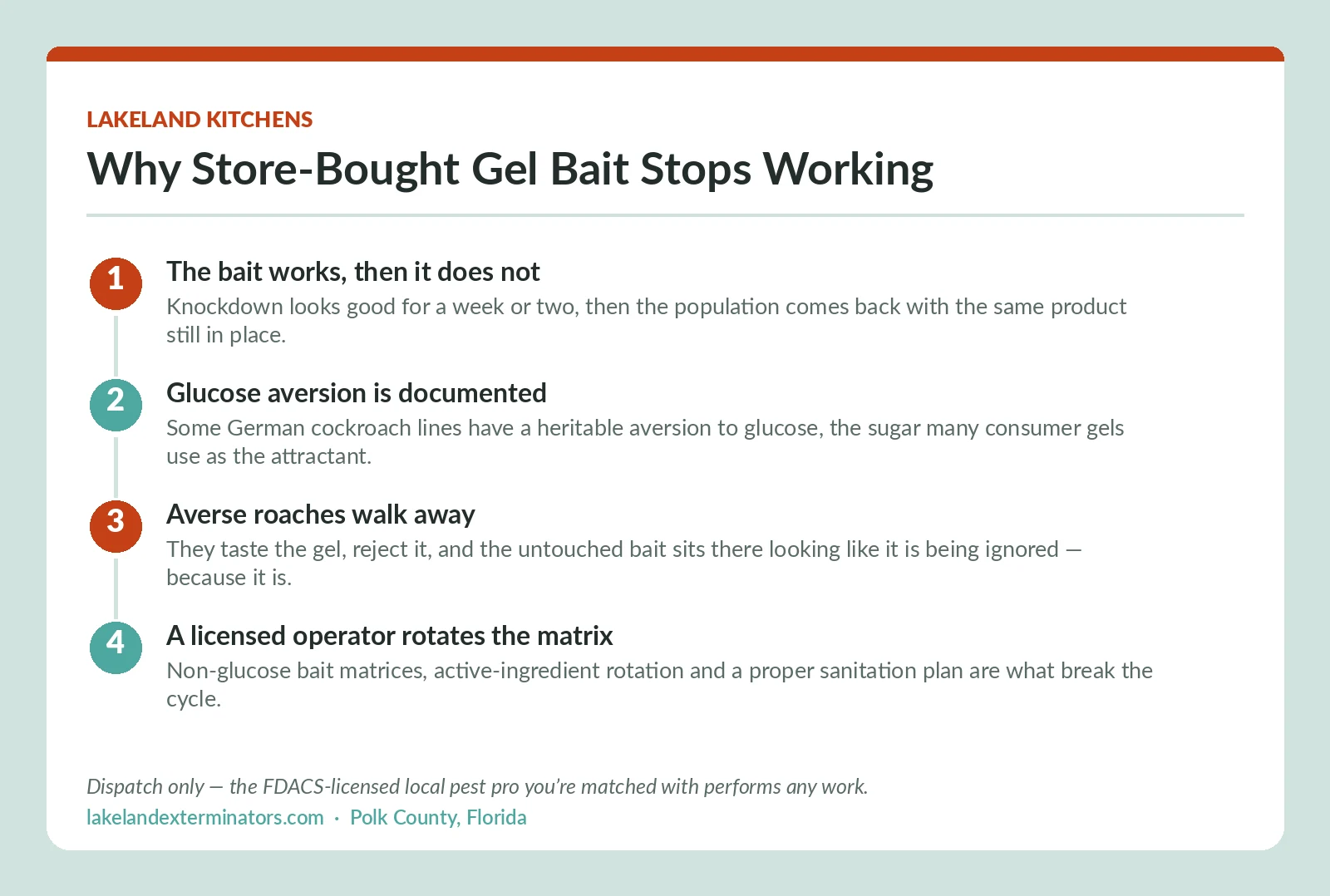
Why does store-bought roach bait stop working?
It’s one of the most common calls Polk County kitchens generate: gel bait wiped out the roaches for two or three weeks, then the trails came back like nothing happened. Homeowners usually assume the colony built a tolerance to the poison itself. Often that’s not what’s happening at all.
German cockroaches (Blattella germanica) are the dominant indoor roach in Central Florida kitchens, and unlike the American cockroach (“palmetto bug”) that wanders in from outside, German roaches live their entire life cycle indoors – behind the refrigerator motor housing, inside cabinet hinges, under the dishwasher. That means an established population is breeding faster than a store-bought bait station can keep up, and it only takes one skipped generation for a resistant trait to spread through the colony.
What is glucose aversion, exactly?
Most consumer gel baits and many professional formulations use a glucose-based sugar matrix to get the roach to eat the bait in the first place – glucose is what makes it taste like food. Documented in university entomology research over the past decade, some German cockroach populations have evolved a genetic trait that makes glucose taste bitter or aversive to them instead of sweet. A roach with that trait walks right past a glucose-based bait station, untouched, while the colony keeps growing behind the wall.
The University of Florida’s entomology department maintains detailed German cockroach biology and control references through its Featured Creatures German cockroach profile, which covers the species’ indoor life cycle and why formulation matters as much as active ingredient in a real control program.
How do you know if this is your problem?
- Bait worked, then plateaued. A real population drop in week one or two, followed by trail activity leveling off instead of continuing to decline.
- Fresh bait sits untouched. Gel placements still look full or barely touched days after placement, with roach activity nearby.
- Multiple bait brands, same result. Rotating between two or three consumer gel products with no real change – most consumer formulations lean on the same glucose-sweetened base.
What does a licensed operator do differently?
A licensed Polk County pest control operator carries multiple bait chemistries and formulations – not just one gel product – specifically because glucose-averse populations are common enough in Florida that rotating formulations is standard practice, not a specialty service. The operator also inspects harborage points (motor housings, hinge cavities, cabinet toe-kicks) that a homeowner placing store bait usually never reaches, and can pair bait rotation with an insect growth regulator to break the breeding cycle rather than only killing visible adults.
One call reaches a licensed, local exterminator who covers your address — and a real person answers, 24/7.
Related Lakeland pest guides
- Roach extermination in Lakeland, FL – the full service overview for German and American cockroach control.
- German cockroach in Polk County – species biology and why it’s hard to kill.
- Restaurant pest control in Lakeland – for commercial kitchens fighting the same bait-resistance problem at scale.
FAQ
Is glucose aversion the same thing as pesticide resistance?
No. Pesticide resistance means the insecticide itself stops killing the roach. Glucose aversion means the roach avoids eating a glucose-sweetened bait in the first place, so the insecticide inside never gets a chance to work. Both can be present in the same population, which is why formulation rotation and active-ingredient rotation are both part of a real program.
Will switching to a different store brand fix it?
Usually not, because most consumer gel baits use a similar glucose-sweetened matrix. A licensed operator carries non-glucose and alternative-sugar formulations that consumer shelves typically don’t stock.
Can I just use spray instead of bait?
Contact sprays kill roaches they directly touch but do nothing for the ones hiding in wall voids and appliance housings, and repellent sprays can scatter a colony into new hiding spots rather than eliminate it. Bait that the colony actually eats and carries back to the harborage remains the more effective approach for an established indoor population.
How fast should bait rotation show results?
A correctly matched bait formulation typically shows a visible drop in trail activity within one to two weeks, with the population declining over several weeks as the colony’s egg cases hatch and get exposed. A licensed operator’s follow-up visit is the way to confirm the rotation is actually working.
Disclosure: Lakeland Exterminators is a dispatch and matching service. We connect Polk County callers with FDACS-licensed structural pest control operators. We are not a licensed pest control operator and do not perform treatment, set prices, or issue warranties. All pricing, scheduling and treatment plans are determined by the FDACS-licensed operator dispatched to your address under Chapter 482, Florida Statutes.