Quick answer: Drywood termites (Cryptotermes brevis) don’t need soil contact the way subterranean termites do – they live entirely inside dry wood, which means the real warning signs in a Polk County home are small: pepper-flake-sized fecal pellets (frass), tiny kick-out holes, and piles of shed swarmer wings after a flight. Because there’s no mud tube to spot from across the yard, drywood termite damage is often found by accident, well after the colony has been established.
Dealing with a pest problem right now?
📞 Call now — get matched with a licensed local exterminator: (888) 295-0220When you call, stay on the line for a few seconds while we match you with the licensed local exterminator for your area. Have your address and a quick description of the problem ready.
Licensed local pros · Fast response, subject to availability · No obligation
Why drywood termites are a distinct problem in Polk County
Florida is one of the few states with an established drywood termite population large enough to matter statewide, and Cryptotermes brevis in particular has spread through Florida’s warm, humid climate in a way it hasn’t in most of the continental U.S., according to the University of Florida’s entomology department (UF IFAS Featured Creatures, West Indian drywood termite). Unlike subterranean termites, which need consistent ground moisture and build visible mud tubes to travel between soil and wood, drywood termites fly directly to exposed wood – attic framing, window and door trim, even furniture – and tunnel in without ever touching soil. Florida’s licensing agency, FDACS, requires WDO (wood-destroying organism) inspections to specifically check for both termite types because the treatment approach is genuinely different (FDACS, Termites).
For a Polk County homeowner, that distinction matters practically: a soil-based termite bond built for subterranean termites doesn’t automatically cover a drywood termite colony living entirely above ground in attic framing or window trim, which is why getting the species right at inspection time changes what’s actually recommended.
It’s also worth knowing that drywood termite colonies grow slowly compared to subterranean species – often taking years to produce a noticeable amount of damage – which is exactly why the small early signs (a pellet pile, a pinhole in trim) matter so much. Catching activity in that slow early window is a very different situation than discovering it after years of undetected tunneling.
What does drywood termite frass actually look like?
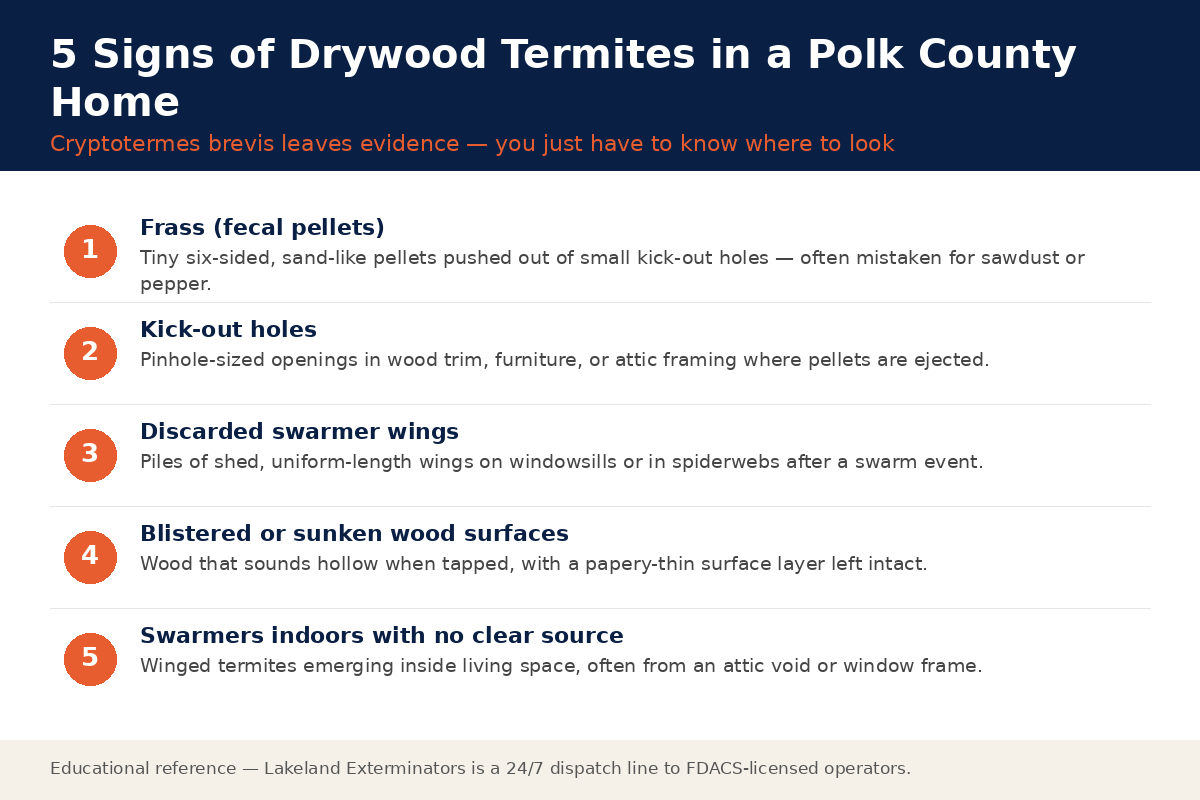
Frass is the giveaway most homeowners eventually notice, usually before anything else. As drywood termites tunnel, they push fecal pellets out of small “kick-out holes” to keep their galleries clean – and because the pellets are dry, six-sided, and roughly the size of ground pepper, they’re frequently mistaken for sawdust, sand, or even drywall dust. Finding small mounds of this material below a windowsill, baseboard, or attic rafter – with no obvious source – is one of the more reliable early signs.
What other signs should a Polk County homeowner watch for?
- Kick-out holes: Pinhole-sized openings in trim, furniture, or framing where pellets are ejected.
- Discarded swarmer wings: After a swarm, drywood termites shed their wings – look for small piles of uniform, translucent wings on windowsills or caught in spiderwebs.
- Blistered or papery wood surfaces: Wood that sounds hollow when tapped but still looks intact on the surface – a sign of tunneling just beneath the finish.
- Swarmers indoors with no clear outdoor source: Winged termites emerging inside a living space, often from an attic void, window frame, or piece of untreated furniture.
When do drywood termites swarm in Central Florida?
Swarming activity in Florida can happen across a broader window than the more predictable spring swarm most people associate with subterranean termites – drywood termite flights are often triggered by warm evenings and can occur into late summer and fall. That’s part of why a swarm event in a Polk County home doesn’t automatically point to the more commonly discussed subterranean species; the timing and indoor entry point both matter for an accurate read.
What does a licensed operator actually check during an inspection?
A licensed FDACS operator performing a WDO inspection checks attic framing, window and door trim, exterior fascia, and any exposed structural wood for frass, kick-out holes, and blistering – not just the areas a homeowner might think to look. Because drywood colonies can exist in isolated pockets of wood without spreading through the whole structure the way subterranean termites do, treatment options can range from localized spot treatment to whole-structure fumigation depending on how widespread the activity is found to be. For the full local breakdown of termite types and how Polk County operators approach each one, see our termite control page for Lakeland, FL. If you want the deeper species profile, our Florida drywood termite species guide covers identification in more detail.
What should you do if you find frass or kick-out holes?
A few things are worth doing (and avoiding) once you spot possible drywood termite evidence:
- Leave the frass pile where it is rather than vacuuming it up immediately – it helps a licensed inspector confirm the source and pinpoint the kick-out hole.
- Take a dated photo of the pellets and any visible holes, since a growing pile over a few days is a useful data point for the inspection.
- Avoid painting or caulking over a suspected kick-out hole before an inspection – sealing it can hide the very evidence an operator needs to confirm activity.
- Check nearby wood surfaces for hollow sound by lightly tapping with a knuckle, without pressing hard enough to damage the surface.
- Request a WDO report if you’re buying, selling, or refinancing a Polk County home – FDACS requires this standardized inspection form (DACS-13645) that documents both subterranean and drywood termite findings.
Drywood termite colonies can stay isolated in one piece of wood for a long time before spreading, which is part of why catching the early signs – rather than waiting for visible structural damage – makes such a difference in how the situation gets handled.
FAQ
Do drywood termites need contact with soil?
No – that’s the key difference from subterranean termites. Drywood termites live entirely inside dry wood above ground and never need soil contact to survive or spread.
Can I tell drywood termite frass from sawdust myself?
Frass pellets are uniformly small, six-sided, and consistent in shape under magnification, while sawdust is irregular. If you’re unsure, a licensed operator can confirm during an inspection.
Does a termite bond cover drywood termites too?
It depends on the specific bond – some are written for subterranean termites only. It’s worth confirming coverage details with the operator you’re matched with rather than assuming.
If you’ve found small pellet piles, tiny kick-out holes, or shed wings in your home, it’s worth having a licensed local operator take a real look before the activity spreads further. Get matched with a licensed Polk County exterminator for termite control.