Quick answer: Ghost ants (Tapinoma melanocephalum) are one of Florida’s most common – and most frustrating – kitchen ants because a single colony can have dozens of queens spread across multiple satellite nests. Spraying the trail you can see often triggers “budding,” where the colony splits into new nests to avoid the threat. That’s why a Lakeland kitchen can have ghost ants disappear for a few days after a spray, then come back worse.
Dealing with a pest problem right now?
📞 Call now — get matched with a licensed local exterminator: (888) 295-0220When you call, stay on the line for a few seconds while we match you with the licensed local exterminator for your area. Have your address and a quick description of the problem ready.
Licensed local pros · Fast response, subject to availability · No obligation
Why ghost ants are such a persistent Florida problem
Ghost ants aren’t native to Florida, but the state’s warm, humid, frost-free climate lets them thrive statewide in a way colder regions never see. The University of Florida’s entomology department notes that ghost ant colonies are polygynous – meaning many queens per colony – and readily bud into new satellite nests when disturbed, which is a documented survival strategy, not random bad luck (UF IFAS Featured Creatures, ghost ant). In USDA Zone 9b, Polk County almost never gets a hard freeze long enough to knock a colony back the way northern winters do elsewhere, so a ghost ant population that establishes itself in landscaping or wall voids can keep growing across every season.
That multi-queen structure is the local information gap worth understanding: treating a ghost ant problem the way you’d treat a single-queen ant species (kill the ones you see, done) doesn’t work, because the workers foraging across your counter represent only a fraction of a colony that may have several independent nesting sites within a few feet of your kitchen.
It’s also worth knowing that ghost ants are considered a “tramp species” by entomologists – meaning they spread easily through human activity like potted plant sales and landscaping material, which helps explain how quickly they’ve become established across nearly every part of Florida, not just coastal or urban areas.
Because ghost ant colonies can be established in more than one spot around a property at the same time – a mulch bed, a wall void, and a potted plant, for example – a single visible trail on the kitchen counter is often just the most noticeable evidence of a larger, connected problem spread across several nesting sites.
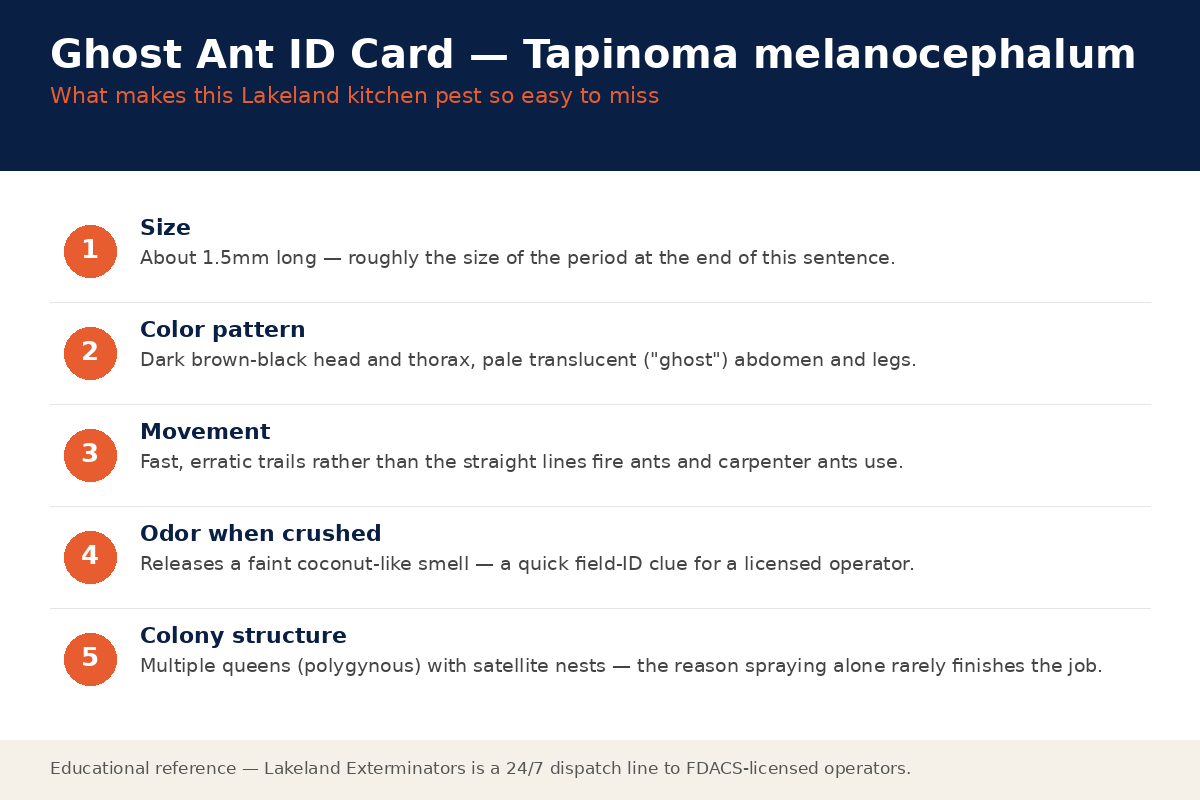
How do you tell a ghost ant from other small Florida ants?
- Size and color: About 1.5mm, with a dark brown-to-black head and thorax against a pale, almost see-through abdomen and legs – the “ghost” in the name.
- Trail pattern: Fast, erratic, wandering trails rather than the straight lines fire ants tend to run.
- Odor when crushed: A faint coconut-like smell, which is a quick field clue a licensed operator will use during inspection.
- Where they nest: Potted plants, mulch beds, wall voids, and even inside houseplant soil – nesting sites most homeowners never think to check.
Why do ghost ants show up more after Central Florida rain?
Heavy rain floods shallow soil nests, and ghost ants – like many small ant species – respond by relocating toward higher, drier ground, which frequently means moving from landscaping straight into a home’s foundation gaps and wall voids. Lakeland’s summer storm pattern, with near-daily afternoon rain during wet season, creates a repeating cycle: outdoor colonies get flooded out, move indoors, and a percentage stay established even after the yard dries back out.
Why does spraying the trail backfire?
A contact spray kills the workers in front of you, but it doesn’t reach the satellite nests those workers came from – and the chemical disturbance itself is one of the known triggers for budding. That’s the mechanism behind the common homeowner complaint that “the ants came back worse after I sprayed.” A licensed operator generally avoids that trigger entirely by using targeted baiting instead, which works with the colony’s own foraging behavior rather than against it – workers carry bait back to the nest and share it with the queens a surface spray never touches.
What does a licensed Polk County operator do differently?
After confirming the species, a licensed operator typically traces trails back toward suspected nesting sites, then places bait matched to what the colony is actively foraging for at that time of year (ghost ants shift between sweet and protein food sources seasonally). Because of the multi-queen, multi-nest structure, full resolution is usually a monitored process over a few weeks rather than a single visit. For the broader Polk County ant picture – including fire ants and carpenter ants – see our ant control page for Lakeland, FL. If you’re comparing ghost ants to Argentine ants, our Argentine ant species reference covers the difference in more depth.
What can you do while you wait to get matched with an operator?
A few habits reduce how much a ghost ant trail can spread while you’re waiting on an inspection:
- Store sugary and greasy foods in sealed containers, including pet food left out overnight.
- Pull mulch and potted plants back a few inches from the foundation where you can – both are common outdoor nesting sites that bridge straight to the house.
- Wipe spills promptly, but skip the over-the-counter spray if you’re planning a professional inspection soon, since it can scatter the colony before an operator has a chance to trace it.
- Leave a short section of an active trail alone rather than eliminating it completely – it helps an operator trace the path back toward the nesting site.
- Check houseplant soil for ant activity, since indoor potted plants are an often-overlooked nesting spot ghost ants use during Central Florida’s wet season.
These steps won’t eliminate an established multi-queen colony on their own, but they limit how far it spreads while you’re waiting to get matched with a licensed Polk County operator.
FAQ
Are ghost ants dangerous?
No – ghost ants don’t sting and aren’t known to bite people. The issue is persistence and food contamination in kitchens and pantries, not a health or safety risk.
Why did the ants disappear after I sprayed, then come back?
Sprays kill visible workers but rarely reach the nest itself, and the disturbance can trigger the colony to bud into new satellite nests – which is why the population sometimes rebounds larger than before.
Does cleaning the counter stop ghost ants?
It removes the immediate food source but not the colony. Consistent sanitation helps reduce what draws them indoors, but an established multi-queen colony usually needs targeted baiting to fully resolve.
If ghost ants have been a repeat problem on your counters, it’s worth having a licensed local operator take a real look at the nesting sites, not just the trail. Get matched with a licensed Polk County exterminator for ant control.