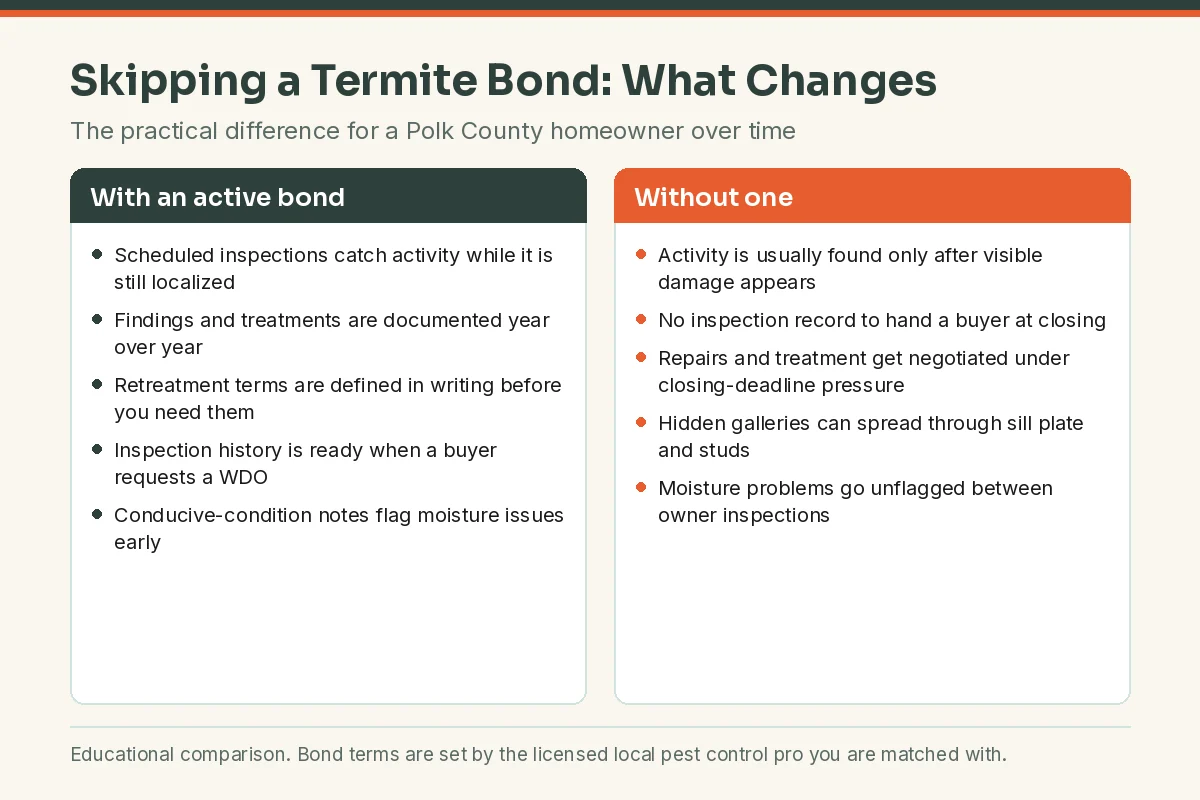
Most Lakeland homeowners with a Sentricon or Termidor bond view it as an annual nuisance — a recurring annual charge that shows up every year, doesn’t seem to produce visible results, and is easy to “save money” by canceling. The conversation usually goes the same way: the bond is up for renewal, the homeowner remembers paying it last year, no termites have appeared, and the renewal goes in the “maybe I’ll skip it” pile. Then, two or three years later, the WDO inspection for a real estate sale finds active termite damage. At that point the math is brutally different. This post lays out what skipping a termite bond actually costs in Polk County, with real ranges and the specific scenarios where it goes wrong.
Dealing with a pest problem right now?
📞 Call now — get matched with a licensed local exterminator: (888) 295-0220When you call, stay on the line for a few seconds while we match you with the licensed local exterminator for your area. Have your address and a quick description of the problem ready.
Licensed local pros · Fast response, subject to availability · No obligation
One call reaches a licensed, local exterminator who covers your address — and a real person answers, 24/7.
The base math: bond vs no-bond
Polk County 2026 annual termite bond renewal pricing typically falls in this range:
- Sentricon bond renewal: Moderate annual cost
- Termidor liquid bond renewal: Lower annual cost
- National chain bonds (Terminix, Orkin, Truly Nolen): Higher annual cost
Annual cost of bond protection compounds over 10 years into a modest cumulative total — far below what a single serious termite-damage scenario can run, as the breakdowns below show. If you’re weighing a bond against paying for treatment as issues come up, our termite treatment cost guide for Lakeland & Polk County breaks down what individual inspections, spot treatments, and full jobs typically run.
Skipping the bond for 10 years saves you that money. But the variance in skipped-bond outcomes is enormous. Most Polk County homes that skip a bond will pay no termite cost in any given year. Some will pay a lot.
Scenario 1: The skip that goes fine
You bought a 2008 Lakeland home that came with the builder’s 1-year subterranean termite warranty. You let it lapse, you’ve never seen termites, you’ve maintained your perimeter via quarterly pest control, and you sell the house in 2034.
The WDO inspection at closing finds no active termites and no evidence of past damage. You pay a modest, inspection-only fee for the WDO. Your buyer might ask for a treatment to “be safe” but most don’t. This is exactly the kind of report a buyer’s separate home inspection and WDO check in Polk County is designed to catch (or, in this case, not catch anything at all).
10-year cost of skipping the bond: just the price of a single WDO inspection — the lowest-cost outcome on this page.
This is the most common scenario in Polk County. Most homes don’t get hit with significant termite damage in any given decade. The lottery-style nature of termite pressure means that the median homeowner who skips the bond pays nothing.
Scenario 2: The skip that goes badly
You bought the same 2008 Lakeland home. Same skipped bond. But:
- A neighbor’s mature oak comes down in a 2030 hurricane, leaving a saturated wood pile near your fence line for 18 months.
- A roof tile damaged in 2031 lets water into your soffit, undetected, for 8 months. The wet sheathing becomes a Formosan attractant.
- A small Eastern subterranean colony establishes in your slab penetrations in late 2031.
- By the 2034 WDO inspection, you have active subterranean termite damage in 3 wall studs near your master bath plus active termite tubes inside an exterior soffit.
Polk County 2026 (inflated for 2034) cost of this scenario:
| Item | Relative Cost Level |
|---|---|
| Initial WDO inspection finding active | Modest (inspection-fee level) |
| Subterranean termite spot + monitoring install | Moderate |
| Structural repair (3 studs + sheathing) | Moderate-to-high |
| Soffit replacement + repaint | Moderate |
| Real estate price impact (post-WDO buyer concession) | High |
| New buyer-required bond | Moderate (ongoing annual) |
Total impact: a combined bill running many times the cost of a decade of bond payments before factoring in the price concession on resale. Even just the inspection, treatment, and structural-repair line items on their own far exceed the 10 years of skipped bond payments.
The bond would not have prevented all damage — but it would have caught the issue at the annual inspection, triggered retreatment, and likely kept structural damage close to zero.
Scenario 3: The catastrophic skip (drywood + subterranean combo)
This one is rare but real in Polk County because of our dual-pressure zone (Eastern subterranean AND Florida drywood termite activity simultaneously).
You skipped the bond. The home has both pressures. Subterranean activity is in the slab as in Scenario 2. Drywood activity is in attic framing — slow, invisible, undetected for 5+ years.
By the time it’s discovered:
- Whole-home drywood tenting becomes necessary: moderate-to-high cost
- Subterranean treatment + bond install: moderate cost
- Structural repair for advanced drywood damage to attic rafters: high-to-severe cost, scaling with how much framing is compromised
- Insurance generally doesn’t cover termite damage (specifically excluded)
- Real estate price impact: severe — a documented active termite history is one of the biggest negotiating levers a buyer can use at closing
Total impact: a bill that dwarfs decades of bond payments combined.
Catastrophic scenarios are uncommon but not negligible. They represent maybe 1-3% of skipped-bond Polk County homes over a 20-year horizon — but the consequences are large.
The expected value calculation
If you model a Lakeland homeowner over 20 years, expected costs roughly break down:
| Outcome | Approximate probability | Relative Cost Level |
|---|---|---|
| No issue | 80% | Negligible — just the WDO fee at eventual sale |
| Moderate damage discovered at sale | 15% | Moderate-to-high |
| Major damage discovered mid-tenure | 4% | High |
| Catastrophic damage | 1% | Severe |
Expected value of skipping the bond over 20 years: a moderate figure that still lands meaningfully below 20 years of bond payments, on average (these are rough probabilities, not exact actuarial estimates).
20-year bond cost (Sentricon at a moderate average annual rate): several times the average expected cost of skipping.
On expected value alone, the bond is “negative” relative to skipping. Bond protection is closer to insurance than to a savings product — the median homeowner pays for protection they don’t use. What the bond buys you is variance reduction: you trade a guaranteed annual cost for elimination of the right-tail risk.
When the bond is clearly worth it
The expected value math flips toward “definitely bond” in several Polk County scenarios:
- Heavy local termite pressure — Older Lakeland neighborhoods with documented termite activity (parts of Dixieland, older Lake Hollingsworth, older Polk City) have higher than 20% scenario-2 probability.
- Older home with prior damage history — Past damage signals future risk.
- Homes in floodplains or with chronic moisture — Subterranean activity is elevated.
- Citrus-edge subdivisions — Drywood pressure is elevated. Even more important for these properties.
- Homes you plan to sell in 5-10 years — A bond + clean WDO history is a sale-friendly document.
- Risk-averse homeowners — If a large, unexpected structural-repair bill would cause real financial strain, the bond is cheap insurance.
When the bond is closer to a wash:
- Newer (post-2015) construction with active builder warranty + Sentricon install pre-included — Initial protection is already in place; consider stepping down to monitoring-only.
- Drier inland lots without mature canopy — Subterranean pressure is lower.
- Homes you plan to sell in 1-2 years — Damage that would show up at WDO will likely show whether you bond or not.
What the bond actually pays for
Most Polk County bonds include:
- Annual visual inspection of accessible structure — Operator walks the property, checks bait stations or treated soil zones, reports findings.
- Reapplication or retreatment if activity is found — At no additional cost during bond.
- Damage repair clause (some bonds) — Termidor liquid bonds increasingly include this; Sentricon Always Active typically does. Verify the specific language.
- Transferability — At resale, the bond can transfer to new owner (usually for a fee).
What it doesn’t include:
- Drywood termite work (different category — most subterranean bonds are explicit on this)
- Carpenter ant or other wood-destroying pests
- Damage from prior infestations that pre-date the bond
- Repair if you let the bond lapse and reinstate
See annual termite bond worth it — Lakeland for a fuller treatment of the bond economics.
Frequently asked questions
What’s the difference between Sentricon and Termidor bonds? Sentricon is a bait system (hexaflumuron) — stations buried around the perimeter. Termidor is a liquid soil barrier (fipronil) — applied as a treated zone in soil around the slab. Both work. Sentricon tends to have higher annual cost; Termidor tends to have higher initial install. See Sentricon vs Termidor — Lakeland.
Can I negotiate bond renewal prices? Yes, especially with local operators. National chains have less flexibility. Comparing quotes from 2-3 operators is the simplest leverage — most local Polk County operators will match a competitive quote rather than lose a multi-year customer.
Does the bond cover drywood termites? Most subterranean termite bonds explicitly exclude drywood termites. If you live in a drywood-pressure zone (Lake Wales, Frostproof, citrus belt), you need separate drywood coverage or you should plan for drywood inspection separately.
What happens if my bond lapses for a few months? Most operators will reinstate without re-inspection if the lapse is short (under 30 days). Longer lapses typically require a new WDO inspection and possibly retreatment before the bond can resume.
Is the bond transferable when I sell? Usually yes, for a modest transfer fee. The new buyer gets continued coverage. A transferable active bond is a selling point — it shows the home has had ongoing professional termite protection.
Next steps
One call reaches a licensed, local exterminator who covers your address — and a real person answers, 24/7.
Related Polk County termite reading:
- Annual termite bond worth it — Lakeland
- Termite treatment complete guide — Lakeland
- Termite treatment cost — Lakeland
- Sentricon vs Termidor — Lakeland
- Sentricon installation — Lakeland
- WDO inspection — Lakeland
- WDO reports for Polk County real estate closings — 2026 guide
- Pest control complete guide — Lakeland
One call reaches a licensed, local exterminator who covers your address — and a real person answers, 24/7.
Disclaimer: Lakeland Exterminators is a local dispatch and referral service, not a licensed pest-control operator. We connect Polk County, Florida homeowners with independent, FDACS-licensed and insured pest-control companies. All inspections and treatments are performed by those independent providers, who set their own pricing, scheduling, and service terms.
Any reference to same-day, emergency, or 24/7 service describes the typical scheduling of matched independent providers and is not guaranteed; actual response times vary by provider, season, location, and demand.