📞 Call (888) 295-0220Open 24/7. Enter your ZIP on the keypad and talk live with a local pest control company that serves your area.
Polk County is lake country. Between Lakeland and Lake Wales sit dozens of named lakes, miles of citrus and former grove land, and the warm, humid Central Florida air that defines life here — and every one of those features shapes the pest pressure that homeowners across the county deal with year-round. Whether you are in a Winter Haven neighborhood ringed by water, a Bartow home on older shaded streets, or a newer subdivision in Auburndale or Haines City, the pests are largely the same; only the local texture changes.
This guide explains what unites pest pressure across Polk County, the specific pests that drive the most concern county-wide, and the local notes that make each town a little different — so you know what you are dealing with and what to have ready when you get connected with a local pest control company who serves your part of the county.
Need a pest control company to take a look?
Call, enter your 5-digit ZIP on the keypad, and get connected live with a local pest control company. Free to call, 24/7.
What Unites Polk County Pest Pressure
Three features tie the whole county together when it comes to pests. The first is water. Polk’s chain-of-lakes geography means a large share of homes sit near a lake, a canal, a retention pond, or low, damp ground. Standing and nearby water keeps humidity high and supplies the moisture that nearly every household pest depends on — roaches, ants, rodents, and silverfish are all moisture-driven, and lakeside lots keep that resource constant.
The second is citrus and grove land. Polk County has long been at the heart of Florida citrus, and the citrus belt has a specific pest signature, most notably roof rats — so much so that roof rats are sometimes nicknamed “citrus rats” for their fondness for fruit and the cover that groves and mature plantings provide. Even where groves have given way to development, the mature trees, fruit trees in yards, and established landscaping continue to support climbing rodents.
The third is humidity and a long warm season. Central Florida’s climate keeps pests active and reproducing for most of the year, with the May-through-October wet season driving repeated surges. There is no hard winter to reset populations, so the pressure is steady and the outdoor populations pressing against homes stay large. Put water, citrus-country cover, and year-round humidity together and you get distinctive, persistent, multi-pest pressure across every Polk town.
The Pests Driving Concern County-Wide
A handful of pests account for most of the homeowner concern across Polk County. Knowing which one you have — and why it shows up here — helps you describe it accurately when you reach a pro.
Termites — subterranean and drywood
Termites are the highest-stakes pest in the county, and Central Florida sees both subterranean termites, which nest in the soil and build mud tubes up into a structure, and drywood termites, which live entirely inside dry wood with no soil contact. The warm, humid climate and abundant wood keep both active, and spring and early summer bring swarms that send panicked homeowners looking for answers. Because termite damage builds quietly inside wood and the two types require different treatment approaches — soil and perimeter work for subterranean, wood-targeted or whole-structure options for drywood — this is the pest where a professional inspection matters most. Local pest control companies address both as part of broader pest control across Polk County.
Ghost ants and tawny crazy ants
Two ant species drive a large share of Polk County ant problems. Ghost ants are tiny, pale-legged ants — the insect many people know as “sugar ants” — that trail to kitchen and bathroom moisture and sweets, nest in many small satellite colonies, and are notoriously hard to chase out with store-bought sprays because scattering them just splits the colony. Tawny crazy ants are reddish-brown ants that move in fast, erratic patterns and build enormous populations; they are infamous for swarming electrical equipment and AC units and for sheer overwhelming numbers. Both respond far better to a targeted professional approach than to retail products, which often make ghost-ant problems worse by triggering the colony to split.
Roof rats — the citrus-belt signature
Roof rats are the rodent that defines Polk County, earning the local “citrus rat” nickname. They are agile climbers that travel along tree limbs, fences, and utility lines and enter homes high — through gaps at the roofline, soffit, gable vents, and along the eaves — then nest in attics. Citrus and fruit trees, mature landscaping, and the county’s tree cover give them food and a highway straight to the roof. Signs include scratching and scampering in the attic or walls at night, droppings in the attic or garage, and gnaw marks. Exclusion — sealing the roofline entries and trimming limbs off the roof — is the heart of any lasting fix.
Roaches
The large palmetto-bug roaches — American and smokybrown cockroaches — are a county-wide constant. They breed outdoors in mulch, leaf litter, woodpiles, and sewers and come inside for water and shelter, especially after the heavy summer rains that flood their outdoor habitat. The smaller German cockroach, by contrast, breeds indoors in kitchens and is a different fight. Lakeside humidity and lush landscaping keep roach pressure high across every town.
One call reaches a local pest control company who covers your address — 24/7.
Town Notes Across Polk County
The county is not one uniform place, and pest pressure has local texture from town to town.
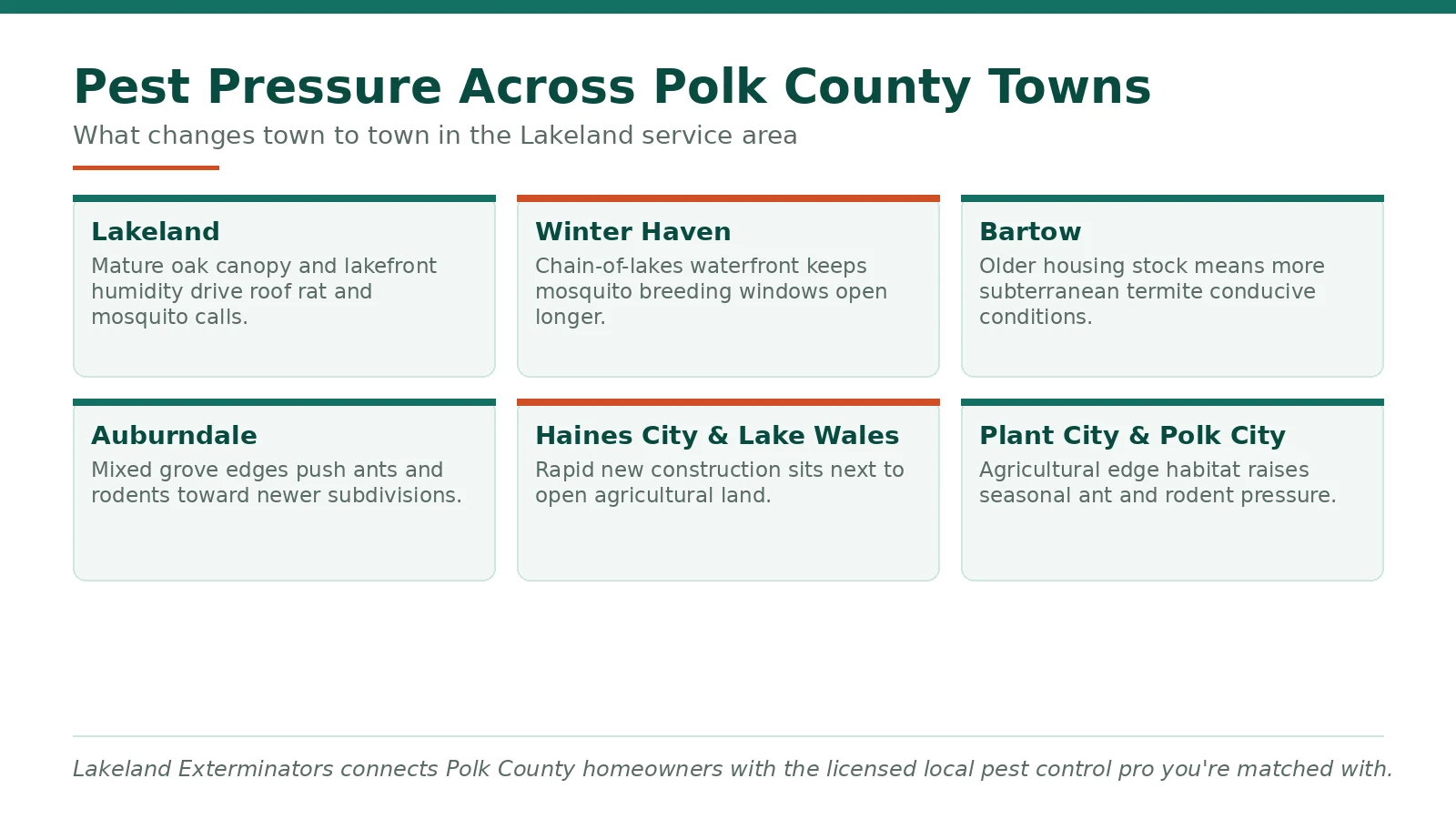
Auburndale. Set among lakes and former grove land between Lakeland and Winter Haven, Auburndale combines lakeside humidity with citrus-country roof-rat pressure and steady new development that draws subterranean termites to freshly graded soil. Homes near the water see strong roach and ant activity. Nearby communities are served through pages like pest control in Lake Hamilton just to the east.
Bartow. The county seat has many older, established, tree-shaded neighborhoods, a setting that favors roof rats traveling the mature canopy, palmetto bugs in settled homes, and both termite types in older wood. Established landscaping and mature trees are the throughline.
Winter Haven. Famous for its chain of lakes, Winter Haven is lakeside living at its most literal, which means high humidity, strong roach and ant pressure, and rodents where neighborhoods back up to water and vegetation. Waterfront and near-water lots are the local hot spots.
Haines City and the Loughman/Davenport corridor. The fast-growing northeast end of the county is heavy on new construction, which puts subterranean termites and construction-gap rodents front and center, alongside the ant and roach pressure common to new subdivisions on damp ground. The corridor is served through pages like pest control in Loughman.
Lake Wales and the southern lakes. The Ridge and the southern lake communities mix citrus heritage, rural and large-lot properties, and lake humidity — a combination that keeps roof rats, roaches, ants, and termites all in play, with large wooded lots adding harborage close to homes. Smaller surrounding communities are covered through pages like pest control in Eagle Lake and pest control in Kathleen.
Across all of them, the common thread is water plus warmth plus cover — which is why a genuinely local approach, tuned to your specific lot and neighborhood, beats a generic treatment.
What to Have Ready When You Reach Out
A little preparation makes getting connected with the right pro faster and the visit more productive. Know your town and general location so the call reaches a company that serves your part of Polk County. Be ready to describe what you are seeing — the pest if you can identify it, or its size, color, and behavior if you cannot — and where and when you notice it, since clustering and timing point to the source. Note any structural or moisture context: a recent swarm and where, mud tubes on the foundation, attic noise or droppings, mulch beds against the house, fruit trees or limbs touching the roof, or a damp area indoors. And mention whether you have pets or small children, so you can ask the exterminator about pet-safe product options and placement when you connect. The clearer the picture, the more precisely the treatment can be aimed. For the full picture of what local pest control companies handle, see the complete pest control guide for Lakeland.
One call reaches a local pest control company who covers your address — 24/7.
Check the company before treatment starts
In Florida, pest control companies must hold a business license from the Florida Department of Agriculture and Consumer Services (FDACS) under Chapter 482, Florida Statutes. Ask for the company’s license number and look it up on the FDACS license search before work starts.
Get the treatment plan, the products to be used, any follow-up visits and the price in writing. For termite work, ask what the contract or bond covers, whether it’s retreatment only or includes repair of damage, and how long it lasts. Our guide on checking an FDACS pest control license walks through it.
How the call works
- Call (888) 295-0220. Any time, day or night.
- Enter your 5-digit ZIP code on your phone’s keypad when prompted.
- Get connected live with a local pest control company that serves your ZIP. Describe what happened and ask when they can come out and what the job will cost.
Frequently Asked Questions
What pests are most common in Polk County, FL? The most common are termites (both subterranean and drywood), ghost ants and tawny crazy ants, roof rats, and large palmetto-bug roaches. Polk County’s chain-of-lakes humidity, citrus-country tree cover, and long warm season keep all of them active for most of the year, so multi-pest pressure is the norm across Lakeland, Auburndale, Bartow, Winter Haven, and the surrounding towns.
Why are roof rats such a problem in Polk County? Polk County is at the heart of Florida citrus, and roof rats — sometimes known as “citrus rats” — are drawn to fruit and to the cover that citrus, mature trees, and established landscaping provide. They are agile climbers that travel limbs and utility lines into attics through roofline gaps. The county’s tree cover and fruit trees give them both food and a direct route in, which is why they are the signature rodent here.
Are the exterminators you connect me with licensed in Florida? We are a referral line that connects you with a local pest control company that serves your Polk County town — we are not ourselves a pest control company, and the actual work and any quote are handled directly between you and the pro.
What kind of ants trail through Polk County kitchens? The most common are ghost ants — tiny, pale-legged ants many people know as “sugar ants” — which trail to moisture and sweets and nest in many small satellite colonies. Tawny crazy ants, reddish-brown ants that move erratically and build huge numbers, are also widespread. Both are hard to control with retail sprays; scattering ghost ants can actually split the colony and worsen the problem, so a targeted professional approach works better.
Do new homes in Polk County get termites? Yes. New construction can attract subterranean termites because building disturbs soil and existing colonies and creates fresh structures on damp, graded ground. A new home is not automatically protected unless a termite treatment or protection plan is in place. With the fast growth in areas like Haines City and the Loughman corridor, confirming and maintaining termite protection is especially worthwhile.
Why do I see roaches near the lake even with a clean house? The large palmetto-bug roaches breed outdoors in mulch, leaf litter, and damp ground and come inside seeking water and shelter, so their numbers are driven by the humid, lakeside environment rather than indoor cleanliness. Near-water lots keep humidity and outdoor populations high, so even spotless homes see periodic sightings, especially after the summer rains flood the roaches’ outdoor habitat.
Which Polk County towns do you cover? Local pest control companies serve communities across the county, including Lakeland, Auburndale, Bartow, Winter Haven, Haines City, Lake Wales, and smaller surrounding communities like Eagle Lake, Kathleen, Lake Hamilton, and Loughman. Entering your ZIP connects you with a company that covers your town.
LakelandExterminators.com is a referral line. We connect callers with Florida exterminators. We are not a pest control company. The disclaimer in our site footer and our 24/7 referral caveat apply to this page.
Lakeland Exterminators is a free referral line that connects callers with independent local pest control companies. We don’t perform the work. The company you’re connected with gives the quote, does the work and stands behind it.