📞 Call (888) 295-0220Open 24/7. Enter your ZIP on the keypad and talk live with a local pest control company that serves your area.
Polk County’s subtropical climate supports near-year-round mosquito activity, with seasonal pressure peaks driven by rainfall, temperature, and breeding habitat. Understanding when each major mosquito species is active helps Polk County homeowners time prevention and treatment effectively. This is an informational guide; mosquito treatment in Polk County is performed by independent Florida pest-control companies.
Mosquitoes taking over the yard?
Call, enter your 5-digit ZIP on the keypad, and get connected live with a local pest control company. Free to call, 24/7.
The Three Mosquito Species That Matter Most in Polk County
Aedes aegypti (yellow fever mosquito) — Daytime biter. Primary vector for Zika, dengue, chikungunya, yellow fever. Breeds in artificial containers (plant saucers, gutters, tire piles, buckets, birdbaths). Active March through November in Polk County, with summer peak.
Aedes albopictus (Asian tiger mosquito) — Aggressive daytime biter with distinctive black-and-white striped legs. Same disease vector profile as Aedes aegypti. Highly adaptable. Active March through November, sometimes year-round in warmer winters.
Culex species (Southern house mosquito and others) — Primarily night and dusk biters. Vectors for West Nile Virus, Eastern Equine Encephalitis (EEE), St. Louis Encephalitis (SLE). Breeds in stagnant water — ditches, retention ponds, abandoned pool water, neglected swimming pools. Active April through October, peak summer.
Anopheles species — Historical malaria vectors, low-grade ongoing concern. Primarily dusk-active. Less significant in Polk County than the Aedes and Culex species.
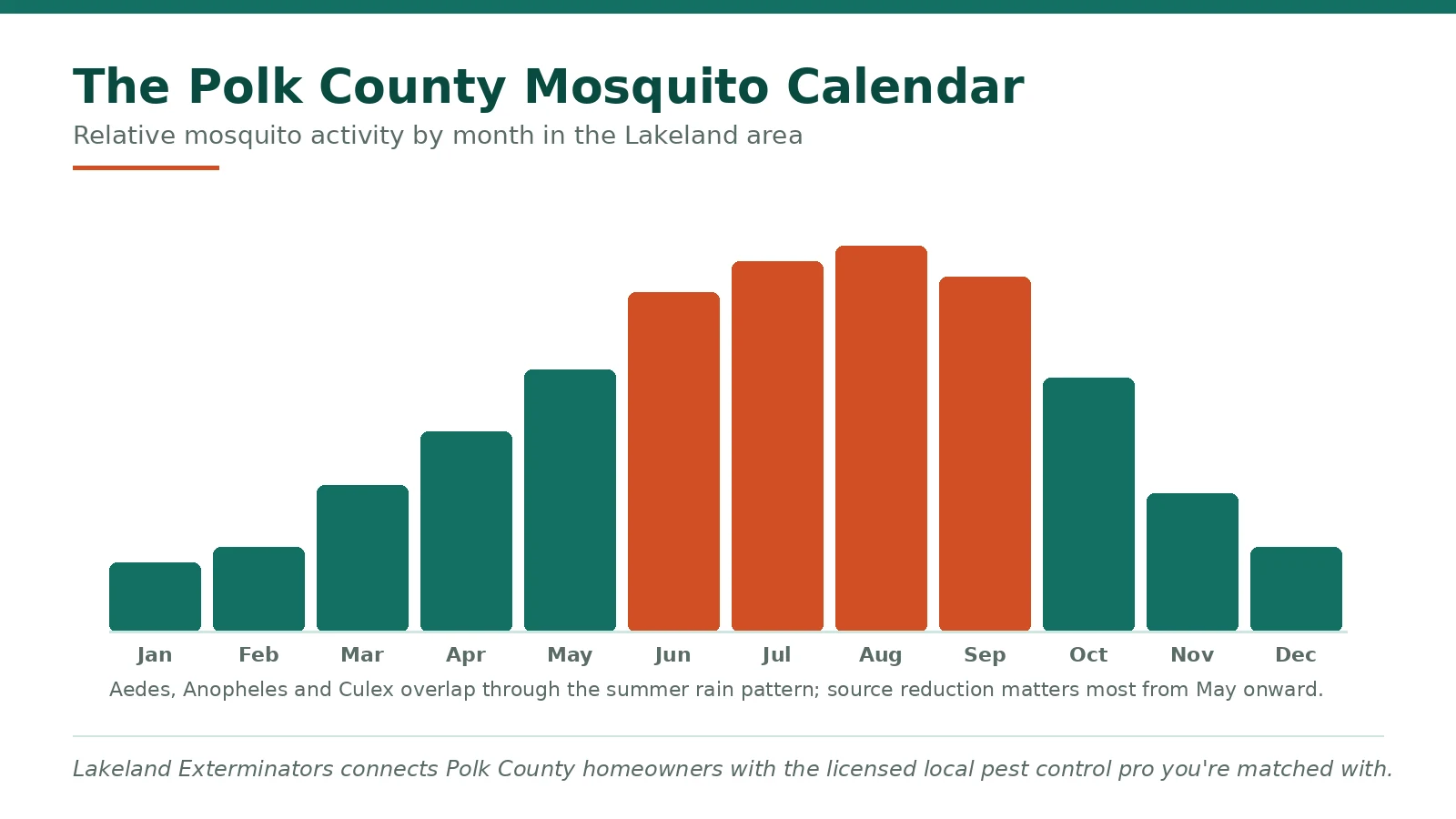
The 12-Month Polk County Mosquito Calendar
January
Activity level: Low to moderate
- Mild winter temperatures may still support occasional Aedes albopictus activity
- Culex activity reduced
- Action: Eliminate standing water from holiday season debris. Inspect property for breeding sites before spring.
February
Activity level: Low to moderate
- Warming temperatures begin to support mosquito reproduction
- First Aedes eggs hatch from prior season
- Action: Pre-season prep — clean gutters, eliminate plant saucers, treat ornamental ponds.
March
Activity level: Moderate
- Aedes aegypti and Aedes albopictus populations begin to build
- Culex species emerging
- Action: Schedule first quarterly mosquito treatment for the season.
April
Activity level: Moderate to high
- All major species active
- Aedes daytime biting intensifies
- Action: Monthly or bi-monthly mosquito service recommended.
May
Activity level: High
- Peak Aedes daytime biting in warm-humid weather
- Culex population building toward summer peak
- Polk County Mosquito Control District (Bartow HQ) operations intensify
- Action: Active mosquito treatment season. Outdoor events benefit from pre-event treatment.
June
Activity level: Peak
- Highest combined activity across all species
- Hurricane season begins June 1 — early-season tropical activity drives mosquito breeding
- Action: Bi-weekly or monthly mosquito service. Source reduction critical.
July
Activity level: Peak
- Peak Aedes activity
- Culex peak West Nile Virus transmission risk
- Florida summer rainfall pattern drives breeding explosions
- Action: Active treatment, source reduction, special-event pre-treatment.
August
Activity level: Peak
- Sustained peak across all species
- Active hurricane season impact on breeding sites
- Action: Maintain treatment cadence. Watch for hurricane-driven population spikes.
September
Activity level: High
- Peak hurricane season (September is statistical peak)
- Post-storm mosquito explosions documented Polk County pattern
- Action: Post-storm follow-up treatment if tropical system passes.
October
Activity level: Moderate to high
- Cooling temperatures slow some populations
- Aedes still active in warm afternoons
- Action: Maintain quarterly treatment. Pre-winter inspection.
November
Activity level: Moderate
- Hurricane season ends November 30
- Cool fronts begin to suppress mosquito activity
- Action: Final quarterly treatment of the year. Property cleanup.
December
Activity level: Low
- Cooler temperatures suppress most activity
- Occasional warm spells may produce temporary activity
- Action: Off-season property maintenance — clean gutters, eliminate winter standing water.
Source Reduction — What Polk County Homeowners Can Do
The Polk County Mosquito Control District (headquartered in Bartow) operates aerial and ground-based adulticiding programs across the county — but residential yard mosquito pressure typically requires homeowner action plus private treatment. Source reduction is an inexpensive and reliable long-term mosquito management approach.
Eliminate standing water:
- Plant saucers and pot trays
- Pet water bowls (refresh daily)
- Birdbaths (refresh weekly)
- Children’s wading pools (drain when not in use)
- Tire piles, buckets, tarps with depressions
- Gutters (clean to prevent water pooling)
- Abandoned swimming pools (treat or drain)
- Boat covers and tarps with depressions
- Decorative ornaments holding water
- Tree holes (fill with sand or expanding foam)
Address landscape features:
- Bromeliad cups (treat with Bti granules monthly during active season)
- Self-watering planters
- Drainage swales that hold water
- Low spots in yard
Use Bti (Bacillus thuringiensis israelensis):
- Larvicide that kills mosquito larvae but is safe for fish, birds, mammals, and other insects
- Available as granules, briquettes, or liquid
- Treat retention ponds, ornamental ponds, drainage swales, bromeliads
- Polk County Mosquito Control District uses Bti in larviciding programs — homeowners can use the same products
When To Bring In a Professional
- Aggressive daytime mosquito activity in yard (likely Aedes albopictus or Aedes aegypti)
- Heavy dusk/dawn mosquito swarms (likely Culex)
- Standing water you cannot eliminate (retention ponds, neighbor’s abandoned pool, low-spot drainage)
- Pre-event treatment for outdoor gathering
- Recurring service plan for whole-season coverage
- Post-hurricane population spike
- Pool gone abandoned and become a breeding site
Polk County Mosquito Control District Resources
The Polk County Mosquito Control District provides resources to county residents:
- Address: 4177 Ben Durrance Road, Bartow, FL 33830
- Contact: see the Polk County Mosquito Control District page on the county website for current contact details
- Services: Aerial ULV adulticiding, truck-mounted ULV adulticiding, larviciding, surveillance trapping, citizen service requests
Residents can contact the district to report mosquito activity, request service, or learn about scheduled treatment operations in their area.
Related Pages
- Pest control in Polk County (common household pests our referral line covers)
- Mosquito Control in Lakeland
- Hurricane Pest Prep for Polk County
- Pest Control in Winter Haven (Chain of Lakes mosquito pressure)
- Pest Control in Bartow (Polk County Mosquito Control District HQ)
Check the company before treatment starts
In Florida, pest control companies must hold a business license from the Florida Department of Agriculture and Consumer Services (FDACS) under Chapter 482, Florida Statutes. Ask for the company’s license number and look it up on the FDACS license search before work starts.
Get the treatment plan, the products to be used, any follow-up visits and the price in writing. For termite work, ask what the contract or bond covers, whether it’s retreatment only or includes repair of damage, and how long it lasts. Our guide on checking an FDACS pest control license walks through it.
How the call works
- Call (888) 295-0220. Any time, day or night.
- Enter your 5-digit ZIP code on your phone’s keypad when prompted.
- Get connected live with a local pest control company that serves your ZIP. Describe what happened and ask when they can come out and what the job will cost.
Lakeland Exterminators is a free referral line that connects callers with independent local pest control companies. We don’t perform the work. The company you’re connected with gives the quote, does the work and stands behind it.