Lakeland gets its name honestly — the city has more than three dozen named lakes inside its limits, from Lake Hollingsworth and Lake Morton downtown to Lake Parker and Lake Bonny further out. That’s a lot of shoreline, and shoreline plus Florida summer heat is exactly the recipe mosquitoes need. Add in the old phosphate-mine ponds and stormwater retention areas scattered through newer Polk County developments, and Lakeland ends up with more standing freshwater per square mile than most of the towns around it.
Dealing with a pest problem right now?
📞 Call now — get matched with a licensed local exterminator: (888) 295-0220When you call, stay on the line for a few seconds while we match you with the licensed local exterminator for your area. Have your address and a quick description of the problem ready.
Licensed local pros · Fast response, subject to availability · No obligation
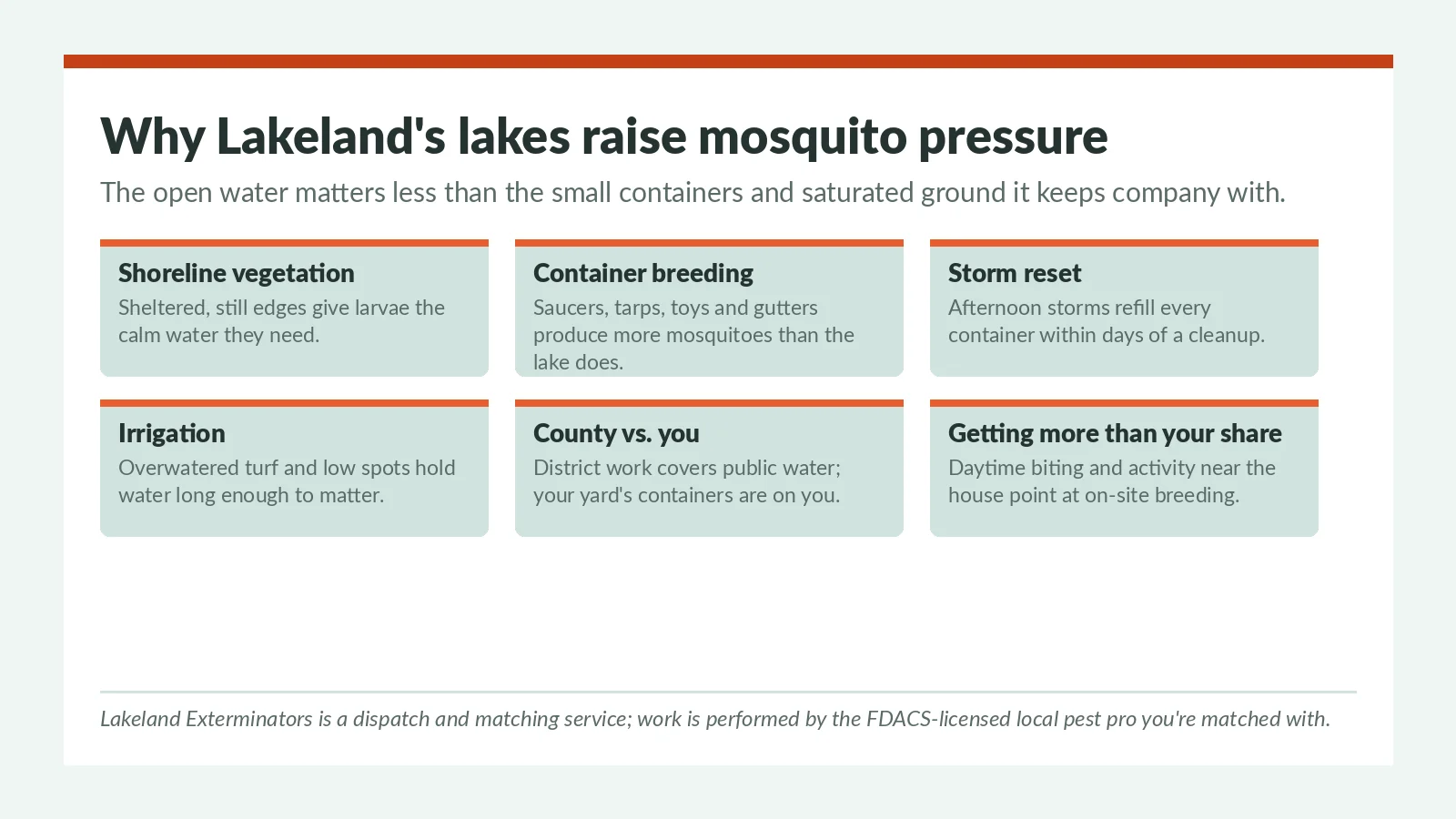
It’s not just the lakes themselves
Open lake water with fish and some current isn’t actually the biggest mosquito problem — predatory fish and wave action keep larvae in check there. The real trouble is the shallow, still edges around that water:
- Marshy shoreline pockets where cattails and reeds trap standing water
- Retention ponds in newer subdivisions that hold water after every afternoon storm
- Old phosphate-pit ponds with irregular, weedy edges
- Drainage ditches feeding into the lake system that pool between rain events
Homes near any of these features — not just homes directly on a named lake — tend to deal with heavier mosquito pressure than homes in the drier, more inland parts of the county.
The container-breeding half of the problem
Lake proximity explains the baseline pressure, but the mosquitoes actually biting you on the lanai are often coming from something much closer to home: a clogged gutter, a saucer under a potted plant, a pool cover sagging in the middle, or a kiddie pool that didn’t get dumped after the last storm. Florida’s summer humidity keeps these small pockets of water from evaporating quickly, so they last long enough for a full mosquito life cycle to complete — often in about a week.
This is the part of the problem a homeowner can actually fix without outside help: walk the yard every few days during summer and dump or scrub anything holding water, including spots that don’t look obviously wet, like a folded tarp or an overturned trash can lid.
The four mosquito groups Polk County homeowners actually deal with
“Mosquito” is not one problem. Central Florida carries several genera with completely different breeding habits, and knowing which one is biting you tells you where to look:
- Container breeders (Aedes aegypti and Aedes albopictus) — the yellow fever and Asian tiger mosquitoes. They lay eggs on the damp inner wall of anything that holds water, above the waterline, and the eggs hatch when the next rain raises the level. They bite hard during daylight, they rarely travel more than a couple hundred yards from where they hatched, and they are the reason afternoon bites on a shaded lanai are almost always a yard problem, not a lake problem.
- Southern house mosquito (Culex quinquefasciatus) — prefers water that is organically rich and stagnant: a neglected birdbath gone green, a stormwater inlet with leaf sludge, an unmaintained ornamental pond. Dusk and after-dark biter. This is the species most associated with West Nile virus surveillance in Florida.
- Floodwater mosquitoes (Psorophora and several Aedes species) — eggs sit dormant in dry low ground for months, then hatch en masse when a tropical system or a heavy August cell floods a pasture, ditch, or reclaimed phosphate depression. These produce the sudden, county-wide, unbearable week that follows a storm and then fades.
- Marsh and shoreline species — the group most genuinely tied to lake and wetland edges, breeding in the shallow vegetated margin rather than in open water.
Only the last group is a true lake problem. The first three are why two houses on the same Lakeland street can have completely different mosquito experiences.
Why Lakeland’s specific water features behave differently
Lakeland’s water is not uniform, and the differences matter more than the total acreage:
- The downtown chain — Hollingsworth, Morton, Mirror, Wire, and Hunter sit inside developed blocks with hard, maintained edges and open water. Mosquito production from the water body itself is generally modest; the pressure in those neighborhoods comes from mature tree canopy, old gutters on older housing stock, and dense ornamental planting.
- Lake Parker, Lake Bonny, and Banana Lake — larger and shallower with substantial vegetated and marshy margins in places, which is exactly the habitat shoreline species use.
- Reclaimed phosphate pits — Polk County’s mining legacy left hundreds of irregular ponds and clay-settling areas across the county, many with weedy, undulating, unmanaged edges. These are the highest-value larval habitat in the county and the least likely to be visible from a road.
- Subdivision retention ponds — engineered to hold and slowly release stormwater. When they function as designed and drain within a few days, they produce little. When an outfall clogs or the littoral shelf silts in and holds a permanent shallow ring, they become continuous producers within a few hundred feet of every house on the pond.
The one-week clock, and why it decides everything
A container mosquito can go from egg to biting adult in roughly seven to ten days in Polk County summer heat — sometimes faster during a stretch of upper-nineties afternoons. That single number is the most useful thing a homeowner can hold onto, because it converts a vague chore into a schedule: anything holding water for less than about five days does not produce mosquitoes.
That is why “dump it every weekend” genuinely works and “dump it when I notice it” does not. It is also why the source is so often something nobody thinks of as a container:
- Corrugated downspout extensions and the low elbow at the bottom of a gutter run
- The pleats and sagging center of a pool or spa cover
- Bromeliads and other tank plants, which hold water in the leaf axils by design and are extremely common in Lakeland landscaping
- Boat and trailer covers, tarps over a mower, and the well of an upturned wheelbarrow
- Screened-enclosure track channels and the base of paver drains
- Irrigation valve boxes that sit below grade and fill after every storm
- Old tires, a very common backyard find, which are close to the perfect larval habitat: dark, insulated, and impossible to fully drain
A bromeliad-heavy bed against the lanai can out-produce the retention pond behind the house. This is not a hypothetical — it is the single most common surprise finding when an operator walks a Lakeland yard that has already been “cleared of standing water.”
Irrigation, storms, and the Polk County rhythm
Polk County sits in the Southwest Florida Water Management District, which sets the day-of-week watering schedule most local governments enforce. Restricted irrigation days concentrate a lot of applied water into a couple of mornings a week, and a misaimed head that puts water into a mulch bed or a low corner on those days creates a reliable, recurring damp spot on a schedule mosquitoes can breed against. Walking the yard during a run cycle — not after it — is how those get found.
The seasonal rhythm is just as predictable. The wet season generally runs late May into early October, with near-daily convective storms building off the sea-breeze collision over the peninsula. Each of those storms resets every container in the yard. A hurricane or a slow tropical rain band does something different and worse: it floods dormant floodwater-mosquito eggs across pasture, ditch, and reclaimed ground all at once, which is why the week after a storm feels categorically different from a normal wet-season week. Our hurricane pest prep guide for Polk County covers the rest of that storm-driven surge.
What a residential mosquito program actually does
Residential mosquito work is not fogging the yard and hoping. A competent program run by an FDACS-licensed operator has three distinct parts, and a homeowner should expect to hear all three described:
- A source survey. The operator walks the property looking for larval habitat — the gutters, the bromeliads, the valve boxes, the pond edge — and tells you what to remove. Anything that can be eliminated should be, because it is permanent and free.
- Larviciding what cannot be removed. Water that has to stay — an ornamental feature, a chronically wet low area, a drain basin — can be treated with larvicides such as Bacillus thuringiensis israelensis (Bti) or an insect growth regulator, which act on larvae rather than adults.
- A targeted barrier application to resting sites. Adult mosquitoes spend the day resting on the shaded underside of foliage, under the lanai, in dense hedge interiors and along fence lines. The residual application goes there, not on open turf and not on blooming plants, where it would hit pollinators without reaching mosquitoes.
The site work matters more than the spray. An operator who only sprays is treating this week’s adults while next week’s are still developing in a gutter. If you want to compare what different service models cover, our complete Polk County mosquito control guide lays out the options, and when to spray for mosquitoes in Polk County covers timing.
If pets or children use the yard heavily, ask specifically about product selection and re-entry intervals up front — see pet-conscious mosquito control in Lakeland.
What the county handles vs. what’s on the homeowner
Polk County’s mosquito control efforts — truck spraying and larvicide drops in known problem areas — target public land, roadside ditches, and larger water bodies. They don’t reach inside a fenced backyard, around a pool screen enclosure, or into the landscaping right against your house. That gap is exactly where a licensed pest control operator’s residential barrier treatment and targeted larvicide work come in, especially for homes backed up to lake edges or retention ponds where the breeding pressure is constant instead of occasional.
Signs your property is getting more than its share
- Mosquitoes are biting well before dusk, not just at the classic early-evening peak
- Bites keep happening even after you’ve cleared every obvious standing-water source in your own yard
- Your property backs up to a lake, pond, or drainage feature with marshy or reedy edges
- Screened lanais or pool enclosures aren’t keeping mosquitoes out the way they used to
Frequently asked questions
How far can a mosquito travel from where it hatched?
It depends entirely on the species. Container breeders like the Asian tiger mosquito typically stay within a few hundred yards of their breeding site for their whole lives, which is why daytime biting almost always means an on-property or next-door source. Some floodwater species can disperse several miles, which is why the week after a storm affects entire neighborhoods at once regardless of how clean any individual yard is.
Does a retention pond behind my house guarantee a mosquito problem?
No. A retention pond that drains down within a few days after a storm, as designed, produces relatively little. The problem cases are ponds where the outfall has clogged or the shallow vegetated shelf has silted in and holds a permanent damp ring. If the pond is under HOA control, a clogged outfall is worth reporting, because it is a shared source no single homeowner can fix.
Do bromeliads really breed mosquitoes?
Yes, and they are one of the most commonly missed sources in Lakeland landscaping. The plants hold water in the leaf axils by design. Flushing them with a hose every few days, or having them treated with a Bti product by a licensed operator, resolves it without removing the plants.
Are mosquito-repelling plants or bug zappers worth it?
Neither addresses breeding. Citronella and similar plants release meaningful oil only when the foliage is crushed, so simply having them in a bed does little. Electric zappers kill large numbers of non-target night-flying insects and very few mosquitoes, since mosquitoes are drawn to carbon dioxide and body heat rather than to ultraviolet light. Source reduction is the lever that actually moves the count.
How do I check whether my own yard is the source?
Fill a dark-colored bucket with water, leave it in a shaded corner for a week, then look for larvae wriggling in it. If your yard is producing, that bucket will show it. Our yard-source versus neighbor-source walkthrough covers the rest of the diagnosis.
Do all of Lakeland’s lakes have the same mosquito risk?
No — larger, deeper lakes with fish and open water tend to have less larval survival than shallow, weedy, or stagnant edges, retention ponds, and old mine-pit ponds.
How much does living near a lake actually increase mosquito exposure?
It varies by property, but homes directly bordering marshy shoreline or a retention pond typically report noticeably heavier evening mosquito pressure than homes several blocks from any standing water.
Is county spraying enough to handle a bad mosquito year?
County spraying targets public areas and larger water features. It generally doesn’t reach into a homeowner’s own yard, which is why persistent problems near lake edges often still need a residential treatment plan.
Related Polk County reading
- Mosquito control — Lakeland, FL
- Mosquito control in Polk County — complete guide
- When to spray for mosquitoes in Polk County
- Pet-conscious mosquito control in Lakeland
- Asian tiger mosquito — Polk County profile
- Hurricane pest prep — Polk County
- Pest control near Lake Hollingsworth
- Pest control in Lakeland — complete guide
One call reaches a licensed, local exterminator who covers your address — and a real person answers, 24/7.