Peak pest season in Lakeland runs roughly June through September — the stretch when daily heat, afternoon thunderstorms, and Florida humidity line up to push almost every common household pest into overdrive at once. Rather than chasing one pest at a time as it shows up, a short seasonal walkthrough of the property catches most of the conditions that invite ants, roaches, mosquitoes, and rodents inside before they become a real problem.
Dealing with a pest problem right now?
📞 Call now — get matched with a licensed local exterminator: (888) 295-0220When you call, stay on the line for a few seconds while we match you with the licensed local exterminator for your area. Have your address and a quick description of the problem ready.
Licensed local pros · Fast response, subject to availability · No obligation
Start outside: the entry points
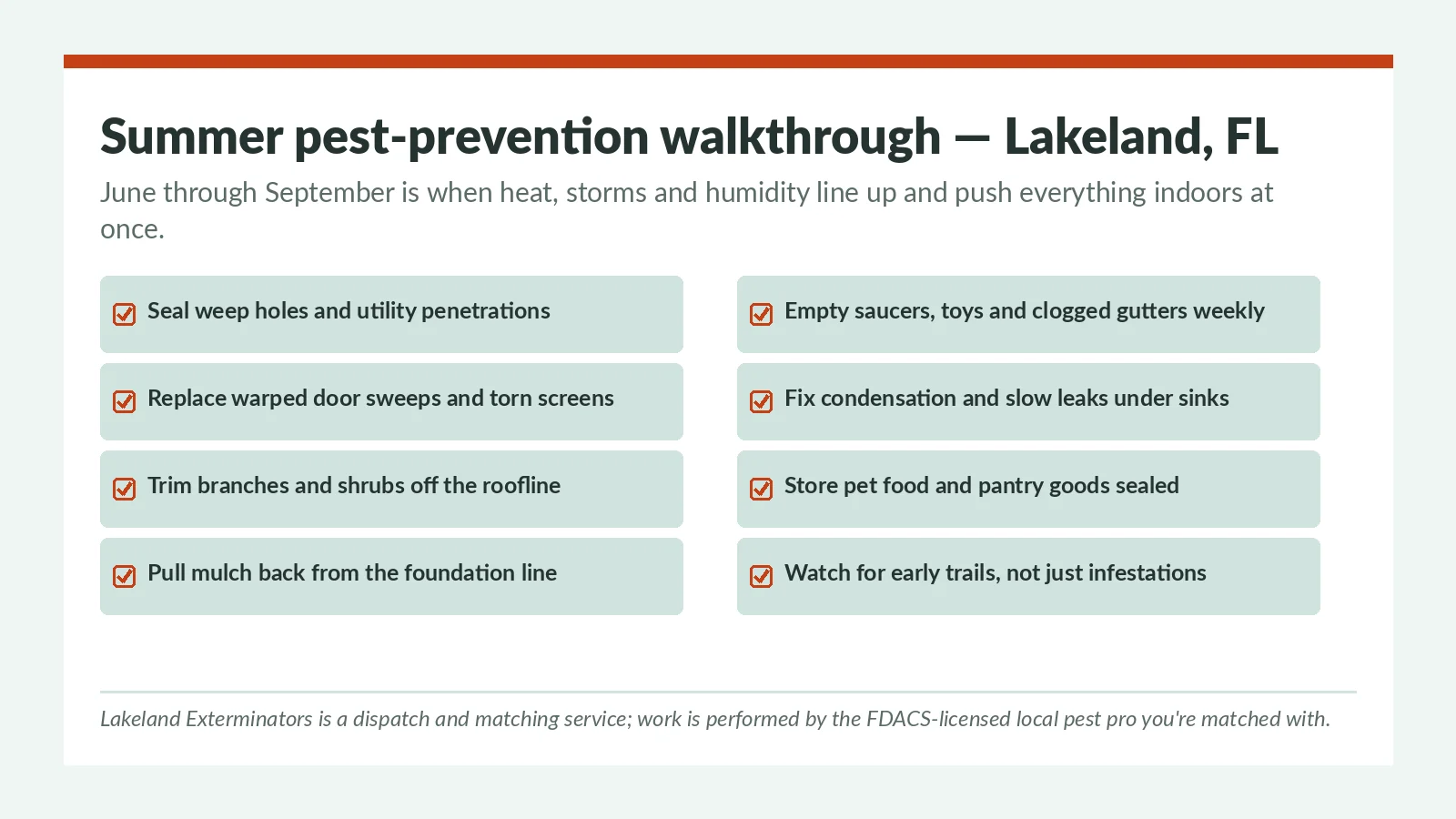
- Check weep holes and utility penetrations. Gaps around pipes, cable lines, and dryer vents are common entry points for roaches and rodents, especially once cooler AC air draws them toward the house from outside.
- Look at door sweeps and window screens. Florida’s humidity swells and warps wood and vinyl over a season; a door sweep that sealed fine in spring may have a gap by mid-summer.
- Trim vegetation off the house. Branches and shrubs touching the roofline or siding give ants and other pests a bridge straight to the structure, bypassing any ground-level barrier treatment.
- Pull mulch back a few inches from the foundation. Thick mulch against the foundation stays damp and shaded — exactly what ants and moisture pests prefer.
Manage the water
Standing water is the common thread behind Lakeland’s worst summer pest problems, mosquitoes especially:
- Clean gutters before summer storm season peaks — clogged gutters hold water long enough for mosquitoes to breed in them
- Check AC condensate lines for pooling near the unit
- Empty anything holding rainwater every few days: plant saucers, pool covers, kids’ toys, tarps
- Fix low spots in the yard where water sits for more than a day or two after a storm
Handle attractants inside and out
- Keep outdoor trash cans sealed and away from doors
- Store pet food in sealed containers, not open bags in the garage
- Wipe down kitchen counters and sweep up crumbs nightly — sugar ants and roaches key in on food residue fast in the summer heat
- Store firewood off the ground and away from the house rather than stacked against a wall
Watch for early signs, not just full infestations
Catching a problem early is almost always the difference between a quick fix and a bigger one:
- A few ants on a kitchen counter one week can mean a trail and a nest nearby the next
- Small droppings near the pantry or garage are often the first sign of rodent activity, well before you hear anything in the attic
- A handful of mosquito bites at dusk on the lanai is worth investigating for standing water before it becomes an every-evening problem
- Roaches seen during the day, not just at night, often means a larger population is already established
A month-by-month version of the same checklist
Peak season is not one uniform block. Polk County’s pest calendar shifts week to week, and the walkthrough is far more useful if you know what you are actually looking for on the day you do it:
- Late May – June. The wet season starts. Subterranean termite flights are tapering while drywood swarms build. Gutters, downspout elbows and pool covers are the priority, because the first sustained rains reset every container in the yard. This is also when ghost ants and white-footed ants begin showing up on kitchen counters as outdoor foraging gets easier.
- July. The hottest, wettest stretch. Mosquito generations are turning over in about a week. Roach pressure moves indoors as outdoor harborage becomes saturated. Fire ant mounds relocate constantly after each storm, so a mound that was in the middle of the lawn in June may be against the slab in July.
- August. Peak everything, plus the second lovebug flight late in the month. Mud-tube activity on foundations is at its most visible because the soil stays workably damp. Watch for the first roof-rat noise in attics as fruit and citrus ripen.
- September. Statistical peak of hurricane season and the month with the highest chance of a flooding rain event. Rodent movement indoors accelerates as pasture and vacant-lot cover gets flooded or cut. This is the month a storm-prep pass earns the most.
If you would rather run this on a calendar than from memory, we keep dedicated month pages — June and September are the two that matter most for the summer window.
The seal-up pass, in the order that matters
Exclusion is the highest-return item on any prevention list, because a sealed gap stops being a problem permanently while a spray has to be renewed. Work the structure from the ground up:
- Weep holes. Most Lakeland block-and-stucco homes have weep holes at the base of the wall by design — they let the wall cavity drain and must stay open. Do not caulk them. Stainless-mesh weep-hole covers keep roaches, wasps and mice out while preserving drainage. Sealing them outright traps moisture in the wall, which trades a pest problem for a rot problem.
- Utility penetrations. Where the refrigerant line set, water line, gas line, cable and irrigation wiring enter the wall, there is usually an oversized hole with a smear of decayed sealant. Pack with copper mesh or stainless wool and seal over it. A quarter-inch gap passes a young roof rat.
- Door sweeps and thresholds. Garage-door bottom seals are the single largest opening on most Florida houses. Check the corners specifically — the seal usually fails at the ends first, and light visible from inside a closed garage in daylight is a gap.
- Soffit and roofline. Roof rats enter above the ground, not at it. Check for lifted soffit panels, gaps at the fascia return, unscreened gable and ridge vents, and any spot where a branch touches the roof edge.
- Screens and lanai. Florida humidity works on frames and splines all year. Look at the lower corners of screen panels and at the door track, where most failures start.
Anything you can seal at the roofline is worth more than the same effort at ground level, because rodents are the pest most likely to cause secondary damage — see rodent exclusion in Lakeland for what a full professional exclusion covers.
The pests this checklist is actually aimed at
It helps to know what each item is defending against, because that tells you which line to take seriously for your particular house:
- Roof rats. Florida’s dominant residential rodent, and an above-ground climber rather than a burrower. Citrus, ornamental fruit, palm boots, attached trellises and overhanging limbs are their approach routes. Trimming limbs back six to eight feet from the roof edge does more than any bait station.
- German cockroaches. Almost always introduced, not invaded — they arrive in grocery cartons, appliances, and secondhand furniture, then live entirely indoors near warmth and moisture. Perimeter work outside does very little for them; sanitation and interior baiting do.
- Palmetto bugs (American cockroaches). The opposite case: outdoor insects living in mulch, palm boots, sewer laterals and irrigation boxes that come inside when it rains hard or when it gets very dry. These are the ones the perimeter and weep-hole work actually addresses.
- Ghost, white-footed and Argentine ants. Trail-followers with huge, multi-queen colonies. Spraying a visible trail kills the workers you can see and often causes the colony to bud into several new nests, which makes the problem worse. Baiting is the correct approach.
- Subterranean termites. Never stop being active in Polk County. The prevention items that matter are mulch clearance, wood-to-soil contact, downspout discharge away from the slab, and keeping the base of the wall visible so mud tubes can be seen.
That last distinction is the one most worth remembering: a checklist item that works against palmetto bugs may do nothing against German roaches, and a spray that works on both can make an ant problem worse. Our complete Lakeland pest control guide breaks the approach down pest by pest.
Two mistakes that undo the whole checklist
Mulch against the slab. Organic mulch piled to the stucco holds moisture at the wall line, hides the exact band where termite mud tubes would be visible, and gives ants and roaches a humid staging area inches from the weep holes. Keep a two- to three-inch gap of bare soil or rock at the foundation and keep mulch depth to about two inches. Rubber or rock mulch in the first band solves it permanently in most beds.
Spraying the trail. Over-the-counter contact sprays are repellent by design, which is the opposite of what most Polk County ant species need. A repellent barrier splits a budding colony and scatters it into new satellite nests, and you end up with three trails where you had one. If ants keep coming back within days of treatment, that is the likely reason, and it is the point at which a licensed operator with non-repellent products and species-appropriate bait will get further than another trip to the hardware store.
After a storm: the second walkthrough
A named storm or any heavy flooding rain changes the property enough to justify repeating the pass:
- Re-check every container and low spot — the water is now sitting in different places than it was before
- Look for new soffit, fascia, and screen damage that opened an entry point overnight
- Expect displaced pests: fire ant colonies raft and relocate, palmetto bugs abandon flooded harborage, and rodents move toward dry structure
- Check that downspouts and the retention outfall are still discharging away from the slab
- Move any debris pile, storm-damaged limbs, or stacked plywood away from the house rather than leaning it on a wall
The full version of this pass is in our hurricane recovery pest checklist for Polk County.
What’s worth a professional look
A seasonal walkthrough handles prevention, but it doesn’t replace a licensed pest control operator’s treatment once pests are established. If you’re seeing recurring activity after cleaning up the obvious attractants — ants coming back within days, roaches during daylight, or rodent signs in more than one spot — that’s usually the point where matching with a local operator makes more sense than continuing to DIY.
Frequently asked questions
Should I seal my weep holes to keep bugs out?
No. Weep holes are a drainage feature of block-and-stucco construction and sealing them can trap moisture inside the wall. Use stainless-mesh weep-hole covers instead, which exclude insects and rodents while leaving the drainage path open.
Why do ants come back a few days after I spray them?
Most common Polk County ants live in large multi-queen colonies, and the over-the-counter sprays homeowners reach for are repellent. Killing the visible trail often causes the colony to bud into several new nests instead of collapsing. Species-appropriate baiting, or a non-repellent product applied by a licensed operator, is what actually reduces the colony.
How far back should I trim branches from the roof?
Six to eight feet of clearance from the roof edge and the wall is the usual target. Roof rats are climbers and will use a limb, a trellis, or a run of cable as a bridge; removing the bridge is more effective than trapping after they are already in the attic.
Is mulch bad for pest control?
Mulch itself is fine; where it sits is the issue. Keep it about two inches deep and pull it back two to three inches from the foundation so the base of the wall stays visible and dry. That band is exactly where subterranean termite mud tubes would appear, so burying it removes your earliest warning.
How often should I do a pest-prevention walkthrough in summer?
Once a month during peak season (June through September) catches most developing issues before they establish. After a major storm is also a good time to check, since heavy rain shifts where water pools and can open new entry points.
Does keeping a clean house really prevent pests in Florida?
It significantly reduces the food and water attractants that draw pests in, but Florida’s climate means outdoor pest pressure exists regardless of how clean a home is inside. Prevention lowers risk; it doesn’t eliminate it entirely.
What’s the single biggest thing I can do this summer?
Eliminating standing water around the property addresses the widest range of pests at once, from mosquitoes directly to the general moisture conditions that draw roaches and ants indoors.
Related Polk County reading
- Polk County pest prevention guide
- Pest control in Lakeland — complete guide
- Rodent exclusion — Lakeland
- Hurricane pest prep — Polk County
- Hurricane recovery pest checklist — Polk County
- June pest control — Polk County
- September pest control — Polk County
- Quarterly vs. monthly pest control in Polk County
- DIY vs. professional pest control in Lakeland
One call reaches a licensed, local exterminator who covers your address — and a real person answers, 24/7.