Ask any experienced pest technician what makes a home harder for pests to settle into, and sanitation comes up before chemicals do. Roaches, ants, and pantry pests all need food, water, and a quiet place to hide. Consistent cleaning removes the first two and disturbs the third. It is not a substitute for treatment when there is an active problem, but in a Polk County climate that keeps insects active most of the year, a steady cleaning routine is one of the cheapest forms of prevention a household has.
Dealing with a pest problem right now?
📞 Call now — get matched with a licensed local exterminator: (888) 295-0220When you call, stay on the line for a few seconds while we match you with the licensed local exterminator for your area. Have your address and a quick description of the problem ready.
Licensed local pros · Fast response, subject to availability · No obligation
Why cleaning is part of pest control
Crumbs under appliances, grease film on kitchen surfaces, sticky spills, overflowing trash, and standing water in a forgotten mop bucket are exactly the conditions that turn an occasional pest into a resident population. German roaches in particular can sustain themselves on very small amounts of food residue. Remove the buffet and the moisture, and the home becomes far less hospitable, which also makes any professional treatment hold longer.
The routines that matter most
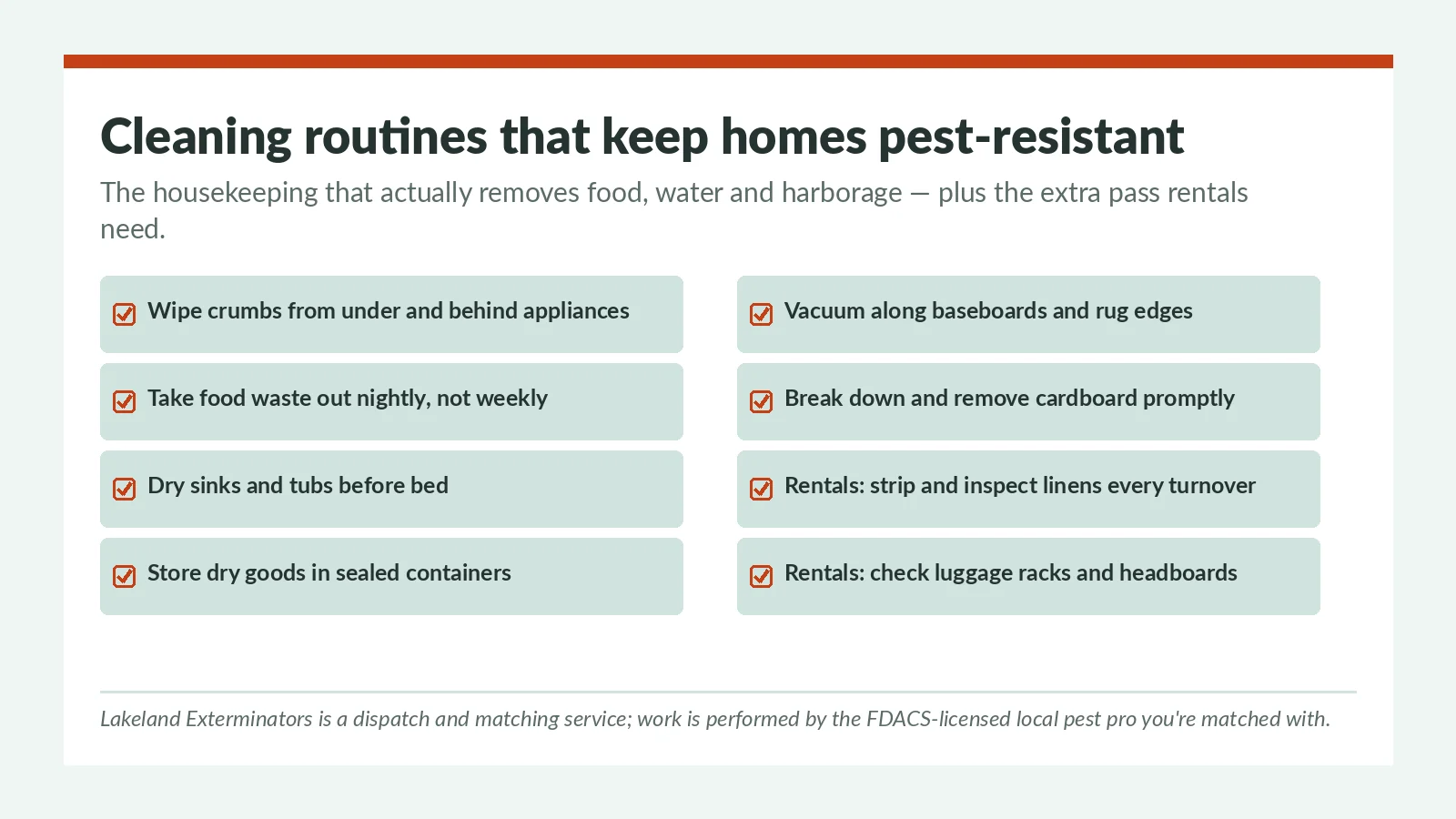
- Kitchens first. Wipe counters and stovetops, sweep and mop floors, and clean under and behind the refrigerator and stove where grease and crumbs collect out of sight.
- Manage trash and recycling. Empty bins regularly, rinse containers before they go in recycling, and keep lids closed. Open food waste is a constant draw.
- Stay on top of moisture. Dry sinks and tubs, fix the slow drips, and do not leave damp towels or standing water sitting out. Moisture is what keeps roaches and ants coming back.
- Deep-clean on a schedule. Baseboards, pantry shelves, and the backs of cabinets need periodic attention, not just surface tidying, to clear the residue pests feed on.
- Reset between occupants. A thorough clean during any vacancy or turnover catches activity early, before it builds.
Short-term rentals need extra attention
Vacation homes and Airbnbs in the Lakeland area face a tougher version of this problem. Constant guest turnover means food gets left behind, spills go unreported, and a small issue can become a review-damaging one before the owner ever sees it. A reliable turnover clean between every stay, with someone actually checking the kitchen and trash, is the difference between catching a stray roach and inheriting a colony.
Why German cockroaches are the pest sanitation actually beats
It is worth being precise about which pest cleaning affects, because the advice is very different depending on the species and generic “keep it clean” guidance sends people in the wrong direction.
German cockroaches (Blattella germanica) live their entire lives indoors. They do not come in from the yard; they arrive in something — a grocery carton, a used appliance, a delivery box, a piece of secondhand furniture, luggage from a previous stay — and then establish near warmth and moisture. A female carries an egg case containing roughly thirty to forty eggs, and a population can double in weeks under good conditions. They also aggregate in tight, warm harborage: the motor housing of a refrigerator, the underside of a dishwasher, the hollow of a hinge, the seam behind a cabinet toe-kick. Exterior perimeter spraying does essentially nothing for them. Sanitation, harborage reduction, and interior gel baiting do.
American cockroaches — palmetto bugs — are the opposite: outdoor insects that live in mulch, palm boots, sewer laterals, irrigation boxes and gutter debris and come inside when it rains hard or gets very dry. A palmetto bug on the kitchen floor after a storm says nothing about the housekeeping. The response there is exclusion and exterior work, not deeper cleaning.
Telling them apart is the first step in knowing whether cleaning is your lever at all; our palmetto bug page for Lakeland and German cockroach page cover the ID.
The spots that matter more than the visible surfaces
A kitchen can look immaculate and still support a population, because the residue that sustains roaches is almost never on the surfaces people wipe:
- Under and behind the refrigerator — including the condenser coils and the drip pan, which combines warmth, moisture and organic residue in one place. This is the single most productive spot in most kitchens.
- The dishwasher — the door gasket, the underside of the door, and the void beneath the unit
- Stove and range hood — the drip pans, the gap between the range and the cabinet, and the grease film inside the hood filter
- Cabinet toe-kicks and hinge voids — classic German roach harborage, and never touched by routine cleaning
- Under the sink — where a slow supply-line drip and stored paper goods meet
- The coffee maker, toaster and microwave — warm, crumb-rich, and rarely moved
- Pantry corners and shelf lips — where pantry moths and beetles establish in flour, rice, birdseed and dry pet food
Pet food deserves its own line. An open bag in a garage or laundry room is one of the most reliable ant, roach, and rodent attractants in a Florida house. Decanting into a sealed hard container removes it entirely.
Moisture is half of it, and in Polk County it is the harder half
Roaches and most pantry pests need water more urgently than they need food — a German cockroach will survive far longer without a crumb than without moisture. In a humid Central Florida house, moisture control is a genuine part of sanitation:
- Dry the sink, tub and shower at the end of the day during an active problem; a wet basin overnight is a water source
- Fix slow drips at supply lines, traps, and hose bibs rather than putting a bowl under them
- Run the bath exhaust fan through the shower and for a stretch afterward, and confirm it actually vents outside rather than into the attic
- Do not leave damp towels, mop heads, or a filled mop bucket sitting
- Empty and dry the AC condensate pan area and confirm the drain line is clear — a backed-up line is a chronic indoor water source
- Keep indoor humidity in a reasonable range; silverfish and booklice in particular are humidity-driven rather than food-driven
A realistic cleaning cadence
- Daily. Wipe counters and the stovetop, run or empty the sink, take out kitchen trash, put pet food away rather than leaving a bowl down overnight.
- Weekly. Sweep and mop including under the table and along the toe-kick line, wipe the microwave and toaster, take recycling out and rinse containers, check under the sink.
- Monthly. Pull the stove and refrigerator out and clean behind and beneath them, clean the refrigerator drip pan and coils, wipe pantry shelves and check dry goods for webbing or fine dust, vacuum baseboards and cabinet interiors.
- Quarterly or at turnover. Empty and wipe cabinet interiors, launder soft goods, vacuum upholstery seams and mattress seams, and inspect storage areas and the garage.
The monthly items are the ones that matter most and the ones most likely to be skipped, which is a large part of why a problem can persist in a home that is cleaned diligently every week.
Short-term rentals: the turnover inspection is the real product
Polk County has a substantial short-term rental market, both around the Lakeland lakes and along the US-27 and Davenport corridor feeding the Orlando attractions. Those properties face a fundamentally different risk profile from an owner-occupied home: nobody lives there to notice a developing problem, and the person most likely to discover it is a guest with a review form.
The highest-value change most owners can make is to treat turnover as an inspection with cleaning attached, rather than cleaning alone. A short written checklist the cleaner completes each turnover should include:
- Check under and behind the refrigerator and the sink for droppings, egg cases, or live activity
- Check mattress seams, box-spring edges, the headboard join, and the underside of the nightstand for bed bug evidence — small dark spotting, shed skins, or live insects
- Check the trash area and confirm outdoor bins are closed and not against the door
- Note and photograph anything unusual rather than simply cleaning it away, so the owner sees a trail rather than a surprise
- Confirm door sweeps, window screens and the lanai door still seal
Bed bugs are the specific risk that cleaning alone will not solve in a rental, because they arrive in luggage regardless of how clean the unit is and they are entirely independent of sanitation. Catching them at the single-room stage is enormously easier than catching them after several turnovers — see signs of bed bugs in Lakeland for what the evidence looks like. For the broader operational picture, our Airbnb and short-term rental pest control page for Polk County covers scheduling and documentation, and rental property pest control covers longer-term tenancies.
One practical note for owners: cleaning frequency and quality is also what makes any professional treatment hold. A licensed operator’s gel bait program for German cockroaches competes directly with available food, and a kitchen with grease film and crumbs under the appliances gives the population an alternative to the bait. Sanitation is not an alternative to treatment; it is what makes treatment work.
A local cleaning company serving Polk County
For owners who would rather not manage all of this themselves, one local option we point people to is Commercial Now Cleaning, run by Melissa King here in the Lakeland area. They handle commercial cleaning as well as residential work, including short-term rentals and Airbnb turnovers, so the routines above get done consistently rather than whenever someone remembers. Pairing steady cleaning with pest control, rather than treating them as separate problems, is what keeps a property quiet over the long run.
Already finding roaches or ants at a Lakeland property?
One call reaches a licensed, local exterminator who covers your address — and a real person answers, 24/7.
Frequently asked questions
Can cleaning alone get rid of a roach problem?
Cleaning removes the food and moisture that sustain pests and makes treatment more effective, but an established infestation is handled by an independent, FDACS-licensed pest-control company.
Why do short-term rentals get pest issues more often?
Frequent guest turnover means food residue and spills accumulate between stays, and problems often go unnoticed until a guest reports them. A consistent turnover clean catches activity early.
What areas should cleaning focus on for pest prevention?
Kitchens, trash and recycling, moisture sources, and the hidden spots, under appliances, behind cabinets, along baseboards, where crumbs and grease build up.
Does a clean house mean I will not get roaches in Florida?
It depends entirely on the species. German cockroaches are strongly tied to available food and moisture indoors, so sanitation makes a real difference. American cockroaches, the palmetto bugs most Floridians see, live outdoors in mulch, palm boots and drainage and come inside after heavy rain or drought regardless of housekeeping. Seeing one after a storm is not a cleanliness signal.
What is the single most productive spot to clean for pest prevention?
Under and behind the refrigerator, including the drip pan and condenser coils. It combines warmth, moisture and organic residue in one place and is almost never reached by routine weekly cleaning.
Can cleaning get rid of bed bugs in a rental?
No. Bed bugs arrive in luggage and are independent of sanitation, so no cleaning schedule prevents them. What a good turnover routine does is catch them early, while activity is confined to one room, which is a far more manageable situation. Treatment is performed by an independent, FDACS-licensed pest-control company.
How often should a short-term rental be inspected rather than just cleaned?
Every turnover should include a short inspection pass alongside the clean, covering under and behind the refrigerator and sink, mattress and box-spring seams, the trash area, and door and window seals. The value is in noticing and documenting early activity, not in the cleaning itself.
Related Polk County reading
- German cockroach — Lakeland
- Palmetto bugs — Lakeland
- Roach extermination — Lakeland
- Airbnb & short-term rental pest control — Polk County
- Rental property pest control — Polk County
- Signs of bed bugs — Lakeland
- Silverfish control — Lakeland
- Polk County pest prevention guide
Disclaimer: Lakeland Exterminators is a local dispatch and referral service, not a licensed pest-control operator. We connect Polk County, Florida homeowners with independent, FDACS-licensed and insured pest-control companies. All treatments are performed by those independent providers, who set their own pricing, scheduling, and service terms. Commercial Now Cleaning is an independent company mentioned here as a local resource; we are not affiliated and receive no payment for the mention.
Any reference to same-day, emergency, or 24/7 service describes the typical scheduling of matched independent providers and is not guaranteed; actual response times vary by provider, season, location, and demand.