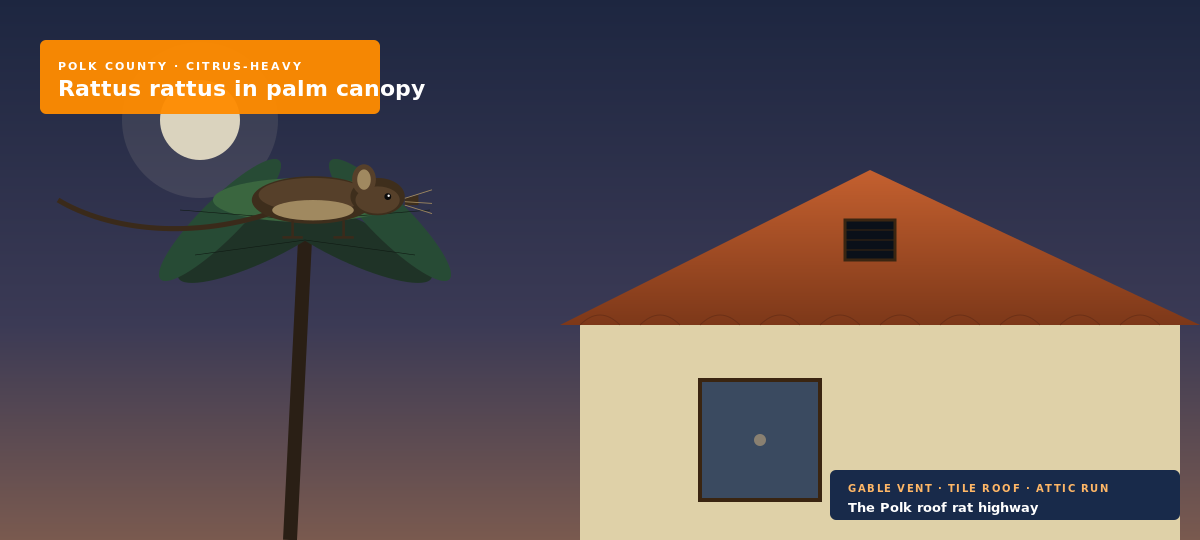
It usually starts at night. You are settling in, the house is quiet, and you hear it — a faint scratching or scurrying overhead, somewhere in the ceiling or the attic. Maybe the next morning you find a grapefruit on the ground hollowed out like a little bowl, the rind gnawed clean. In Polk County, those two clues together point to one culprit: roof rats.
Dealing with a pest problem right now?
📞 Call now — get matched with a licensed local exterminator: (888) 295-0220When you call, stay on the line for a few seconds while we match you with the licensed local exterminator for your area. Have your address and a quick description of the problem ready.
Licensed local pros · Fast response, subject to availability · No obligation
Roof rats go by several nicknames here — fruit rats and palm rats are the common ones — and the names tell you exactly why they thrive in this part of Florida. They are excellent climbers that prefer to live up high rather than in burrows, and Central Florida gives them warm weather, citrus trees, palms, and tile roofs that practically roll out a welcome mat.
This guide explains why Polk County is roof-rat country, the signs that tell you they are already in the attic, how they get up there in the first place, and why the fix that actually works is exclusion-first rather than trapping alone. Homeowners in Davenport, on the county’s western edge near the Orange County line, see the same pattern — see our rodent control in Davenport, FL page for that area’s specifics. The same citrus-and-tile-roof pattern plays out east of Lakeland too — see roof rat control in Winter Haven for that area’s specifics.

Why Polk County Is Roof-Rat Country
Roof rats are a species built for exactly the conditions Polk County offers, which is why they are such a persistent problem from Lakeland out to the surrounding groves and neighborhoods.
Citrus is a built-in food source. Polk County sits in the heart of Florida’s citrus belt and is among the largest citrus-producing counties in the state. That agricultural backbone shows up in backyards too — orange, grapefruit, tangerine, and lemon trees are common around homes here. To a roof rat, that fruit is a reliable, renewable buffet. They feed on fruit still hanging in the tree and on the windfall rotting on the ground, which is exactly why the “fruit rat” nickname stuck. A yard with a single neglected citrus tree dropping fruit can quietly feed a colony.
The climate never shuts them down. Roof rats do not get a hard winter that knocks back their numbers. Central Florida’s warm, humid weather lets them breed and forage close to year-round, so populations build instead of resetting each season.
The architecture suits them. Roof rats are climbers first and foremost — in the wild they nest in trees and palm fronds rather than underground. Florida homes give them an upgraded version of that habitat. Barrel tile and Spanish tile roofs, along with textured stucco walls, give their feet plenty of traction to scale a house. Palms, mature shade trees, and dense landscaping give them elevated highways right up to the roofline. Put a fruiting tree, a tile roof, and an overhanging branch in the same yard and you have assembled nearly everything a roof rat needs.
That combination — food, climate, and climbable structures — is why roof rats are such a familiar attic problem across Lakeland and Polk County, and why catching the signs early matters.
The Signs: How to Know Roof Rats Are in Your Attic
Roof rats are nocturnal and shy, so you will usually notice the evidence before you ever see the animal. Here is what to look and listen for.
Scratching and scurrying at night. This is the most common first clue. Because roof rats are active after dark and live up high, the noise comes from overhead — the attic, the ceiling, the soffit, or inside a wall. You will often hear scratching, gnawing, or quick scampering shortly after the house goes quiet in the evening. Daytime silence followed by nighttime noise overhead is a classic roof rat signature.
Droppings. Roof rat droppings are distinctive once you know them. They are roughly half an inch long, dark, and spindle-shaped — pointed at the ends rather than blunt. You will typically find them concentrated along travel routes and feeding spots: in the attic insulation, across joists, along the upper edges of walls, behind stored boxes, in the garage, or in cabinets and pantry corners. A scatter of these pointed pellets is strong confirmation.
Gnaw marks on wiring — the fire-risk angle. Roof rats have continuously growing teeth and an instinct to gnaw, so they chew on whatever runs through the attic: wood, PVC, insulation, and electrical wiring. Chewed wiring is the part you should take seriously, because exposed or damaged wires in an attic are a genuine fire hazard. Frayed insulation around wires, or fresh gnaw marks on cables, beams, and stored items, is a sign you want addressed promptly.
Greasy rub marks. Rats travel the same paths over and over and follow edges with their bodies. Over time the oils and dirt in their fur leave dark, greasy smudge marks along their regular routes — along rafters, around the openings they squeeze through, on pipes, and at the edges of beams. A dark, smudged line tracing a structural edge is a travel route in active use.
Hollowed-out fruit. Out in the yard, look at your citrus. Roof rats often eat fruit right on the tree, leaving the rind largely intact but the inside scooped out — a hollowed shell still hanging or fallen below. Hollowed citrus plus overhead noise at night is about as clear a pair of signs as you will get.
Nests and other clues. You may also find shredded nesting material — insulation, paper, fabric, and palm fibers wadded into hidden corners of the attic — along with a faint musky odor in a heavily used space.
One call reaches a licensed, local exterminator who covers your address — and a real person answers, 24/7.
How Roof Rats Reach the Attic
Understanding the route they take is the whole key to stopping them, because the fix is about closing that route — not just removing the rats already inside.
Tile and stucco give them traction. A roof rat can climb surfaces that look impossible to us. Barrel tile roofing offers ledges and gaps their claws grip easily, and rough stucco gives enough texture to scale a wall directly. The very features that define a lot of Florida homes are, to a roof rat, a climbing wall.
Overhanging branches and lines are bridges. Roof rats rarely have to climb the house from the ground. They prefer aerial routes. A tree branch hanging over or near the roof, a palm leaning against the eave, or a utility line running to the house all serve as bridges that drop a rat directly onto the roof. From there they only need one opening.
Aging soffits and small gaps are the door. Once on the roof, a roof rat hunts for a way in, and older homes give them plenty of options. The usual entry points are gaps where the soffit has pulled away or deteriorated, openings around roof vents and pipe penetrations, damaged fascia, gaps where the roofline meets the wall, and loose or broken tiles. A roof rat can squeeze through an opening about the size of a quarter — roughly half an inch — so a gap that looks too small to matter often is not. Aging soffit gaps in particular are one of the most common ways rats get from the roof into the attic.
So the path is: a fruiting yard draws them, an overhanging branch or line gets them onto a tile roof they can grip, and an aging soffit gap lets them inside. Every step of that chain is something that can be interrupted.
The Exclusion-First Approach: Why Traps Alone Stall
Here is the mistake that keeps roof rat problems going for months: setting traps and stopping there. Traps have a role, but trapping alone almost always stalls, because it treats the symptom and ignores the open door.
Why traps alone fall short. If you remove a few rats but leave the soffit gap, the overhanging branch, and the fruit-laden tree exactly as they were, you have done nothing to stop the next rats from following the same route in. Roof rats reproduce quickly in Florida’s climate, and the structure is still broadcasting an invitation. You can catch rats indefinitely and never get ahead, because the house keeps recruiting more.
Exclusion is the real fix. Exclusion means finding and sealing every way in, so that once the current rats are gone, no new ones can replace them. A thorough exclusion-first approach generally involves:
- Inspecting the whole exterior and roofline to find the actual entry points — soffit gaps, vent openings, pipe penetrations, loose tiles, and gaps at the roof-wall junction.
- Sealing those openings with materials rats cannot simply chew back through, sized to close gaps down past that half-inch threshold.
- Cutting the bridges by trimming tree branches and palms back away from the roof so rats lose their aerial highways.
- Removing the food draw by picking up fallen citrus, harvesting or thinning fruit, and securing other food sources around the property.
- Then removing the rats already inside with trapping, which finally works because no replacements can get in behind them.
That order matters. Do the removal first and the exclusion never, and you are back where you started by next season. Seal the building first, then remove what is trapped inside, and the problem actually ends.
This is the part where a licensed professional is genuinely worth it. Finding every entry point on a tile roof, working safely at height, and sealing gaps so they stay sealed is detailed work. The licensed Polk County exterminators in our network can inspect the roofline, identify the entry points, and build an exclusion-first plan matched to how roof rats move on Florida homes. Our overview of roof rats and tile roofs in Polk County digs deeper into why this regional combination is so common, and the broader Polk County pest control guide covers how roof rats fit alongside the other pests local homes deal with. Curious what standard those exterminators had to clear before joining our network? See how we vet Polk County pest control pros.
What to Tell the Exterminator
When you describe a possible roof rat problem, a few details help the professional you are connected with come prepared:
- Where you hear them — which part of the house the overhead noise comes from (attic, a specific ceiling, a wall, the soffit).
- When you hear them — time of day or night; roof rats are usually loudest after dark.
- What you have found — spindle-shaped droppings, gnaw marks on wiring or wood, greasy rub marks, hollowed fruit, or shredded nesting material, and where.
- Your yard — whether you have citrus, palms, or large trees, and whether branches overhang the roof or any utility lines run to the house.
- Your roof and home age — tile vs. shingle, and whether the soffits or fascia look aged or damaged.
Those specifics help a pro head straight for the likely entry points and travel routes instead of starting from scratch.
One call reaches a licensed, local exterminator who covers your address — and a real person answers, 24/7.
Frequently Asked Questions
Are fruit rats and palm rats the same as roof rats? Yes. “Fruit rat” and “palm rat” are common nicknames for the roof rat in Florida. The names come from their habits — feeding on citrus and other fruit, and nesting in palms and trees. They are all the same climbing rat that gets into attics.
Why are roof rats so common in Polk County? Polk County combines everything roof rats want: it is among the largest citrus-producing counties in Florida, so fruit is plentiful; the warm climate lets them stay active most of the year; and tile roofs, stucco, palms, and shade trees give them traction and elevated paths right up to the roofline.
What do roof rat droppings look like? Roof rat droppings are about half an inch long, dark, and spindle-shaped — pointed at both ends rather than blunt. You typically find them clustered along travel routes and feeding areas, such as attic insulation, the tops of joists and walls, garages, and pantry corners.
What does scratching in the attic at night mean? Overhead scratching, gnawing, or scurrying that starts after the house goes quiet is a classic roof rat sign, because they are nocturnal and prefer to live up high. Daytime quiet with nighttime noise from the ceiling or attic strongly suggests roof rats rather than another pest.
Can roof rats cause a fire? They can raise the risk. Roof rats gnaw constantly, including on electrical wiring in the attic. Chewed or exposed wiring is a genuine fire hazard, which is one reason chewed wires are a sign worth addressing promptly rather than waiting.
How do roof rats get into the attic? They climb onto the roof using tile and stucco traction or by crossing from overhanging branches, palms, and utility lines, then enter through small openings — most often aging soffit gaps, vent and pipe openings, damaged fascia, and loose tiles. They can fit through a gap around half an inch wide.
Why don’t traps get rid of roof rats on their own? Traps remove individual rats but do nothing about the open entry points, overhanging branches, and fruit drawing them in. With the route still open and roof rats breeding quickly in Florida’s climate, new rats keep replacing the ones you catch. Sealing the building first is what makes removal stick.
What is exclusion-first roof rat control? It means finding and sealing every entry point, trimming back branches that bridge to the roof, and removing food sources before removing the rats inside. Once the building is sealed and the draws are gone, trapping out the remaining rats actually ends the problem instead of stalling.
Should I remove fallen citrus from my yard? Yes. Fallen and ripening fruit is a prime food source for roof rats in Central Florida. Picking up windfall citrus, thinning or harvesting fruit, and not leaving it to rot under the tree removes one of the main reasons rats are drawn to the property.
LakelandExterminators.com is a dispatch and matching service. We connect callers with independent, licensed Florida exterminators; we are not a licensed pest control company ourselves. Any reference to prompt or same-day response describes typical scheduling of matched independent providers and is not guaranteed — actual response times vary by provider, season, location, and demand. See our full disclaimer in the site footer.