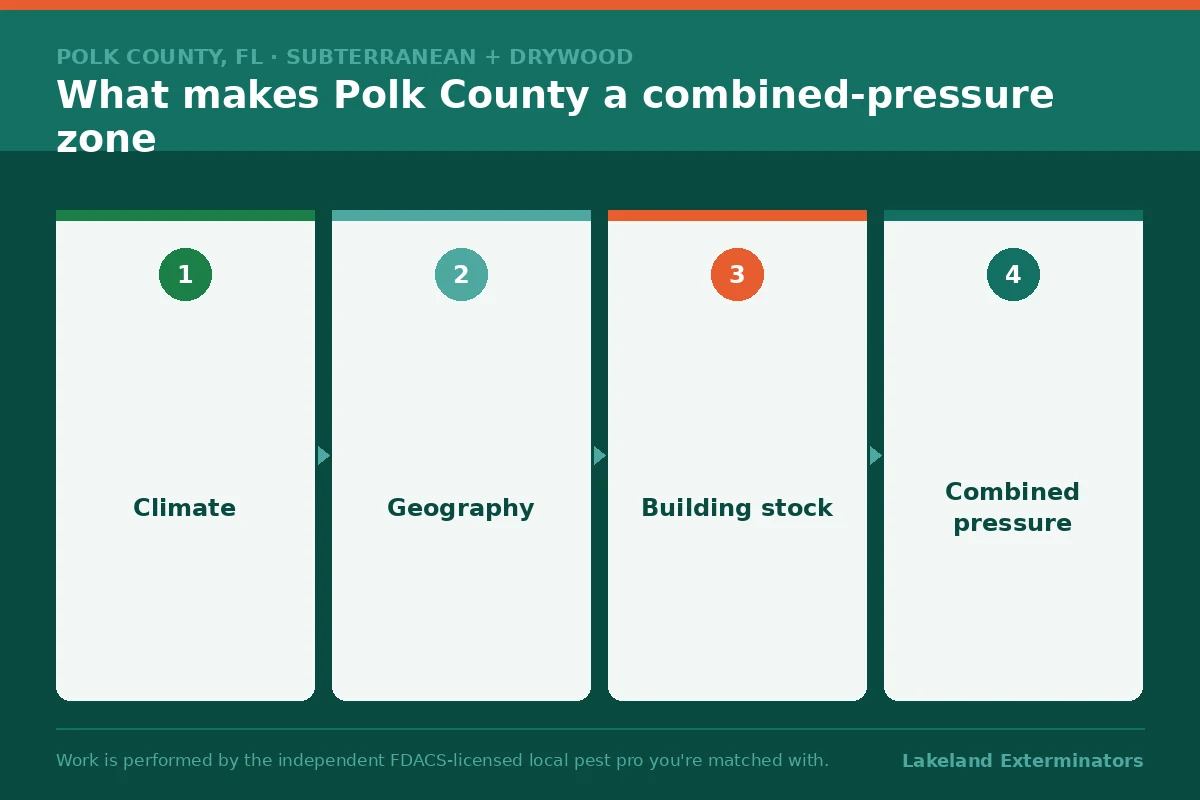
Most U.S. termite markets have one dominant species. Lakeland has two. The convergence of climate, geography, and building stock makes Polk County one of the very few American markets where both subterranean termites (Reticulitermes flavipes) and drywood termites (Cryptotermes brevis and Incisitermes snyderi) are established at high density — and where homeowners reasonably need to think about both. Call the number below for an FDACS-licensed termite inspection.
Dealing with a pest problem right now?
📞 Call now — get matched with a licensed local exterminator: (888) 295-0220When you call, stay on the line for a few seconds while we match you with the licensed local exterminator for your area. Have your address and a quick description of the problem ready.
Licensed local pros · Fast response, subject to availability · No obligation
✅ FDACS-Licensed • 🏠 Polk County Local • 🔍 Inspection • ⚡ Same-Day Available
This post explains why.
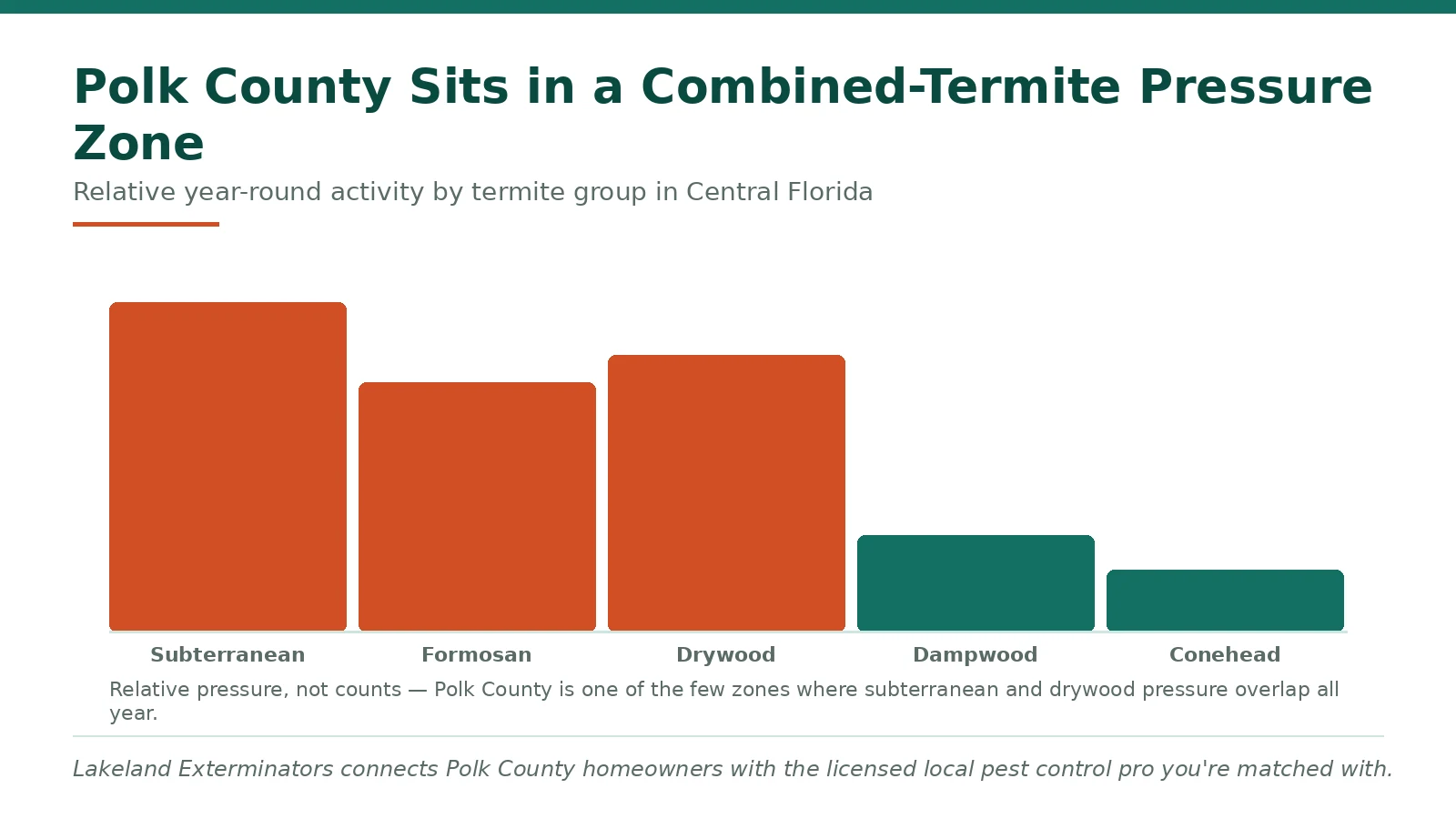
The Combined-Termite States
In the United States, only four states have established drywood termite populations sufficient to constitute a major structural pest threat:
- Florida (statewide)
- California (coastal and southern regions)
- Louisiana (coastal parishes)
- Hawaii (statewide)
In all other U.S. states, drywood termites are either absent or limited to incidental detections that don’t drive structural concern.
Of these four, Florida has the broadest combined-species pressure. California has heavy drywood pressure but lighter subterranean pressure than Florida. Louisiana has heavy Formosan subterranean pressure (a particularly aggressive subterranean species) but drywood pressure is more localized. Hawaii has both species but a much smaller market.
Florida, by contrast, has consistently heavy pressure from both species across most of the state — and Polk County sits in the heart of that overlap.
What Makes Polk County a Combined-Pressure Zone
Three converging factors create Polk County’s distinctive combined-termite environment.
1. Climate
Polk County’s climate is classified as humid subtropical (Köppen Cfa), transitioning to tropical savanna (Aw) in the southern third of the county. The relevant data from the National Oceanic and Atmospheric Administration’s National Weather Service Tampa Bay station, measured at Lakeland Linder International Airport:
- Mean annual temperature: 72°F
- Mean relative humidity: 75% — among the highest sustained humidities in Central Florida
- Annual rainfall: 50–55 inches
- Frost-free days: ~325/year
The implications:
- Subterranean termites require soil moisture to survive. Polk County’s rainfall pattern + lake density + irrigation maintains consistent soil moisture year-round. Soil temperatures rarely drop below 60°F, so colony biological activity continues 12 months a year.
- Drywood termites extract moisture from atmospheric humidity (no soil contact required). Polk County’s 75% mean humidity is well within drywood termite establishment range. Frost-free year keeps colonies active.
Either species thrives. Together they create double pressure.
2. Geography
Polk County’s lake density is exceptional. The Chain of Lakes around Winter Haven includes 25 interconnected lakes. The Lake Wales Ridge features sandhill lakes. Hundreds of additional named lakes dot the county. Plus retention ponds, drainage swales, agricultural irrigation systems, and the Green Swamp’s edge to the north.
This geography:
- Maintains consistent soil moisture for subterranean colonies
- Creates the high humidity that drywood termites favor
- Means most Polk County residential properties are within a few hundred yards of standing water — well within drywood swarmer flight range
The soil profile (predominantly sandy — Astatula, Candler, Pomello, Tavares series) is also ideal for subterranean termite tunneling.
3. Building Stock
Polk County’s housing stock spans nearly 150 years of Florida construction:
- Pre-1900: Florida cracker-style wood-frame in Bartow and Lake Wales historic districts
- 1900s–1940s: Wood-frame and frame-stucco in Lakeland’s Cleveland Heights, Lake Hollingsworth, Dixieland; Winter Haven’s Lake Howard, Lake Idylwild areas; Lake Wales’ Bok Tower district
- 1950s–1970s: Concrete block (CBS) with wood trim, single-family ranch homes
- 1980s–2000s: CBS-with-stucco subdivisions, growing in south Lakeland, Polk Parkway corridor, and the Winter Haven suburbs
- 2010s–2020s: Mass-production CBS-with-stucco growth in Davenport, Champions Gate, Haines City, and south Lakeland
The result:
- Older wood-frame stock is vulnerable to both drywood and subterranean termites
- Mid-century CBS-with-wood-trim is vulnerable to drywood termites in trim, fascia, eaves, attic structural members, plus subterranean in slab penetrations
- Modern CBS-with-stucco is less vulnerable to drywood (less exposed wood) but still has subterranean pressure at bath traps, plumbing penetrations, expansion joints
Almost every residential structure in Polk County has some termite vulnerability profile.
The Numbers — Termite Activity Patterns
While exact infestation rates are proprietary to pest control operators, several public data points illustrate the pressure:
- University of Florida Institute of Food and Agricultural Sciences (UF/IFAS) Cooperative Extension Service documents drywood termite establishment throughout Polk County, with concentration zones in older neighborhoods of Lakeland, Lake Wales, Bartow, and Winter Haven.
- Florida WDO inspection reports for residential closings frequently note evidence of past or current termite activity. While exact rates vary, industry estimates place the proportion of Polk County homes with some termite evidence at 30–50%+ over a 30-year ownership horizon.
- Florida Department of Agriculture and Consumer Services (FDACS) maintains records of termite treatments performed by licensed operators. The volume of treatments in Polk County is among the highest in Florida on a per-capita basis.
What This Means for Polk County Homeowners
1. Annual inspection is reasonable. In low-pressure markets (most of the U.S.), termite inspection every 3–5 years is sufficient. In Polk County’s combined-pressure environment, annual inspection is the prudent baseline.
2. Both-species awareness matters. A subterranean-only treatment leaves a home exposed to drywood; a drywood-only treatment doesn’t address subterranean. Comprehensive coverage typically requires either both treatments simultaneously or a termite bond that covers both.
3. Real estate transactions consistently surface termite issues. WDO inspection reports for Polk County closings frequently identify past or active termite activity.
4. New construction is not immune. While modern CBS-with-stucco construction reduces some termite vulnerability, slab penetrations, bath traps, and expansion joints remain entry points for subterranean termites. Florida Building Code-required pre-construction pretreatment helps but is not absolute protection.
5. Climate-driven year-round activity. Unlike northern markets where termite activity slows in winter, Polk County termite biological activity continues year-round. Treatment can be performed any month.
How Pest Control Operators in Polk County Address Combined Pressure
The FDACS-licensed operators reachable through this directory typically structure Polk County termite service around the combined-species reality:
- Initial inspection addresses both species
- Treatment recommendations may include both subterranean and drywood approaches if both are present
- Termite bonds often cover both species (verify wording — some bonds are subterranean-only)
- Annual re-inspection checks for both species’ activity
- Real estate WDO inspection reports explicitly document both species
The combined-pressure environment is also why the Fumigation category license is more common among Polk County operators than in lower-pressure markets — whole-house drywood fumigation is a routine service here.
When to Get an Inspection
- Annual preventive inspection (recommended baseline for any Polk County home)
- Pre-listing inspection before selling a home
- Pre-purchase inspection during real estate closing (WDO inspection report)
- After observing swarmers, mud tubes, frass, or kick-out holes
- After a hurricane or major storm that damaged structural wood
- When termite bond is approaching renewal
Related Pages
- Termite Treatment in Lakeland
- Drywood Termite Treatment
- Subterranean Termite in Polk County
- WDO Inspection in Lakeland
- Sentricon Installation in Lakeland
- Termite Swarming Season Florida
- Monthly Pest Control Cost in Lakeland
- FDACS Licensing for Polk County Homeowners
- Drywood vs Subterranean Termites in Polk County
- ant control in Haines City, FL
- subterranean termite treatment in Bartow
- skipping a termite bond in Polk County
Disclaimer: Lakeland Exterminators is a local dispatch and referral service, not a licensed pest-control operator. We connect Polk County, Florida homeowners with independent, FDACS-licensed and insured pest-control companies. All inspections and treatments are performed by those independent providers, who set their own pricing, scheduling, and service terms.
Any reference to same-day, emergency, or 24/7 service describes the typical scheduling of matched independent providers and is not guaranteed; actual response times vary by provider, season, location, and demand.